
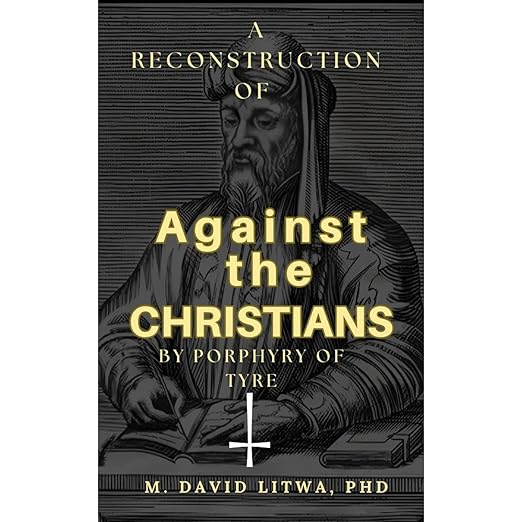
Three Christian emperors ordered the destruction of the text this audiobook tries to put back together, which is a provenance most books can only envy. Porphyry of Tyre wrote the ancient world's most damaging critique of Christianity, and it worked well enough that the church spent centuries erasing it. What survives does so inside the writings of the people it attacked. M. David Litwa's task here is to pull those pieces out and decide, one by one, what each is actually worth.
Sorting What's Probably Porphyry From What Isn't
Probability is the organizing principle, and it is the main reason this edition earns its hours. A five-star response praises Litwa for sorting the material into what is probably representative of Porphyry, what might be, and what almost certainly is not, instead of handing over one confident text. That reader's word for the effect was refreshing, and the refreshment comes from watching a scholar decline to force a personal preference onto broken evidence.
Two Parts, and Correcting the Hoffmann Translation
Part one is the testimonies and fragments with commentary attached to each. Part two is a short attempt at something like what Porphyry might have written, labeled plainly as an attempt. Keeping those two operations apart is the whole methodological argument of the book, and it is what allows a general listener to follow a technical project without being asked to take anything on trust.
Hoffmann's 1994 translation is the explicit target. The stated purpose is to correct its errors and its considerable gaps and to leave a reliable text readable for a new generation, which makes this a corrective edition as much as a fresh translation. If you own the older version, that comparison is the point of buying this one. If you do not, the polemic passes overhead without doing any harm.
Fragments That Read Like a Legal Proceeding
Biblioholic's five-star response frames the history better than the description manages: a multi-volume attack so disturbing to emperors of the fourth and fifth centuries that they ordered it destroyed, surviving mainly in patristic works, and rebuilt here on the basis of the best German scholarship by somebody whose specialty is early Christian, Gnostic and heretical writing. That is an accurate account of what is on offer.
Fragments are strange things to listen to, and the strangeness is the appeal. Each one arrives inside a hostile quotation, so you are hearing a Christian author's version of what Porphyry said, immediately followed by an assessment of how much of it is really Porphyry's. The effect lands closer to a legal proceeding than to a treatise, and it is far more absorbing than a smoothed-over reconstruction would have been.
Litwa's commentary carries the argument through the gaps. The fragments by themselves are too broken to sustain five hours of listening; what sustains it is the running judgment about attribution and the willingness to say out loud when the evidence has run out. Anyone who has waded through confident reconstructions of lost ancient works will know how rare that restraint is.
Virtual Voice Struggles With Greek and Latin Names
Synthetic narration is the real limitation. Virtual Voice holds the credit where a reader's name would normally sit, and this is close to the hardest material anybody could hand to a machine: Greek and Latin names, numbered fragments, ancient authors quoted inside other ancient authors. No companion PDF is mentioned anywhere on the listing either, so the citation apparatus that would anchor all of it has nowhere to live in this format.
Only one vote on this page is not a five. Eleven ratings averaging 4.9 can only come from a total of fifty-four stars, which means ten fives and a single four, and all four written responses are fives. So the one deduction belongs to somebody who never explained it. On a book this specialized, near-unanimous approval across eleven votes mostly tells you that the right readers found their way to it.
Shelving is the other oddity worth flagging. A translation and commentary on an ancient philosopher's attack on Christianity is filed here under religion with an agnosticism tag, which delivers it to almost exactly the wrong browsing audience. This is patristics and source criticism. Anybody arriving in search of a contemporary argument about belief will find close attribution work instead, and will not enjoy it.
Gabriel's Five-Star Review Wants the Next Polemic
Gabriel's five-star response is the best guide to who this genuinely serves: easy to read, easy to understand, valuable for the commentary as much as the translation, and finished with an immediate appetite for Against the Galileans next. Somebody who completes a reconstruction of a burned book and instantly wants the next ancient polemic knows exactly which shelf they are standing in front of.
Anyone wanting a general history of early Christian controversy should look elsewhere. This assumes you care about attribution, and it spends real time on whether a given sentence inside a Christian author is Porphyry speaking or a hostile paraphrase of Porphyry. That question is the substance rather than the apparatus, and arriving in expectation of narrative will make five hours feel considerably longer.
Reconstruction of a destroyed text is partial work by definition, and the honest version of it says so constantly. What Litwa delivers is a readable translation of what survived, a clear account of how much confidence each surviving piece deserves, and a brief imaginative reassembly marked plainly as imagination. For a book that three emperors tried to burn out of history, that is about as close as anyone will get.
Good to Know
Do you need Greek or Latin to follow this audiobook?
No. Everything is translated and the commentary is written for a reader without the languages. What you should expect are unfamiliar names, numbered fragments and quotations nested inside quotations, all of which are easier to track on a page than through headphones.
Is this audiobook an attack on Christianity or a study of one?
A study. Litwa's work is to establish what Porphyry probably wrote and how much confidence each surviving piece deserves, not to endorse or rebut the argument. The polemical energy belongs to the ancient critic; the voice around it stays scholarly and measured throughout.
How much of Porphyry's original work actually survives?
Only testimonies and fragments, preserved almost entirely inside the Christian authors who set out to refute it. The complete multi-volume attack was destroyed by imperial decree, so no continuous text exists, and every passage here reaches us through somebody hostile to it.
Would this work as an introduction to Porphyry?
To this one destroyed book, yes. To Porphyry as a philosopher, no. The edition concentrates entirely on the anti-Christian material and its transmission, so the wider philosophical work sits outside the frame and you will finish knowing the controversy rather than the thinker.







