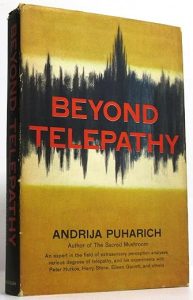
A 1962 print record sits underneath this audiobook. The publisher field reads Doubleday and Company, the release date reads January 1962, and the page count reads 312, none of which describes a recording running eight hours and nineteen minutes with Seth Andrews reading it. So what are you buying? A genuinely old book, newly voiced, behind a product page that was never told the difference. Everything odd about this listing follows from that single collision, and most of it turns harmless once you know.
Is Beyond Telepathy Worth Your Time?
Nothing in the description reads like marketing copy. It is Puharich's own preface, running in the first person: this work provides a journey that every man can follow, and, further down, in this work I give you the stories of normal men and women who have explored the far reaches of their minds. Somebody pasted several hundred words of the book itself into the field where a blurb belongs. As accidents go it is generous, since you get a long unfiltered sample of the prose before spending anything.
And the sample is revealing. Puharich opens by insisting your own mind is interesting even if your life has not been, then supplies a demonstration: look at the blue sky, relax, and you will directly observe blood cells moving through the fine vessels of your eye. Lie down at absolute rest in an unlit basement room and within an hour you begin to see, feel and hear things you never suspected existed. That is the method in miniature, an invitation to test something on yourself before any argument arrives.
What follows those invitations is a catalog of the phenomena Puharich took seriously: telepathy, clairvoyance, the action of mind at a distance and, as the preface has it, most remarkable of all, a personality freeing itself of the body to travel where it will across time and space. The framing insists on checking throughout, because a mind unchecked by facts creates fantasies that turn injurious. Whether that check holds is the question the whole book stands or falls on.
The Best Parts of Beyond Telepathy
Reads like an interesting novel is the phrase a four-star filed in India reaches for in August 2018, alongside the note that Puharich was a well-known researcher in parapsychology, plus a request that his other book, the one about Uri Geller, be made available too. That last detail is a useful signal about where this title sits in the work: not the famous one. As a description of the reading experience, though, the phrase is exact.
Which is what makes it suited to being read aloud. A book of case histories carries in a way a technical monograph never does, because every account has a beginning, an end and a person at the center. The mid-century essayistic register, long sentences, formal address, an author who says you and means it, sits comfortably in a voice. Eight hours of this is nearer to a lecture series from a persuasive host than to anything resembling a textbook.
Historical interest is the second reason to press play. This is a primary document from a moment when the field still expected admission to the laboratory, and the confidence in the preface has dated in the most interesting way possible. Hearing an argument made with that much assurance, about territory nobody has since mapped to anyone's satisfaction, is its own experience regardless of what you finally conclude about any individual claim inside it.
Before You Commit to Beyond Telepathy
Metadata comes first, being the most confusing part. Everything on this page except the runtime and the narrator credit describes a volume published in 1962: publisher, release date, a count of 312 pages. Invisible left-to-right marks still cling to the publisher and language fields, which is what happens when a record gets pasted off a retail page rather than typed. Nothing identifying the audio edition itself, its recording date or its producer, appears anywhere at all.
Then the responses, fewer of them than the counter implies. Three sit beneath a rating assembled from eleven votes, and the sharpest is a three-star from June 2017 calling this one of those books that uses many words to say many things that mean nothing. That grade carries half of every star deducted from this title across all eleven votes, and the arithmetic settles the rest. An average of 4.6 over eleven can only come from a total of fifty-one stars out of a possible fifty-five. The three visible grades supply twelve, leaving thirty-nine spread across eight unseen votes against a ceiling of forty, so seven of those eight are perfect and the eighth is a four.
Age shows in the language as well. The preface addresses a reader it calls every man and speaks of what man has learned since time began, which is 1962 usage rather than a stated position, but it arrives unannotated in a recording aimed at listeners who will notice. The science dates in parallel. Terminology has moved, the standard of evidence has moved, and anyone expecting contemporary rigor should hear this as a period document instead of a current one.
Should You Listen to Beyond Telepathy?
Anyone with a serious interest in the history of parapsychology should hear this, along with listeners who enjoy watching a confident mind build a system out of anecdote. The preface works as a filter: if the blue-sky demonstration strikes you as an elegant piece of observation, plenty more of the same is waiting, and the case histories are genuinely strange. Occult-shelf browsers hunting for practice instructions will find description where they wanted procedure.
Skeptical listeners who need controls, sample sizes and replication will be irritated early and stay irritated, because the checking the preface promises is the author's own account of having checked. Anyone shopping for technique will come away empty as well, since the book reports what people said they experienced rather than instructing anybody in how to repeat it. A listener wanting a modern survey of the field should treat this as a source, not a summary.
Take the claims at whatever weight suits you. What is unarguable is the frame. Beyond Telepathy is the sound of a moment, a researcher in 1962 addressing an ordinary reader with total confidence that the interior life is measurable territory waiting to be surveyed. The document is real, the prose carries, and the product page wrapped around it remains the only genuinely misleading thing in the whole package.
Common Questions
Is the Beyond Telepathy audiobook based on the original 1962 text?
Everything on the record points that way. The publisher is given as Doubleday and Company, the date as January 1962, and a page count of 312 sits on a listing for a recording. No revision, new introduction or updated afterword is indicated anywhere, so expect the book as written, with its mid-century vocabulary fully intact.
What do the existing reviews tell you about this audiobook?
Less than the count suggests. Three written responses sit beneath eleven grades, and the most enthusiastic of the three, five stars in March 2024, reports only that the book arrived quickly and in great condition, which is a verdict on a parcel rather than on any contents. Weigh the written material accordingly.