Quick Take
- Narration: Barry Abrams delivers Rabbi Moffic’s conversational, warm teaching style effectively, the narration feels like a thoughtful guided conversation rather than a lecture.
- Themes: Jewish-Christian shared roots, interfaith understanding, Rabbinic wisdom traditions
- Mood: Warm and enriching, genuinely ecumenical
- Verdict: A generous and carefully handled bridge-building text, Moffic answers real questions about Judaism with the confidence of someone who has spent years in interfaith dialogue, and Abrams makes it a pleasure to hear.
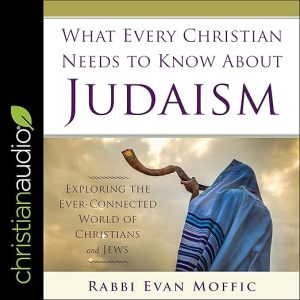
There is a particular kind of book that does something quietly important: it reduces the distance between traditions without pretending that distance does not exist. Rabbi Evan Moffic’s guide to Judaism for Christian listeners belongs to that category. I came to it with background in comparative religion but without sustained engagement with contemporary interfaith literature, and I found it both more specific and more generous than the title might suggest.
Moffic frames his project around a straightforward observation: when Christians learn about Jewish tradition and history, they see the Bible and the life of Jesus with new depth. His argument is not that Christians should become Jews, or that the traditions are interchangeable, but that the Jewishness of Jesus is so thoroughly documented in scripture that understanding Jewish practice and thought illuminates the Christian texts in ways that ignorance of those roots cannot. That is a measured and credible claim, and Moffic makes it without condescension in either direction.
Our Take on What Every Christian Needs to Know About Judaism
The book is organized around hundreds of questions that Moffic has received from Christian listeners and readers over the years of his interfaith work. That structure gives it a responsive, practical quality. He is not building an abstract theological argument; he is answering what people actually want to know. Questions about Jewish prayer, holidays, the Talmud, the relationship between Torah and Christian scripture, the role of rabbis, and Jewish views on the afterlife all appear, addressed with the directness of someone who has had these conversations many times and knows where the genuine curiosity is.
Reviewer PN from France writes that the book offers an opportunity to sincerely appreciate Judaism and thereby to deepen an appreciation for the religion in which Jesus of Nazareth grew up. That framing captures the book’s essential positioning: this is not comparative theology in the academic sense but a guided deepening for listeners whose faith is Christian but whose curiosity extends to the tradition that formed it.
Why Listen to What Every Christian Needs to Know About Judaism
All three available reviews are five stars, and they come from listeners with different levels of existing knowledge. One reviewer describes listening with Bible and notebook in hand, treating it as an active study guide. Another found it enlightening and written in a lovely spirit. These are the responses of listeners who brought genuine questions and received genuine answers, which is the basic test of any instructional text.
Barry Abrams narrates, and his performance matches the material’s conversational register. At five hours and fifty-five minutes, this is a length that can be absorbed in two or three sittings, which suits the topic well. Moffic’s own career as a popular rabbi and author of multiple books on Jewish wisdom for interfaith audiences means the content is distilled from years of real teaching rather than assembled for publication. That practical base makes the audio feel like a conversation with someone who knows what confuses people and how to address it.
What to Watch For in What Every Christian Needs to Know About Judaism
The book is firmly positioned within a framework of goodwill and shared appreciation rather than critical engagement. Listeners wanting to understand the historical tensions between Christianity and Judaism, or the ways in which Christian interpretation has distorted Jewish texts over centuries, will find this treatment too irenic. Moffic is building bridges, not excavating foundations. That is a legitimate choice for an interfaith guide, but it means some historical complexity is smoothed over. The framing that learning about Judaism brings Christians closer to Jesus is genuine but also reveals the audience: this is written for Christian listeners rather than for secular inquirers or Jewish readers checking how they are represented.
Who Should Listen to What Every Christian Needs to Know About Judaism
Christians with genuine curiosity about the Jewish roots of their tradition, particularly those who find that standard Bible study leaves them wanting more context. Interfaith discussion group participants and pastors looking for accessible materials on Jewish practice and thought. Those wanting a critical or historically rigorous account of Jewish-Christian relations will need to supplement this with scholarship outside the interfaith genre.
Frequently Asked Questions
Does this book require theological background to follow, or is it accessible to general listeners?
It is written for general listeners with no assumed theological expertise. Moffic answers basic questions about Jewish practice, belief, and history in accessible language. Someone with no prior background in either Judaism or Christianity can follow the material comfortably.
Is this book useful for Jewish listeners as well, or is it written exclusively for a Christian audience?
It is written with a Christian audience as the primary addressee. Jewish listeners may find value in seeing how Moffic explains their tradition to outsiders, but the framing, including how learning about Judaism deepens a relationship with Jesus, is specifically positioned for Christian readers.
How does Barry Abrams handle Moffic’s teaching style in the narration?
Abrams captures Moffic’s conversational warmth effectively. The narration feels like a guided explanation rather than a formal presentation, which suits material organized around real questions from real listeners. The five-hour runtime moves efficiently in his reading.
Does the book address any of the historical conflicts between Christianity and Judaism?
Only lightly. Moffic’s focus is on shared roots and mutual enrichment rather than on the history of anti-semitism, forced conversion, or theological conflict. The book is constructive in orientation, and listeners wanting a more historically complete account of Jewish-Christian relations will need to look elsewhere.