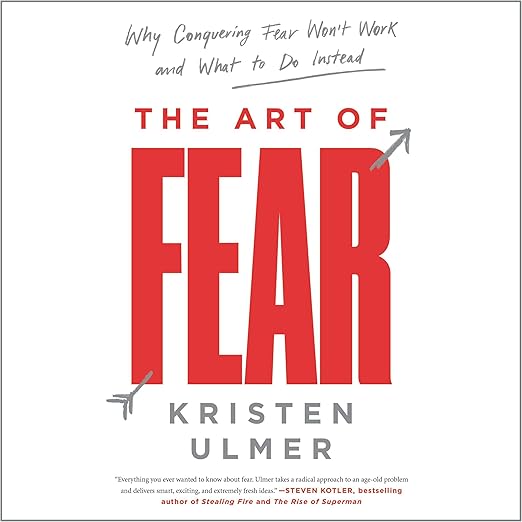
Kristen Ulmer spent twelve years recognized as the best extreme skier in the world and then spent fifteen more years helping other people understand why they were afraid. The Art of Fear audiobook arrives from that particular combination of biography, and it is a better book for it. The argument, that fear is not the problem and that our relationship with fear is the problem, is not new in the psychology of performance. What makes Ulmer's version of it distinctive is that it comes from someone who was professionally paid to be afraid in situations where the consequence of bad judgment was death, and who found the standard advice, push through it, overcome it, ignore it, actively dangerous.
This audiobook runs nearly 12 hours and narrated by Jane Oppenheimer, who delivers Ulmer's conversational prose with sufficient warmth to make the extended runtime feel like a genuine conversation rather than a lecture. The book is chatty, as one reviewer notes accurately, and that quality reads differently in audio than it does on the page. In audio, the chattiness functions as the texture of an ongoing dialogue rather than as the absence of editorial tightening. Whether that works for you will depend significantly on your tolerance for a book that circles its central ideas multiple times from different angles rather than driving straight to its conclusions.
Where This One Lands
Ulmer's core reframing asks the listener to understand fear as one of what she calls 10,000 voices that constitute our experience of reality, ranking alongside joy, love, and gratitude rather than standing apart as the one voice that needs to be silenced or conquered. She is arguing against what might be called the war model of fear, in which the internal battle against the emotion is the real test of character, and replacing it with what she frames as a relationship model, in which the goal is to hear fear accurately and respond to it proportionally rather than either suppressing or amplifying it.
The practical tool she introduces, a mindfulness technique she calls "Shift," is the book's most concrete offering. The framework is designed to change the experience of fear in the moment, moving from a reactive state into something that is in contact with fear's information without being dominated by it. The technique draws from Ulmer's experience as a mindset facilitator working with athletes, executives, and people in recovery from fear-based paralysis. A reviewer who describes being a 58-year-old hermit effectively shut in by fear and who found the methods genuinely work is the kind of testimonial that is impossible to verify but hard to dismiss when it appears alongside a 5-star rating and a specific before-and-after account.
Why Listen to The Art of Fear
The athletic biography that underlies the book gives it credibility in places where a pure self-help or mindfulness text would need to work harder. Ulmer is not theorizing about extreme fear from an office. She is describing what it felt like to compete at the top level of a sport that kills practitioners, and how the standard psychological toolkit for managing fear in high-stakes environments failed her until she developed a different framework. That biographical grounding is present throughout the audiobook, and Oppenheimer's narration maintains enough personal warmth that the extreme-sport sections and the mindfulness-framework sections feel continuous rather than like two separate books awkwardly joined.
The audio format is particularly well suited to a book organized around experiential teaching rather than information transfer. Ulmer is not primarily asking the listener to learn facts. She is trying to shift a habitual orientation toward an internal experience, and the spoken word has a more direct line to that kind of shift than reading. Listeners who find that the book's ideas feel abstract when read sometimes report that hearing them delivered gives the concepts more immediate purchase.
What Gives Us Pause
The book's least convincing section is its treatment of fear's origins, where Ulmer draws on a mix of evolutionary psychology and embodied cognition frameworks that she summarizes quickly enough to lose some readers who want more careful sourcing. The ideas are not wrong, but they are not developed with the rigor that specialists in those fields would apply. For a book whose argument ultimately rests on personal testimony and clinical observation rather than experimental research, this is less damaging than it would be for a more empirically ambitious project, but it is worth noting as the place where the book's chatty confidence occasionally outpaces its evidence.
The most powerful sections are those dealing with fear and performance at the edges of human experience: Ulmer's account of what it meant to ski in conditions that most people would refuse entirely is where the book's ideas become most vivid and most earned. These passages, delivered in Oppenheimer's steady, engaged narration, are the moments that make the book's 12-hour commitment most clearly worthwhile.
Should You Listen to The Art of Fear?
Listeners who have found conventional fear management advice either ineffective or emotionally hollow will find Ulmer's reframing genuinely refreshing. Athletes who have hit a psychological ceiling around fear in their discipline, whether in extreme sports, competitive performance, or high-stakes professional environments, will find material that is directly applicable rather than generally inspirational. People whose fear has become avoidance, the reviewer who describes near-total social isolation is an extreme example of a pattern Ulmer addresses throughout, will find the Shift technique worth the runtime alone.
Listeners who want a tightly argued, evidence-based psychology text will find The Art of Fear too discursive and insufficiently sourced. The book is experiential and conversational before it is empirical, and readers who need systematic research backing will be frustrated by the pace at which anecdote and observation substitute for citation. And listeners who are primarily interested in Ulmer's skiing career as athletic biography will find the book tilts heavily toward the psychological framework rather than the competitive narrative.
Key Details
- Voice: Jane Oppenheimer delivers Ulmer's conversational, sometimes digressive prose with enough warmth to keep the listening experience personal rather than academic.
- Big ideas: Reframing fear as a natural voice rather than an obstacle, mindfulness and the body's intelligence, performance psychology through extreme sport
- Atmosphere: Earnest and unconventional, like a long conversation with a friend who has done things you have not
- Worth it?: A genuinely different take on fear that earns its conclusions through personal experience, though its chatty structure will not suit every listener.