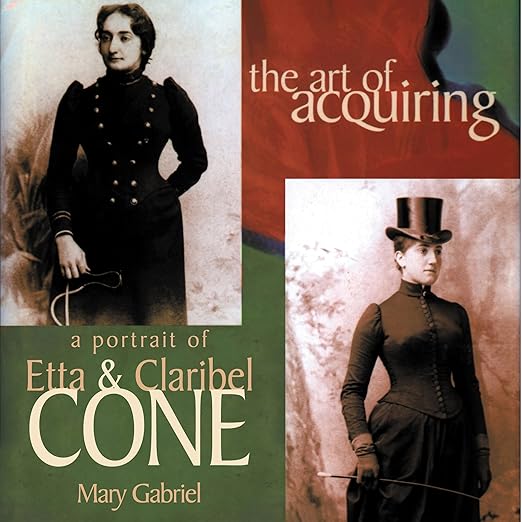
Two unmarried Baltimore sisters, Claribel a doctor, Etta her quieter companion, spent decades quietly buying paintings by artists almost nobody in America wanted yet, and left their city one of the great art collections in the country almost by accident of taste. This audiobook, drawn from Mary Gabriel's The Art of Acquiring, is a compact six-hour, forty-two-minute portrait of Etta and Claribel Cone, and Gabriel, the biographer behind Ninth Street Women, brings the same eye for overlooked women shaping major art movements from the sidelines. The title itself does double duty: this is a book about the literal art the Cone sisters acquired, and about acquiring itself as its own quiet, disciplined craft, knowing what to buy before the world agrees it is worth buying.
The Armory Show's Hostility and Ridicule
Reviewer Anne Phillips frames the sisters' project precisely, noting they 'built and donated one of the most important art collections in the world' over more than forty years of collecting. Reviewer Georgia adds a detail that grounds the whole story in a real, visitable place: the Baltimore Museum of Art still displays a replica of the sisters' own apartment, stuffed with the Matisse and Picasso works they gathered decades before either artist was fashionable. That specificity, a museum a listener can actually walk into, gives Gabriel's narrative a concreteness biography about collectors does not always earn, since the collection itself remains the sisters' most tangible legacy, not just Gabriel's account of assembling it.
American taste for Matisse and Picasso lagged well behind Paris throughout the early twentieth century; even the landmark 1913 Armory Show in New York, which first introduced many Americans to European modernism at scale, met with real hostility and ridicule from critics and the public alike. Buying this work decades before mainstream American museums or collectors caught up required a specific kind of conviction, not just money, and Gabriel's book treats that conviction, more than the sisters' wealth itself, as the real story worth telling. Claribel and Etta were not simply following expert advice or a fashionable trend; they were often years ahead of the institutions that would eventually validate their choices, which is precisely why the Baltimore Museum of Art's Cone Collection remains such a significant, occasionally startling, holding today.
Friends of the Stein Siblings' Paris Circle
The Cone sisters moved in genuinely remarkable company. Reviewer Anne Phillips notes they were 'friends of the Stein siblings,' meaning Gertrude and Leo Stein's circle, the same Paris salon that helped launch Matisse's and Picasso's reputations in the first place. That connection is what let Claribel and Etta buy early and buy well, spotting work before the market caught up, and Gabriel uses it to build a story less about wealth alone than about genuine taste and nerve. Reviewer Grammy Gail calls the sisters 'unusual women' who 'traveled in art circles' most of their unmarried, wealthy peers never touched, and that unusualness, women collecting seriously and independently in the early twentieth century, is the real engine of the book's appeal.
Narrator Laura Jennings carries a dense, name-heavy story, Matisse, Picasso, the Steins, decades of Baltimore social history, with no listener review yet attached to confirm how her performance lands specifically. What the material demands is a steady, unshowy clarity that lets the sisters' own decisions carry the drama rather than an overly theatrical reading pushing emotion the biography does not need. Six hours and forty-two minutes is a genuinely efficient runtime for a subject with this much potential sprawl, suggesting Gabriel kept the focus tight on the Cones themselves rather than wandering into a broader survey of early modernism.
Pull Up the Baltimore Museum's Online Collection
This is a book fundamentally about visual art, and the audio format loses something a print or ebook edition would not: the actual paintings being discussed. A listener cannot glance at a Matisse or a Picasso mid-chapter the way a print reader flipping past a plate section could, which means following along benefits from having images pulled up separately, whether that is the Baltimore Museum of Art's own online collection or a quick search while listening. The listing itself carries a thin synopsis, just two sentences, so most of what a prospective listener has to go on is reviewer testimony rather than extensive marketing copy, which makes those three attached reviews unusually load-bearing for anyone deciding whether to commit.
Unknown by Many, Despite What They Built
Reviewer Grammy Gail notes the Cone sisters remain 'unknown by many' despite the scale of what they built, and that relative obscurity is part of the book's whole case for existing, correcting a gap in how art history gets told. Listeners expecting a comprehensive survey of the entire Cone Collection's holdings, rather than a biographical narrative centered on the sisters themselves, should adjust expectations; this reads as character-driven biography first, art history reference second, the right choice for audio but worth knowing going in.
Even with so little marketing copy to go on, the underlying story carries real narrative momentum: two sisters building a shared life and a shared collecting practice across decades, without either marrying or subordinating her own taste to the other's. Gabriel keeps her attention on specific individual purchases and the reasoning behind each one, rather than folding in extensive tangents about either sister's medical career, Claribel practiced medicine, or a wider institutional history of the museum itself. Listeners wanting a maximalist, exhaustive treatment of early twentieth century art collecting broadly should look elsewhere; this book's case rests on two specific, well-documented lives rather than a sweeping survey.
A Reviewer's Museum Visit as the Model Listener
Art history enthusiasts, especially anyone drawn to impressionism, fauvism, or early modernism, will find this a rewarding character study built around real acquisitions rather than abstract movements. Reviewer Georgia's own path into the book, discovering the Cone sisters through a Baltimore Museum of Art visit, is a good model for the ideal listener: someone curious enough about a specific collection or artist to want the human story behind how it came together. Fans of women's history and unconventional Gilded Age and early twentieth century biography, particularly stories of independent, unmarried women building something lasting on their own terms, will also find plenty here.
Art lovers who need visual reference material alongside their art history should plan to pair this audiobook with a printed collection catalog or an open browser tab, since no illustrations survive the format. Those hoping for deep technical art criticism, brushstroke-level analysis of individual paintings, will find Gabriel's focus sits more with the sisters' lives and decisions than with formal art criticism itself. And anyone wanting an exhaustive, comprehensive history of the entire Baltimore Museum of Art collection, rather than this specific, personal angle on two of its founding donors, should look for a broader institutional history instead.
- Narration: Laura Jennings has no listener reviews yet confirming her performance, though the dense, name-heavy material calls for steady, unshowy clarity.
- Themes: art collecting and patronage, early modernism, independent women building a legacy
- Mood: Intimate, cultured, and quietly admiring
- Verdict: A compact, well-sourced biography of two remarkable collectors, best paired with visual references since no images survive the audio format.