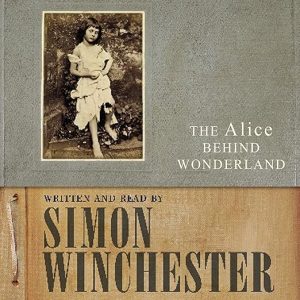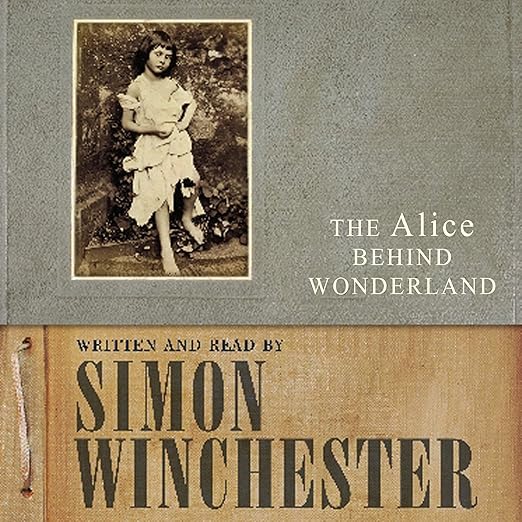
Simon Winchester's The Alice Behind Wonderland begins with a photograph: six-year-old Alice Liddell, photographed in a garden behind Christ Church College, Oxford in 1858 by Charles Dodgson, the shy, half-deaf mathematics lecturer who would eventually become Lewis Carroll. Winchester narrates this audiobook himself, and his measured scholarly cadence is precisely right for a work that uses a single image as the entry point into a much larger investigation of how a photograph, a mathematician's obsession, and a little girl's presence together produced one of the most influential works in the English language. The book runs two hours and forty-three minutes, which is considerably shorter than Winchester's more familiar historical narratives, and the compression is part of its design rather than a limitation.
The Beggar Maid Photograph Anchors the Whole Essay
Winchester is more typically associated with substantial narrative histories like The Professor and the Madman or The Map That Changed the World, where he has room to build elaborate archival arguments across hundreds of pages. The Alice Behind Wonderland is a different kind of project: an essay rather than a book in the conventional sense, elegant and concentrated, using Dodgson's photograph of Alice Liddell as the Beggar Maid as both its organizing image and its central argument. Winchester is not attempting to produce a comprehensive biography of Lewis Carroll. He is tracing a specific thread, the relationship between Dodgson's photographic practice and the transformation of his imaginative life, and he follows it with the discipline of a scholar who knows exactly which details belong to his argument and which are noise.
The photograph itself is the first problem the essay presents. Winchester describes it as unsettling as it is famous, and this framing is deliberate and important. The image of Alice Liddell costumed in rags, with bare shoulders and an expression that has generated, as Winchester notes, bottomless speculation, sits at the center of a set of questions about Dodgson's inner life that cannot be fully answered by the available evidence. Winchester uses Dodgson's published writings, private diaries, and photographic portraits to trace what can be known, and he is appropriately careful about what cannot. The camera Dodgson used, a Thomas Ottewill Registered Double Folding camera recently purchased in London, is described with the same attention Winchester gives to the mathematical mind behind it: as a tool that was transforming a shy, interior man into someone capable of sustained public looking.
One reviewer took exception to what they read as Winchester's too-quick dismissal of the possibility that the relationship between Dodgson and Alice was in any way troubled. This is a fair critical response to what is genuinely a hard interpretive question. Winchester's treatment is more cautious than exculpatory: he acknowledges the unsettling qualities of the image and the long history of scholarly debate around Dodgson's photographs of children, but he draws the limits of his own claims conservatively. Listeners who want a more critical engagement with those questions will need to supplement Winchester's essay with Carroll scholarship specifically focused on this dimension of Dodgson's work.
A Quality of Focused Intimacy When Read Aloud
Winchester as his own narrator brings specific value here that another voice would not provide. The essay's argument depends on a quality of attention that Winchester exercises as a writer, and he delivers the same quality as a narrator. He does not perform the archival material; he presents it with the confidence of someone who has spent real time inside these sources. The sections on Victorian photography, on the specific social conditions that made amateur photography both accessible and peculiar in 1858 Oxford, are handled with the kind of relaxed authority that comes from genuine knowledge rather than research assembled for a deadline. His pronunciation of proper names and his handling of technical photographic vocabulary have the precision of someone who has read extensively in the period.
The audio format works particularly well for an essay of this length and type. Reading the printed version would produce a similar effect, but hearing Winchester speak the argument creates a quality of focused intimacy that suits the subject. The essay is fundamentally about looking closely, about attending to a single image with sustained intellectual curiosity, and listening to it narrated maintains that quality of concentrated attention in a way that the reading experience also can but through different means.
A Register That Sent One Reviewer to the Dictionary
Listeners expecting a full biographical treatment of Lewis Carroll's life and work will need to look elsewhere. The book is explicitly scoped to the photographic dimension of Dodgson's development and to the specific relationship between his camera and his literary imagination. Carroll's actual fiction appears only at the edges of Winchester's argument; the books are the destination the essay is gesturing toward, not the subject it's examining. Similarly, the darker questions around Dodgson's photographs of children, which have occupied Carroll scholars for decades, are acknowledged but not fully unpacked. The essay's brevity is both its virtue and its primary limitation.
One reviewer described Winchester's language as requiring a dictionary at points, which is accurate for his prose in general. He writes with a precision of vocabulary that is appropriate to the scholarly register he's working in, and his own narration handles this without affectation. The language is exact rather than showy, but listeners who prefer plain-prose nonfiction should be aware of the register before committing to the listening experience.
Victorian Photography Fans Get More Than Carroll Fans
Readers of literary biography and Victorian history will find this essay a rewarding two-and-a-half hours. Winchester fans who want to hear him work in compressed form, rather than the long-form narrative history he's best known for, will find this a genuinely different demonstration of his range as a writer and as a narrator. Those interested in the history of photography and its relationship to Victorian culture will get more from this essay than from most accounts of the period that treat photography as background technology rather than as a transformative social practice that changed how educated Victorians saw the world and themselves. Listeners who want comprehensive Lewis Carroll biography, or who are primarily interested in Alice in Wonderland as a literary text, should look at longer and more conventional Carroll scholarship.
In Brief
- Narrator: Simon Winchester narrates his own work, and his scholar's care with language, combined with a measured English cadence, suits this careful, archival essay perfectly.
- Subjects: Photography as obsession, Victorian childhood and its discontents, the origins of literary genius
- Tone: Intimate and quietly unsettling
- Bottom line: A beautifully compressed piece of literary scholarship that opens more questions about Lewis Carroll than it closes.
Common Questions
Does Simon Winchester narrate this audiobook himself?
Yes. Winchester narrates The Alice Behind Wonderland in his own voice, bringing a scholar's precision and a measured English cadence to the material. For an essay this closely argued and this dependent on the quality of Winchester's attention to detail, self-narration gives the listening experience an authority that another voice would dilute.
Is this audiobook a full biography of Lewis Carroll?
No. It is a compressed essay, just under three hours, focused specifically on Charles Dodgson's photographic practice and its relationship to his literary imagination. It uses a single famous photograph of Alice Liddell as its organizing image and traces one specific thread of Carroll's development rather than providing a comprehensive life account.
Does this audiobook address the troubling aspects of Dodgson's relationship with Alice Liddell?
Winchester acknowledges the unsettling qualities of the photograph of Alice Liddell as the Beggar Maid and the broader questions around Dodgson's photography of children. His treatment is careful rather than dismissive, but some reviewers have found that he draws the limits of what he's willing to claim too conservatively. Listeners who want more critical engagement with these questions will need supplementary reading.
How does this audiobook compare to Winchester's longer historical narratives?
The Alice Behind Wonderland is considerably shorter and more compressed than works like The Professor and the Madman or The Map That Changed the World. It functions as an essay rather than a narrative history, using a single point of entry to make a focused argument. Winchester fans who love his expansive archival storytelling will find this rewarding but will need to adjust expectations for the scope.