- Performance: Andrew Joseph Perez delivers Moreno's argument with steady authority, though the material's repetitive stretches test even a capable narrator.
- What it covers: Urban planning reform, car dependency, proximity and community resilience
- Feel: Optimistic but uneven, a policy manifesto with genuine momentum
- Our call: Strongest for urban planners and policy-minded listeners who want the origin story of a concept that has reshaped city planning conversations worldwide.
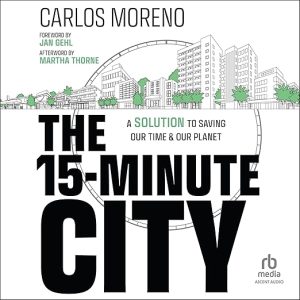
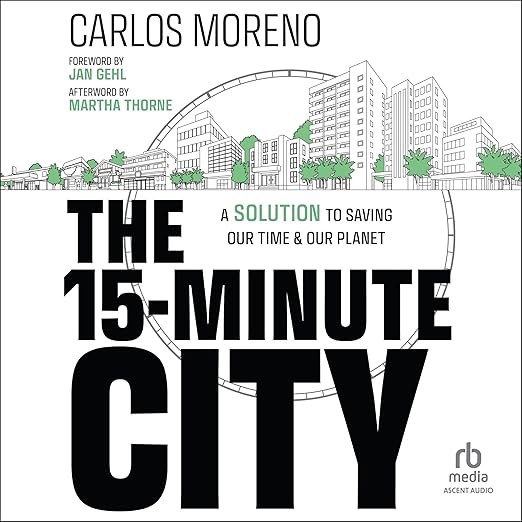
Carlos Moreno's audiobook The 15-Minute City arrives at a moment when urban planning has rarely felt more politically charged. The concept, which holds that residents should be able to reach schools, offices, markets, and parks within fifteen minutes on foot or by bicycle, sounds almost disarmingly modest. And yet it has become a flashpoint, embraced by hundreds of mayors, studied in policy papers, and occasionally mischaracterized in populist media as a scheme to restrict movement. Moreno's book gives listeners the chance to hear the idea in the voice of its chief architect, which turns out to be both its greatest asset and, in places, its most revealing limitation.
Six Functions and the Geography of Time
Moreno writes as an urban scientist rather than a polemicist, and that distinction matters. The 15-minute city is presented here not as a utopian fantasy but as the product of decades of research into what he calls the geography of time, a framework for thinking about how proximity or its absence shapes everything from carbon emissions to social cohesion. The argument is organized around six essential functions that a well-designed neighborhood should provide: living, working, supplying, caring, learning, and enjoying. Listeners familiar with predecessors such as Jane Jacobs or Jeff Speck will recognize the intellectual lineage, and Moreno is honest enough to gesture toward that tradition, even if reviewers have noted he does not always engage with it as deeply as one might hope.
The strongest sections deal with real policy case history. Paris, Bogota, Melbourne, and several smaller cities are marshaled as evidence that the concept can survive contact with political reality. Moreno traces how the pandemic created a rare window for cities to repurpose streets, redistribute density, and reimagine commuting. These passages have the quality of genuine on-the-ground reporting, and they give the abstract framework a sense of material weight. A PDF companion accompanies this audiobook in your library, which matters because Moreno's argument is occasionally data-heavy enough that having the charts and diagrams at hand improves comprehension significantly.
Perez Lets the Neighborhood Passages Breathe
The case for choosing the audiobook version of this title rests partly on Moreno's accessible explanatory style and partly on Andrew Joseph Perez's measured delivery. Perez handles the narration with consistent clarity, and the pacing suits the book's lecture-hall quality. Where the prose is strongest, in its descriptions of neighborhood fabric, street-level experience, and the sensory contrast between car-dominated and walkable cities, the audio format lets those passages breathe in a way that a rapid skim on the page might not. Perez does not impose unnecessary drama, which is the right call for a text that occasionally flirts with repetition and needs a narrator who can keep forward momentum without overselling.
It is also worth noting that Moreno is not writing for specialists alone. The prose is calibrated for a general educated audience, and the book functions well as a primer for anyone trying to understand why city design has become a live debate again. For listeners who encounter the phrase fifteen-minute city in news coverage and want to understand what it actually means versus what its critics claim it means, this audiobook is a direct and often persuasive answer from the source.
An Advocacy Document, Not a Planning Manual
The critical reviews in the data here are worth taking seriously. One listener accurately observes that the book's central idea has been addressed by stronger stylists writing on urbanism before, and that Moreno's version sometimes reads at a level that underserves the complexity of the subject. The repetition problem is real. Key arguments are restated often enough that listeners coming to this fresh may find themselves ahead of the text by the book's midpoint. The absence of sustained engagement with infrastructure financing, land use law, or political opposition means that the book is better described as an advocacy document and origin narrative than a comprehensive planning manual.
The book also largely sets aside the criticism that fifteen-minute city policies, applied without careful attention to affordability, can accelerate gentrification and displace the lower-income residents they purport to benefit. That omission does not invalidate Moreno's core argument, but listeners should arrive knowing the book is a case for a concept rather than a balanced audit of its real-world track record. Coming to it with that frame set appropriately makes the experience considerably more rewarding than arriving with expectations of critical depth the text was never designed to provide.
Pair This With Speck or Jacobs Instead
This audiobook works well for urban policy students, city council members, and engaged citizens who want to understand a concept that has already changed how dozens of cities think about zoning, transportation, and neighborhood design. It also suits listeners who consume urban planning titles as part of a broader interest in climate adaptation or public health, given how strongly Moreno ties neighborhood design to both. Those looking for a more critically rigorous treatment of the subject will want to pair it with Speck's Walkable City or revisit Jacobs's Death and Life of Great American Cities alongside it. Architecture professionals expecting technical depth will likely find the book too general. The PDF companion is a genuine addition, so plan to have it accessible if you intend to follow the data closely. Moreno's book rewards listeners who come with a genuine curiosity about how cities might work better rather than a demand that the argument prove itself against every objection it raises.
Does the audiobook version of The 15-Minute City include the PDF companion?
Yes. Moreno's publisher includes a PDF supplement in your audiobook library alongside the audio files. It contains charts and reference data that make some of the denser policy arguments easier to follow, so it is worth downloading before you start.
How does this audiobook compare to other urban planning titles like Walkable City by Jeff Speck?
Speck is more technically precise about street design and more willing to engage with counterarguments. Moreno's book reads more as an origin story and advocacy document for his specific framework. Both are worthwhile, but they serve different purposes: Speck for implementation depth, Moreno for the conceptual and political history of the 15-minute city idea.