Quick Take
- Narration: Virtual Voice handles an eighteen-hour technical survey with the reliability you would expect from synthetic delivery, flat but consistent, which matters for reference-style material.
- Themes: Business telecommunications infrastructure, cloud communications, emerging connectivity technologies
- Mood: Dense and encyclopedic, structured as a reference guide more than a linear argument
- Verdict: A comprehensive overview of telecommunications for business decision-makers, though at eighteen hours with a single rating the value here is difficult to assess independently of the author’s own promotional framing.
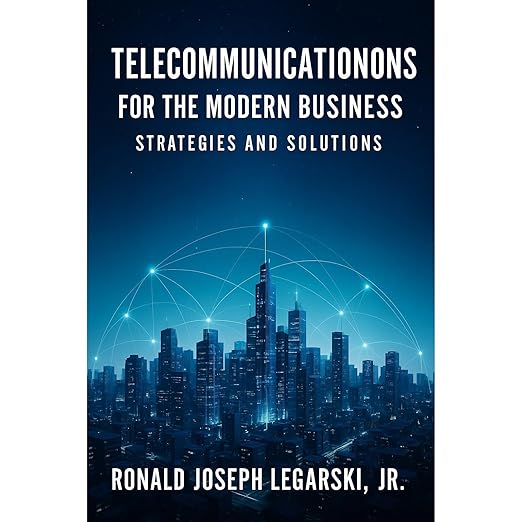
I will be transparent about something before diving into this one: Telecommunications for the Modern Business by Ronald Legarski is a self-published title from the author of SolveForce, a telecommunications consulting and brokerage firm. The book is authored by the company’s President and CEO. That framing is not disqualifying, practitioner expertise is often exactly what makes a technical reference valuable, but it shapes how you should read what follows.
The book runs to eighteen hours and eight minutes, which is long even by the standards of comprehensive technical surveys. Legarski structures it as a guide for business leaders, IT professionals, and decision-makers who need to understand telecommunications infrastructure as a strategic asset rather than a purely technical concern. The promise is foundational knowledge plus practical implementation guidance plus forward-looking coverage of 5G, AI integration, and quantum communications. That is a wide remit, and whether it succeeds depends substantially on your needs going in.
The Scope and Structure of the Coverage
The book’s genuine strength is breadth. Legarski covers network fundamentals, cloud communications platforms, voice-over-IP infrastructure, cybersecurity frameworks as they apply to telecommunications, and the emerging landscape of 5G and its business implications. If you are a business leader who needs to evaluate vendor proposals, understand what questions to ask, or assess the resilience of your organization’s communications infrastructure, the foundational chapters provide a genuine education in the vocabulary and concepts that will frame those conversations.
The structure is systematic in the way that a well-organized reference work is systematic: it moves through layers of the telecommunications stack with the intention of leaving no major topic uncovered. This is both its strength and its limitation for audio. A book this structured rewards browsing and reference use more than linear listening, and Virtual Voice narration at eighteen hours is a real test of a listener’s tolerance for synthetic delivery.
A Note on the Single Review
There is one rating and review for this title. The review is from someone who describes themselves as a professional website builder and software engineer, and praises the book for its depth on SEO and website promotion. This is a mismatch with the actual content, which focuses on telecommunications infrastructure rather than digital marketing. It is possible the review was posted to the wrong title. With a single data point that does not appear to describe the book being reviewed, it is not possible to draw reliable conclusions about listener reception, and I am treating this accordingly as a provisional assessment.
What the Author’s Position Means for the Analysis
Legarski’s position as a telecommunications services broker means he has real operational knowledge of the landscape he is describing. He has presumably navigated these systems on behalf of many business clients. It also means that the framing of certain strategic recommendations will reflect the perspective of someone whose business model involves connecting businesses to telecommunications providers. This is a structural consideration, not an accusation. A lawyer who has written a book about contracts is writing from inside the profession, which adds authority and carries perspective simultaneously. The same is true here.
Who Should Listen, Who Should Skip
This is for business leaders and IT decision-makers who need a comprehensive orientation to telecommunications infrastructure and want something more systematic than a blog survey. The breadth is genuine. Skip it if you want a concise strategic overview, eighteen hours is a substantial investment, and this reads as a reference work more than a focused argument. Also skip it if you expect virtual voice narration to sustain your engagement through long technical exposition; that is a combination that works best for readers who are highly motivated by the specific subject matter. The print edition may serve reference use better.
Frequently Asked Questions
Does Telecommunications for the Modern Business cover 5G and AI-driven network technologies, or is it focused on legacy infrastructure?
The book explicitly covers emerging technologies including 5G, AI integration in telecommunications, and quantum communications as forward-looking chapters. The coverage of these areas is framed as strategic orientation for business decision-makers rather than deep technical implementation guidance.
Is this book appropriate for IT managers who already have some networking knowledge, or is it aimed at non-technical business executives?
Legarski targets both audiences, business leaders who need strategic context and IT professionals who want a comprehensive survey. Readers with existing networking knowledge will likely move through the foundational sections quickly and find more value in the strategy and emerging-technology chapters.
At eighteen hours, is this viable as a cover-to-cover listen, or does it work better as a reference?
The structure is encyclopedic rather than argumentative, which makes it more naturally suited to reference use, consulting specific chapters based on current needs, than linear listening. For cover-to-cover listening, a high level of engagement with the specific subject matter is necessary to sustain attention through Virtual Voice delivery over this length.
The author is the CEO of a telecommunications consulting firm. Does the book read as promotional, or does it maintain analytical independence?
The practitioner background adds real expertise, particularly in sections on vendor evaluation and implementation strategy. Readers should be aware of the author’s professional position as context for any strategic recommendations involving service provider choices, as with any practitioner-authored business reference.