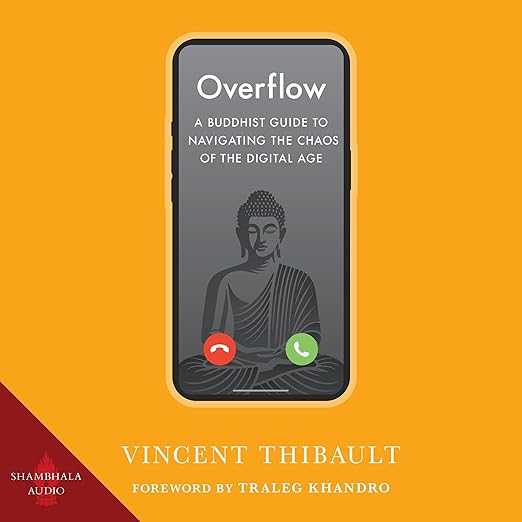
Quick Take
- Narration: Leo Wiggins brings a calm, unhurried quality to Thibault’s contemplative prose, the pacing suits the subject and avoids the trap of making mindfulness content sound like a guided meditation recording.
- Themes: Digital overload and mindfulness, Buddhist practice in modern life, technology and contemplative living
- Mood: Spacious and reflective, with practical anchors that prevent it from floating into abstraction
- Verdict: A thoughtful and unusual entry in the digital wellness space, less about deleting apps and more about developing the inner capacity to be present regardless of what the feed shows you.
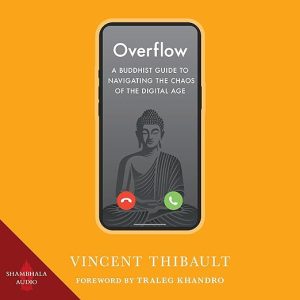
I came to Overflow at a moment when I genuinely needed it, which is probably not the most critical starting position but is an honest one. I’d spent a week in what I can only describe as notification fog, the state in which you reach for your phone before your feet hit the floor in the morning and discover that you’ve answered seven messages before you’ve had coffee, none of them particularly important. Vincent Thibault’s book found me at exactly that inflection point, and it had the good sense not to lecture me about it.
Most books about digital overload share a common architecture: the problem is introduced with alarming statistics, the reader is encouraged to feel appropriately ashamed, and a program of digital reduction is prescribed. Thibault largely avoids this structure. He is not trying to get you off your phone. He is trying to give you an interior life robust enough that the phone stops running it. That is a meaningfully different project, and it draws on Buddhist practice and modern psychology in proportions that feel carefully considered rather than fashionably combined.
Buddhist Wisdom Without the Sales Pitch
What distinguishes Thibault’s approach from the broader mindfulness market, a market that has been thoroughly colonized by the same optimization rhetoric it claims to resist, is the seriousness with which he engages Buddhist concepts. The breath, posture, awareness, contentment, and wonder that he identifies as working elements are not presented as exotic additions to your wellness routine. They are presented as the kinds of capacities that humans have historically developed when they paid attention to their inner lives, and as the kinds of capacities that digital saturation actively works against.
The book does not require you to be a practitioner or to have any existing familiarity with Buddhist thought. Thibault translates the relevant concepts into contemporary language without flattening them into self-help slogans. His argument that we don’t need silence to live a contemplative life and we don’t need stillness to find peace is genuinely useful reframing, it counters the implicit message of most meditation apps, which is that contemplative practice requires you to extract yourself from ordinary life in order to do it properly.
Where Thibault’s Framework Becomes Practical
At eleven hours, Overflow is a substantive listen, and it earns its length by developing its ideas rather than repeating them. The practical sections are integrated with the conceptual sections in a way that prevents either from becoming dominant. When Thibault discusses working with the breath, he is not giving you a technique to deploy during your lunch break, he is describing a sustained orientation toward bodily experience that gradually changes how you inhabit your own life, including your digital life.
The humor and wonder sections were unexpected and effective. Thibault’s argument that a sense of humor about your own compulsions is a form of mindfulness practice rather than a deviation from it, that you can laugh at yourself checking your phone for the nineteenth time today and that the laughing is part of the practice, is one of the book’s more original contributions. It breaks with the earnest gravity that tends to characterize this genre without sacrificing the seriousness of the project.
Leo Wiggins and the Sound of Unhurried Thinking
The narration choice is important for a book like this. Thibault’s prose is considered and layered, and a narrator who pushed the pace would damage the accumulative effect the writing builds toward. Wiggins reads at a speed that feels like someone thinking aloud rather than someone performing, there is space between ideas, and the listener’s mind has room to engage with the material rather than just absorbing it passively. This is the appropriate mode for contemplative content, and it works here in a way that it doesn’t always in books that use deliberate pacing as a shortcut for depth.
The single five-star rating is an artifact of limited review data rather than a reliable signal about the book’s quality. The content and the narration partnership suggest a production that warrants wider attention than it has received. This is a niche book on a subject that has acquired a large and somewhat crowded audience, and it may simply have been difficult to find in a genre dominated by more prescriptive titles.
Who Should Listen and Who Should Skip
Listen if you are curious about how contemplative traditions might offer something genuinely different from the app-based mindfulness industry, and if you’re interested in a book that doesn’t reduce the answer to notification settings. Listen if you want something that develops ideas slowly rather than delivering bullet points. Skip if you want a quick protocol for managing your screen time, this book operates at a different timescale and with different ambitions. Skip if the Buddhist conceptual framework is something you actively resist; Thibault treats it seriously rather than decoratively, and it is load-bearing throughout.
Frequently Asked Questions
Is Overflow a secular book, or does it require engagement with Buddhist religious practice?
Thibault draws seriously on Buddhist concepts, but the book is not devotional and does not require the reader to adopt Buddhism as a practice or belief system. The concepts are explained and translated for a general audience. Readers who are skeptical of spiritual frameworks may find some of the language requires translation, but the underlying observations are grounded in psychology and experience rather than doctrinal claim.
How does Overflow differ from other digital wellness books like Digital Minimalism or How to Break Up with Your Phone?
The key difference is the interior focus. Books like Digital Minimalism tend to prescribe structural changes to your environment and habits. Thibault is more interested in developing the inner capacities, attention, contentment, humor, wonder, that make you less susceptible to compulsive digital behavior in the first place. It is a slower, deeper approach that does not produce a checklist.
Is eleven hours too long for this material?
Not if you’re genuinely engaging with the content rather than consuming it for information. Overflow is the kind of book that benefits from being listened to in shorter sessions with time to reflect between them, rather than as a binge. At that pace, the length is appropriate to the depth of what Thibault is attempting.
Does Leo Wiggins’ narration suit the contemplative tone, or does it feel slow?
Wiggins’ pacing is deliberate and suits the material well. For listeners accustomed to faster-paced instructional audio, there may be an adjustment period. For listeners who engage regularly with contemplative content, the pace will feel correct rather than slow.