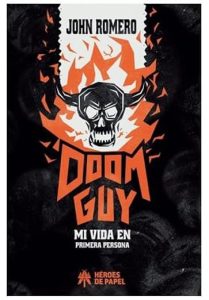
John Romero narrating Doom Guy in Spanish carries a specific charge that even his English-language memoir cannot fully replicate. The man who co-created DOOM, Quake, and Wolfenstein 3-D reading his own story aloud, in the first person, in a language that Spanish-speaking gaming fans can engage with as their own, that combination is worth naming before anything else. This audiobook, running seventeen hours and four minutes, is the Spanish edition of Romero's memoir subtitled Mi vida en primera persona, and it has earned a Forbes endorsement as possibly the best nonfiction book on video games of all time for offering a singular perspective on one of the most transformative eras in the industry through the eyes of one of its most innovative pioneers.
Forbes's language is precise: singular perspective is the operating phrase. What Romero offers that no other author or journalist could provide is total interiority. He was not reporting on id Software from outside. He was id Software, alongside a small group of collaborators, during the years that produced the first-person shooter genre as a dominant cultural force. The audiobook gives that interiority its fullest possible expression.
Hearing Romero Describe His Own Obsession
The self-narrator dynamic works differently in memoir than in any other audiobook category. When Romero reads about smuggling the work computer out of the office at night to keep programming in secret, the sentence carries a weight that a professional narrator could approximate but never match. You are hearing a man describe his own obsession in his own cadence. One Spanish reviewer described the experience as entering Romero's mind, noting the rawness of some personal passages about his difficult childhood as necessary context for understanding how his personality formed.
That difficult childhood is not incidental to the story Romero tells. The memoir traces the line from a kid mailing self-programmed Apple II games to computer magazines through the id Software years and into the celebrated rupture with co-founder John Carmack. Both sides of that rupture get treatment here. One of the more anticipated qualities of the book for gaming historians was whether Romero would address the Carmack split with candor or gloss it. The seventeen-hour runtime suggests room for both breadth and depth, and reviewers have described the content as genuinely illuminating about the creative and commercial dynamics behind DOOM's development at each stage of the process.
Closer to a Deposition Than a Biography
The audio format gives the memoir something the print version cannot: Romero's actual voice, his pacing, the places where he slows down or speeds up, the passages he clearly still finds difficult to narrate. At seventeen hours, the audiobook covers the full arc of his career from the Apple II period through Wolfenstein 3-D and DOOM to the consequences of the fallout with Carmack and his subsequent decades in game development. A listener who completes it has received something closer to a deposition than a biography.
Spanish-speaking gaming fans have historically had limited access to insider accounts of American game development from this era. Most of the primary literature, memoirs, documentaries, and journalism was produced in English. A Spanish-language edition narrated by the subject himself represents a genuine access point into that history for a substantial audience that the English book did not fully reach. That context gives the audiobook importance beyond its quality as a listening experience alone.
The memoir's treatment of the heavy metal soundtrack that accompanied the creative sessions at id Software is one of the unexpected pleasures of the audio format. Romero describes the specific musical atmosphere of those working sessions in a way that Gillis's print version necessarily delivers more abstractly. When Romero himself narrates those passages, the music's role in the creative culture of the studio becomes something you can almost hear in the rhythm of the telling. It is one of those moments where self-narration does something no other format can quite replicate.
Strong Translation, and a Voice That Lived It
The seventeen-hour runtime is the primary practical consideration. This is a serious commitment, and the audiobook functions best approached in sustained listening sessions rather than fragmentary commute-length increments. The content rewards that investment, but listeners who cannot dedicate extended time to it should set expectations accordingly. The print version may serve better for anyone who prefers to move through memoir at a flexible, self-directed pace.
Spanish-language reviewers noted the translation quality as strong rather than flat, which matters for a memoir this personal. Translation can drain intimacy from first-person prose, flattening the author's voice into something approximating a third-person report. In this case, with Romero himself reading, that risk is significantly mitigated. His performance carries the intimacy even through translated text, because the voice behind the words remains the voice of the person who lived them.
It is also worth noting that the memoir's account of Romero's time in the spotlight as the first rock star of video games includes the period after DOOM's release when his public profile became part of the commercial story rather than separate from it. His later project Daikatana, widely regarded as a failure relative to the expectations it generated, is part of the arc that the memoir covers. How Romero reckons with that chapter publicly is one of the more anticipated elements of the book for longtime followers of his career, and the seventeen-hour format gives him room to address it on his own terms.
This Spanish Edition Cannot Substitute for English
Spanish-speaking fans of gaming history, particularly listeners who grew up with DOOM or Quake, will find this audiobook essential. The seventeen hours deliver not just gaming history but a portrait of what it meant to be at the center of a creative explosion that nobody fully understood while it was happening. Listeners interested in co-founder dynamics, creative partnerships under pressure, and the specific tension between technical genius and design vision will find the id Software years deeply satisfying to sit with. The language requirement is real: this is a Spanish-language audiobook and cannot be substituted for the English edition. Listeners without sufficient Spanish should seek out the English version of the memoir instead.
Frequently Asked Questions
Does John Romero narrating his own audiobook add meaningfully to the listening experience?
Yes. Self-narration in memoir creates an intimacy that professional narrators cannot fully replicate. Hearing Romero describe the id Software years, his childhood, and the split with John Carmack in his own voice and cadence gives the material a presence that distinguishes this from a third-party biography.
Does this audiobook address the falling out between Romero and John Carmack at id Software?
Yes. The memoir covers the full arc of Romero's id Software years including the fracture with Carmack, and the seventeen-hour runtime allows for depth rather than superficiality. Reviewers have described the account as illuminating about the creative and commercial dynamics behind DOOM's development.