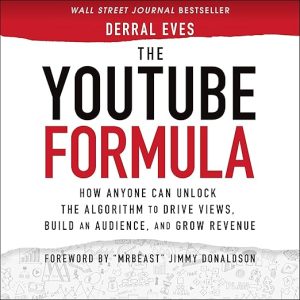
Does a book about video work without video? The YouTube Formula audiobook runs ten hours and three minutes on a subject that is almost entirely visual, and Derral Eves reads it himself, which ends up mattering more than the format problem does. The claims in the copy are not modest either: over sixty billion views generated, and twenty-four channels taken from zero to a million subscribers.
Data Analysis Replaces Magic Pills as Method
Credentials come first here because they are the argument. Eves owns what the copy calls the largest YouTube how-to channel, and the pitch is that the book hands over the inner workings of the algorithm that decides who succeeds on the platform, material the description insists you cannot get anywhere else. That is a very large promise, and it is also an honest description of the book: an operator's account of a system, written by somebody with the view count to justify sitting down and explaining it.
Structure, as the product page describes it, makes sense of the length. One five-star filed on March 17, 2021 describes the opening stretch as a run through the development of YouTube and why things work the way they do, with the second part turning to the approach itself and everything required to succeed on the platform. That same response lands on the operating principle cleanly: the platform is in constant change, so the winning method is a data analysis driven approach rather than any fixed trick. No magic pills, as it puts it.
Somebody trimmed the subtitle out of the title field, which costs you the clearest statement of scope the book has. The description quotes the full title inside the copy, promising to unlock the algorithm to drive views, build an audience and grow revenue, while the title field carries none of it. Anyone deciding by title alone gets three words instead of a full sentence, and the gap between a formula and a revenue plan is exactly what a buyer needs settled before paying.
Eves Reads With the Weight of Experience
The most useful endorsement on the page is about depth. An April 2021 five-star, from somebody who had already worked through a great many of Eves's videos, reports being impressed by the comprehensiveness, calling the book broad in scope and deep in the information it gives, and noting specifically that it contains material the free videos do not. For any creator-authored book that is the only question worth asking, and the answer here comes back yes.
Eves reads the recording himself, which changes what you are buying. A book of frameworks delivered by its author arrives with the emphasis already assigned, because the person deciding which sentence carries the weight is the person who ran the channels those sentences describe. It also means anyone who came to the book through the videos is getting that same person rather than an interpreter, and for a practical title built on personal track record, the absence of a middleman counts for something.
Ten hours is a lot for a practical book, and the shape justifies most of it. The history section earns its keep because the argument depends on it: you cannot reason usefully about the algorithm's incentives without knowing what it was built to solve. The case studies and creator information stack up in the back half, and that is where the running time loosens, since example after example ends up making the same structural point in a different niche.
Thumbnails and Comparisons Stay Purely Visual
Visual content is the real cost of this format, and it is a steep one. A December 2025 five-star praises the recommendations on creating thumbnails and the examples of the best performing ones the book displays, alongside the metrics worth watching and the case studies. Thumbnails are pictures. Performance comparisons are pictures. No companion PDF is mentioned anywhere in the copy, so a book that teaches you to design the most clickable rectangle on the internet asks you to imagine every single example of one.
Somebody on the page also recommends taking it out of order. A four-star from May 2024 offers a pro tip: read part three first, then parts two and one, on the grounds that the actionable material sits at the back. That is a sensible strategy in print and an awkward one here, where moving to a later part means guessing at a chapter marker instead of flipping pages. The same response characterizes the overall method as ready, fire, aim, which is a fair caution about an approach built on fast iteration.
Numbers above the responses do not hold together. The average reads 4.6 from one counted rating, and a single vote can only be a whole number of stars, so no individual could have produced that figure. Five written responses sit underneath it regardless, three of them filed in March and April 2021, a full year ahead of the April 2022 release date. Treat the score as decoration, read the accounts below it, and note that most of them are describing the printed edition.
Fifteen Years in TV Newsrooms, Then YouTube
Nothing pins the intended reader down better than a March 9, 2021 five-star from a traditional media veteran with more than fifteen years in TV newsrooms, CNN among them, who started on YouTube in 2015 and went full-time in late 2017 with help from educators including Eves and Sean and Benji of Video Influencers. That is the profile the book fits: somebody with production skills who needs the platform's logic explained, rather than somebody shopping for a first camera.
Marketers and brand managers qualify for the same reason, and the copy names them outright alongside creators, entrepreneurs and social media strategists. Steer clear if you want a beginner's guide to filming and editing, because that is not the subject on offer. Steer clear as well if a book about the present shape of an algorithm feels risky when the earliest responses on its own page were filed back in 2021. It asks a genuine commitment, but the reasoning underneath the tactics has outlasted several interface redesigns already.
Common Questions
Can you jump straight to the practical sections of the audiobook?
Awkwardly. Moving to a later part means hunting for a chapter marker rather than flipping pages, and the listing gives no sign that the parts are named in the track titles. Note the chapter numbers before you start if you intend to work backward, because scrubbing blind through ten hours is thoroughly unpleasant.
Do you need an existing channel to get value from it?
It helps enormously. The material assumes you will be reading your own metrics, testing thumbnails and iterating on real uploads, so somebody with nothing published has no data to apply any of it to. Launch chapters do exist, but the center of gravity sits well past your first video.
Is The YouTube Formula aimed at creators or at marketers?
Both, and the copy says so, naming creators, entrepreneurs, social media strategists and brand managers as the audience. Marketers get the platform logic and the case studies, creators get the operational detail, and neither group gets a filming or editing tutorial. That last point is the expectation worth adjusting first.
Does the audiobook date badly?
Parts of it will. Tactics tied to a specific interface age quickly, and the earliest responses on this page were filed in 2021. What holds up better is the reasoning, since the book spends its opening stretch on why the platform was built the way it was, and that explanation survives changes to the buttons.