Key Details
- Read by: Michael Hyatt self-narrating brings immediate authority to the practical guidance, with a measured coaching tone that makes the strategies feel personally tested rather than theoretically assembled.
- At its heart: online audience-building, monetizing creative work, signal versus noise in digital presence
- Vibe: Practical and energizing, with the confidence of someone who actually did the thing
- Short version: Platform holds up as a clear-eyed guide to building an audience that matters; the principles transfer even as specific platforms shift.
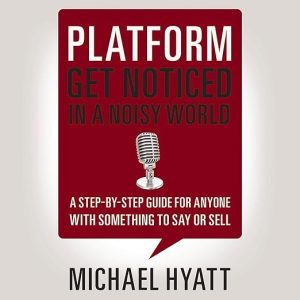
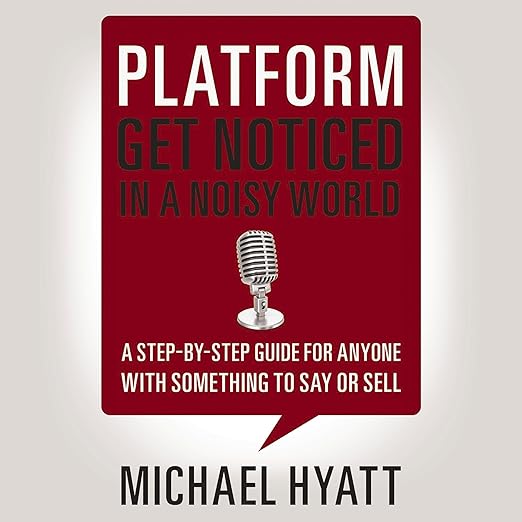
Michael Hyatt published Platform as a how-to guide for people who needed to be heard in a crowded digital landscape, and his decision to narrate the audiobook himself is the right call from the first page. Hyatt built his platform from scratch while serving as CEO of Thomas Nelson Publishing, and the knowledge he shares in this audiobook is not borrowed from adjacent fields. He learned it by doing it, and that specificity comes through in the narration's confident, unhurried delivery across just over five hours.
The book's central argument is both simple and frequently misunderstood: a platform is not a presence. It is a relationship. Hyatt came up in an era when authors, speakers, and entrepreneurs often treated social media as a megaphone, a way to broadcast at people who had not asked to be addressed. What he argues instead is that visibility without genuine utility is noise, and that the professionals who build durable platforms do so by creating content that serves their audience's actual needs first.
Hyatt Watched Who Cultivated Readers Before Launch
Hyatt was well-positioned to write this book. As the former CEO of one of the largest Christian publishing houses in the US, he spent years watching what happened to authors who arrived at launch day with no audience and what happened to those who had built one deliberately before the book even appeared. The gap he observed was not about talent or quality; it was about who had cultivated a relationship with readers versus who expected the book's existence to do that work for them.
Reviewer Paola Garbini described the content as useful for newcomers as well as for those who want to brush up their knowledge of social platforms, blogging, online writing, and brand building, and that range is accurate. Hyatt writes in a way that does not presuppose extensive technical knowledge, but the practical strategies he offers are substantive enough that readers with existing platform presence will still find concrete refinements to test. The chapter structure reflects the book's blogging DNA: tight and purposeful, rarely running longer than necessary to make the point.
Hyatt's Coaching Voice Makes Advice Feel Accountable
The self-narration by Hyatt is a meaningful advantage in a category where audiobooks are often read by hired narrators who can deliver the prose without inhabiting the expertise behind it. When Hyatt explains how he grew his blog readership or how he thinks about email list cultivation, the coaching quality of his voice makes the guidance feel accountable. He is not teaching abstract principles; he is describing a practice he maintains.
Reviewer Paul's breakdown of the book's structure, roughly 60 chapters averaging five to eight pages each, translates well to audio. Each chapter functions as a self-contained lesson, which means the five-hour runtime is easy to consume in segments without losing continuity. Hyatt also links to tools and resources throughout, which is more practically useful in the written format, but the audio listener still gets the structural value: a chapter-by-chapter curriculum that moves from foundational concepts to specific implementation.
Dated Platforms Aside, the Email Chapters Endure
The book was originally published in 2012, and while the underlying principles remain sound, specific platform references have aged. Twitter, Facebook, and early-era blogging tools are sometimes named in ways that feel dated, and listeners today may need to mentally translate certain tactical examples to the current landscape. The core argument transfers; the specific channel recommendations need updating by the listener.
Platform is also unambiguously oriented toward people who want to build a personal brand or creative business rather than community-driven or explicitly non-commercial projects. The framing is consistently entrepreneurial: extend your influence, monetize it, build a sustainable career. That lens is exactly right for the target audience, but listeners looking for a critique of platform culture or a more ambivalent take on self-promotion will not find it here. Hyatt believes in the enterprise and writes accordingly.
What Hyatt gets right that many platform-building guides miss is the sequencing problem. Most people who want to build an audience try to build the audience before they have built anything worth gathering around. Hyatt's framework addresses this directly, insisting that you need something real to offer before you start optimizing how you offer it. That sounds obvious when stated plainly, but the practical execution, what it means to develop a point of view, sharpen your content discipline, and understand what your specific audience actually needs from you, is where the audiobook earns its runtime.
The book's chapters on email, on the importance of owning your relationship with your audience rather than renting it from a platform, are among the most durable in the current landscape. Hyatt was writing in 2012, well before the algorithmic shifts that have repeatedly disrupted creator relationships with social platforms, but his emphasis on building off-platform connections, on the email list as the foundation everything else is built on top of, has become more correct with each passing year, not less. Those sections read as prescient rather than dated.
Aimed at Habit-Building Over Analytics Optimization
Authors in early or mid-career who want to understand what their publisher means when they ask about platform will find Hyatt's book a cleaner explanation than most. Independent creators, speakers, coaches, and entrepreneurs building audience-dependent businesses will find the practical guidance immediately applicable. The five-hour runtime makes this one of the more efficient investments in the category. Skip this if you are looking for a deep dive into content strategy theory or social media analytics; this audiobook is oriented toward building the habit and mindset rather than optimizing existing systems.
Does Michael Hyatt's self-narration add value to the audiobook experience?
Significantly. Hyatt built his own platform from scratch while running a major publishing company, and his narration carries that personal accountability. The coaching quality of his delivery makes the guidance feel practiced rather than theoretical, which matters for how-to content.
At just over 5 hours, does this audiobook cover the topic with enough depth?
Hyatt prioritizes practical clarity over comprehensive coverage, and the chapter structure, around 60 short focused lessons, makes the runtime feel efficient rather than rushed. Listeners wanting a longer theoretical treatment of audience-building will need to supplement this with other resources.
Who is the ideal listener for the Platform audiobook?
Authors, speakers, coaches, and entrepreneurs who need to build audiences for their work and are not sure where to start. It is also useful for people who have been producing content inconsistently and want a framework for making it more strategic and deliberate.