The Short Version
- Narrator: Mary Sarah reads Nagle's dense cultural analysis with clear diction and a controlled pace that keeps the argument accessible without softening its edges.
- Subjects: online culture wars, alt-right genealogy, left-wing purity politics
- Tone: Sharp and provocative, occasionally exhausting
- Bottom line: Nagle's short, bracing analysis of the internet's culture wars remains one of the few books that refuses to let either side off the hook.
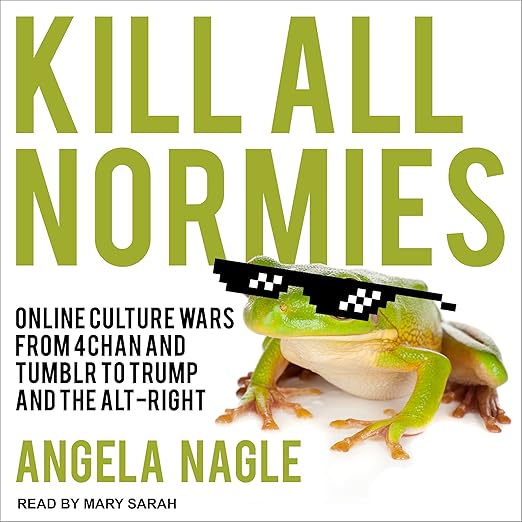
Angela Nagle's Kill All Normies arrived in 2017 and immediately made enemies on every side of the online culture wars it was dissecting. That is probably the most accurate signal of its quality. This audiobook version, just over four hours and narrated by Mary Sarah, compresses a genuinely uncomfortable argument into a listening experience that rewards attention and resists easy summary. The argument, stated simply: the online left and the online right have more in common structurally than either would like to admit, and the cultural logic of transgression and spectacle drives both.
Trigger Warnings Mirror What They Claim to Oppose
Nagle's project is diagnostic rather than prescriptive. She traces the cultural genealogy of the alt-right from its origins in marginal internet spaces, neo-reactionary forums, chan boards, geeky subcultures, through to its mainstream manifestations in figures like Milo Yiannopolous, the Trump-supporting gay libertarian who became a peculiar emblem of a movement built on contradictions. But she does not stop there, and this is where the book earns its distinctiveness. She turns the same analytical lens on the online left, examining its own subcultures, its own dynamics of purity and performance. The therapeutic language of trigger warnings and safe spaces, she argues, has its own forms of social enforcement that mirror what it opposes.
The intellectual framework draws on thinkers ranging from Herbert Marcuse to the transgressive traditions of 1960s counterculture, and Nagle's argument is that both the anti-establishment right and the performative left have inherited those transgressive impulses while repurposing them for radically different ends. This is not a comfortable thesis and it was not designed to be. One reviewer called the book eye-opening, illuminating, chilling, and disturbing, describing it as written particularly for those who could not understand how Donald Trump won in 2016. Another noted it is informative but somewhat lacking, specifically because it predates the Jordan Peterson phenomenon and therefore misses a significant development in the culture it chronicles.
Mary Sarah Resists Personality in a Spare Text
The audiobook format works reasonably well for Nagle's text, which is dense with proper nouns, platform references, and academic concepts but not so structurally complex that it requires a physical text to follow. Mary Sarah's narration is controlled and clear. She does not try to inject personality into a text that is itself quite spare, Nagle writes as a researcher rather than a stylist, and Sarah respects that. The short runtime is both a strength and a limitation. At four hours and five minutes, Kill All Normies is not trying to be comprehensive. It is a provocation, as one reviewer correctly identifies by noting it is published by Zero Books, which positions itself explicitly as bringing academic debates and ideas to a wide audience in the form of short provocations.
For the audiobook listener specifically, this means the text rewards pausing. Some of Nagle's denser passages benefit from processing time, and the audiobook format obviously cannot provide the marginal annotation you might make in a physical book. A notepad nearby, or the willingness to rewind, will make this a more productive listening experience than passive consumption. It is the kind of short, sharp book that is worth multiple passes.
Sourcing Criticism Fits the Zero Books Format
The book's datedness is its most frequently noted limitation. Written too early to account for Jordan Peterson's cultural rise, and predating the even more significant developments in platform politics that followed 2017, Kill All Normies captures a snapshot rather than a full picture. Reading it as current analysis would be a mistake, but reading it as an accurate diagnosis of a specific cultural moment, and as a theoretical framework applicable to subsequent developments, makes it considerably more valuable. The cultural logic Nagle identifies has not gone anywhere. The specific actors and platforms have shifted, but the dynamics she maps remain operative.
The third reviewer in the available responses offers a useful calibration note: Nagle's sourcing has been criticized, but that reviewer argues this is appropriate to the Zero Books format, which is not peer-reviewed scholarship but intellectual provocation for general audiences. That framing matters for how you approach the audiobook. Arrive expecting a rigorous academic text and you may feel underserved. Arrive expecting a smart, pointed, uncomfortable argument that will reorganize how you think about online culture, and Kill All Normies delivers precisely that.
Listeners From the 2013-2017 Culture Wars Get Precision
Anyone trying to understand the political and cultural logic of online spaces, how radicalization spreads, how transgression became a right-wing strategy, how the left's language of care became a tool of social enforcement, will find this audiobook genuinely illuminating. It is particularly well-suited to listeners who already have some familiarity with the terrain Nagle covers, since the book assumes a degree of cultural literacy about the platforms and figures it discusses. Listeners who came of age entirely outside these internet subcultures will need some background context to follow the references.
Avoid this audiobook if you want a comfortable narrative arc or reassuring conclusions. Nagle is not interested in making you feel better about any side. She is interested in making you think more carefully, and the audiobook does that effectively in the four hours it takes to complete.
One additional note worth flagging for audiobook listeners specifically: the text's reliance on internet culture terminology and references to online figures means some passages will land differently depending on how familiar you are with the subcultures under discussion. Nagle does not define every term or explain every name. For listeners who lived through the 2013-2017 period of online culture wars as active participants, the references will feel precise. For those coming to the material cold, some passages will require either background reading or a willingness to follow the argument's shape without grasping every specific example. Neither is a barrier to finding the book valuable, the structural argument is accessible even when the specific examples are opaque, but it is worth knowing before you begin.