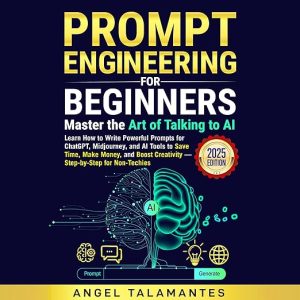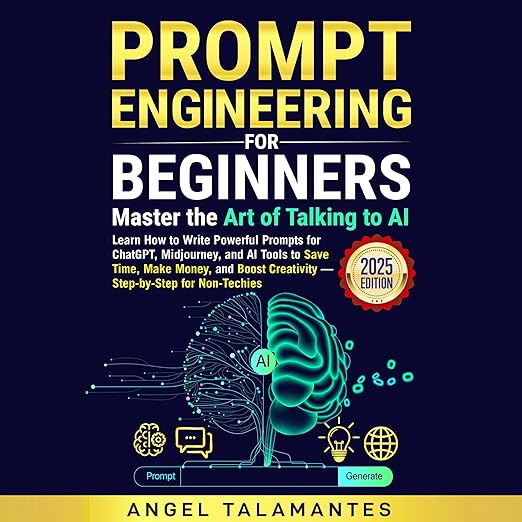
Start with what the title promises and what the description delivers, because on this listing they are not the same product. The title offers a beginner's guide to prompt engineering. The copy underneath sells a business playbook: turning ideas into income with ChatGPT, automating marketing and customer email, building offers and funnels, and working through a thirty-day launch plan. Angel Talamantes wrote and published it, John Wilkinson reads the audiobook, and the whole thing runs four hours and twenty minutes.
An AI Business Blueprint Label Fits the Contents
A series name settles the question of intent. This record belongs to something called the AI Business Blueprint Series, which is an accurate label for the contents as described and a poor match for the words at the head of the page. Prompt craft appears here as a means to an end, and the end is a small online business. Anyone buying this to learn how to structure a prompt will find that subject subordinated to marketing automation.
Taken as what it actually is, the shape is familiar from a hundred entrepreneurial guides published in the past three years. The pitch names its audience directly: creators, freelancers and small business owners with no technical background, promised that no coding is required and that the tools mentioned, ChatGPT alongside Canva, Zapier and other no-code services, can be assembled into workflows that keep running without supervision.
That genre is not worthless. A clear, current overview of what these tools can and cannot do is genuinely useful to someone who has been putting off learning them. What the genre chronically oversells is durability, and the copy here leans hard on the language of passive income and businesses that run themselves, which is the point at which a careful listener should slow down and start subtracting.
Wilkinson Carries Click-by-Click Steps by Voice Alone
Length is the strongest argument. The running time is short enough to finish in two sessions, which is the right size for an orientation to a fast-moving toolset. Longer books in this category pad themselves with case studies that age badly. This one appears to be structured around a sequence of applications, marketing, email, content, offers, funnels, and then a thirty-day plan that gives the whole thing a spine.
An audio-first approach also suits the reconnaissance stage of learning a tool. If you have not yet decided whether any of this applies to your work, hearing an overview costs you an afternoon and no setup. The listening version is for deciding what to try, and the trying happens somewhere else, at a keyboard, with the actual applications open in front of you.
In practice, the tool-heavy material sets a real constraint on the format. Instructions involving a specific service are written for someone looking at a screen, and this listing offers no supporting document, worksheet or link list on the record. Wilkinson has to carry sequences of steps by voice alone, which works for concepts and gets harder the moment a passage starts describing where to click.
One Vote Makes This Book's Entire Rating
A single vote carries the rating on this page. One person has graded this title, and because an individual rating can only be a whole number of stars, the 4.0 displayed is that one person's four stars and nothing else. No written response has been left at all, so no account of the content, the structure or the reading exists anywhere on the record. Treat the number as a placeholder rather than as a consensus.
Nobody, in other words, has yet reported on how Wilkinson handles this material. That silence is a fact about a recent release rather than a judgment, but it does mean a buyer here is going in with no independent signal, and for a self-published title where the publisher field carries the author's own name, the usual editorial filters are also absent from the process.
Shelf life is the last flag. A 2025 edition label sits on a book published in December 2025, describing a landscape the copy itself calls fast-changing, in a field where the leading tools revise their interfaces several times a year. Anything tied to a specific menu or a specific pricing tier starts decaying immediately, and the parts of the book most likely to survive are the ones about how to think, not the ones about where to click.
Business Framing Over Prompt Construction Craft
Someone at the very start. A freelancer or small-business owner who has heard about these tools, has never opened one seriously, and wants an inexpensive four-hour survey before committing time to any of them will get value here. The register is deliberately non-technical, no prior experience is assumed, and the thirty-day framing gives a beginner something to follow rather than a list of possibilities.
Listeners who want the business framing rather than the craft are the real target. If your question is what to build with these tools, this is aimed squarely at you. If your question is how a prompt is actually constructed, how context and constraints and examples change an output, and how to iterate on a bad result, the title is pointing you in a direction the contents do not go.
Experienced users of these tools should pass. So should anyone hoping for the technical depth the phrase prompt engineering has come to imply in professional settings, and anyone allergic to the vocabulary of scaling and income streams, which the copy uses freely. Come to it as a beginner's orientation with a business slant, judge the promises with the skepticism they invite, and the trade is a fair one.
- Voice: John Wilkinson handles a tool-led how-to that was written with a screen in mind, and this record ships without any supporting material.
- Big ideas: AI-assisted small business, no-code automation, marketing workflows, a month-long startup schedule
- Atmosphere: Brisk and promotional
- Worth it?: A short beginner orientation to AI business tools, mis-titled as a prompt engineering guide.
A Few Questions About Prompt Engineering for Beginners (2025 Edition)
Does this audiobook actually teach prompt engineering?
Less than the title suggests. The description and the series name both point at building a small AI-assisted business, with prompt craft serving that goal rather than being the subject. Expect applications, automations and a launch plan rather than a technical treatment of how prompts are constructed.
Can I follow the tool instructions while listening, or do I need a screen?
Plan on a keyboard for anything practical. The value of the listening hours is deciding what to attempt and in what order, since the applications named in the description each have their own interface to learn, and none of that can be followed usefully while your hands are busy elsewhere.
Should the star rating on this listing influence my decision?
Barely. With a December 2025 release and nobody yet writing anything, the number on display carries no consensus behind it and cannot tell you whether the material is clear or the reading is steady. Judge it on the description, the running time and the sample instead.
How quickly will a 2025 edition of this audiobook go out of date?
Faster than most nonfiction. The services described revise their interfaces and their pricing repeatedly within a year, so instructions written against today's screens will drift. The conceptual material about what to automate, and in what order, should hold up considerably longer.