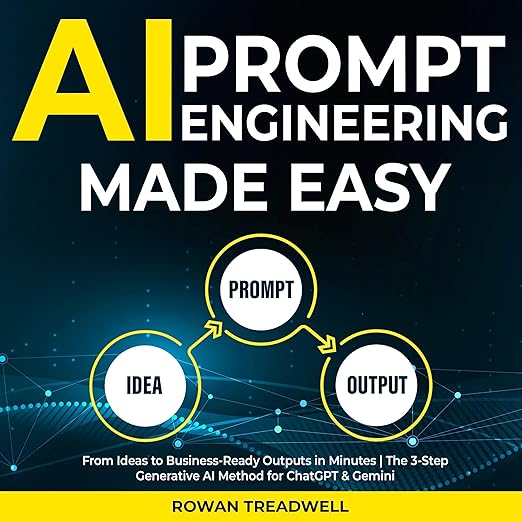
Prompt engineering is one of those skills that everyone using AI tools is developing informally, without necessarily naming it. Rowan Treadwell's audiobook AI Prompt Engineering Made Easy: From Ideas to Business-Ready Outputs in Minutes, narrated by Rory Young, attempts to make that informal skill explicit, systematic, and transferable. The core claim is blunt: the gap between professionals who get excellent AI output and those who get junk is not about the AI, it is about how you talk to it. That premise is more defensible than it sounds, and Treadwell spends the six-hour-and-thirty-eight-minute runtime making a credible case for it.
The book is aimed at a specific working professional: marketers, consultants, entrepreneurs, and developers who are already using tools like ChatGPT and Gemini daily, getting inconsistent results, and suspecting there is a better way to approach the interaction. That is a real and large audience, and Treadwell's framing of prompt engineering as a learnable, repeatable methodology rather than a talent or an art is the right framing for that audience. The introduction's language tips occasionally into the hyperbolic, promising competitive domination and transformation, but the actual content is more measured than the sales pitch, which is the version worth attending to. The practical exercises that accompany each foundational principle are the most valuable part of this framing, because they translate the methodology from something understood abstractly to something practiced in real workflows.
Five Principles Form the Book's Spine
The five foundational principles Treadwell identifies are the book's spine, and they are well-chosen: clarity of intent, specificity of context, role assignment, output format specification, and iterative refinement. None of these are revolutionary to anyone who has read widely in the space, but Treadwell organizes them into a coherent framework with practical exercises that make them actionable rather than merely theoretical. The single five-star review praises exactly this: the three-step method's ability to produce clearer thinking about the prompting process itself, not just the prompts.
The more advanced material, covering meta-prompts, RAG architecture, and defensive prompting, is where the audiobook earns its audience beyond casual users. Meta-prompting, where you use AI to improve your prompts before applying them, is a genuine productivity multiplier that most professionals have not yet adopted systematically. Defensive prompting, which addresses how to structure prompts that resist hallucination and maintain accuracy, is directly applicable to anyone using AI for business-critical output. These sections justify the runtime even for listeners who find the foundational material familiar.
Young Signals Structure Through Pace and Emphasis
Rory Young has the tone right for this material. Instructional nonfiction about technology lives or dies on the narrator's ability to make process steps feel consequential rather than procedural, and Young manages this by varying pace and emphasis in ways that signal which passages are structural versus which are illustrative. He does not oversell the more hyperbolic sections of the book's introduction, which is the right editorial instinct for a methodology guide that argues against uncritical tool enthusiasm.
The runtime of six hours and thirty-eight minutes positions this as practical rather than comprehensive. Treadwell is not trying to replace a formal course in prompt engineering; he is trying to give working professionals enough structured methodology to immediately improve their output quality. That is a more useful goal than exhaustive coverage, and the audio format serves it well, particularly for listeners who can apply concepts immediately after hearing them in a real work context.
Treadwell Treats Prompts as Reusable Assets
The section on A/B testing and monitoring AI outputs is often overlooked in popular treatments of prompt engineering, and Treadwell handles it better than most. The insight that prompts are not single-use artifacts but assets that should be tested, refined, and scaled is a genuinely valuable reframe, particularly for teams using AI at organizational scale. Listeners in content, marketing, or operations roles will find practical application here immediately.
Also worth attention is the material on AI traps, patterns of overconfidence and undercritical acceptance that lead to bad decisions based on fluent but inaccurate AI output. This is the epistemic core of the book, and it is the counterweight that prevents the otherwise enthusiastic methodology from becoming a guide to automating bad judgment faster. The warning that AI can produce confident but wrong output at scale is the most important thing in the book, and Treadwell earns credit for placing it prominently rather than burying it in a late chapter.
Marketers and Consultants Get Consistent Output
Working professionals who are already using AI tools but producing inconsistent results will get the most from this audiobook. The methodology is oriented toward business output, document creation, research synthesis, and workflow automation rather than creative or technical use cases, so marketers, consultants, and operations professionals are the natural audience.
Complete beginners to AI tools may want to spend time with a basic introduction first; Treadwell assumes some familiarity with ChatGPT and similar platforms. Experienced prompt engineers who have already developed systematic approaches may find the foundational content familiar, though the sections on production systems, scaling, and defensive prompting offer genuine value even for sophisticated users. The audiobook's strength is its practicality, and practitioners will recognize the utility of a methodology that is explicit, teachable, and immediately deployable. The six-hour-and-thirty-eight-minute runtime fits naturally into a week of commutes or a weekend session, making it a low-friction way to build a more structured relationship with the AI tools most professionals are already using.
Frequently Asked Questions
Is this audiobook appropriate for someone who has never used ChatGPT or Gemini before?
Treadwell assumes some familiarity with AI tools. Complete beginners would benefit from spending time with the tools themselves before approaching this methodology guide. The book teaches how to prompt effectively, not what AI tools are, so some hands-on experience with ChatGPT or Gemini will make the audiobook's exercises more immediately applicable.
What is defensive prompting, and why does the audiobook say it matters?
Defensive prompting refers to structuring prompts in ways that minimize AI hallucination and maintain output accuracy. Treadwell argues that professionals using AI for business-critical content need to know not just how to get good output but how to structure prompts that actively resist the confident-but-wrong outputs that AI tools occasionally produce. This is among the more practically valuable sections of the audiobook.
Does this audiobook work well in the audio format for a technical methodology guide?
Reasonably well, with some limitations. The conceptual frameworks, process descriptions, and examples of good versus poor prompts all translate effectively to audio. Ready-to-use templates referenced in the synopsis are harder to benefit from in audio since they require visual reference to use directly, so listeners may want supplementary written notes.
The book promises competitive domination and transformation. Is that what the audiobook actually delivers?
The actual content is more measured than the marketing language suggests. Reviewer Melissa Nicole's five-star review focuses on the practical utility of the three-step method rather than any transformative outcomes. The audiobook is a methodology guide for producing better AI output consistently, which is a genuinely useful but less dramatic benefit than the synopsis promises.