
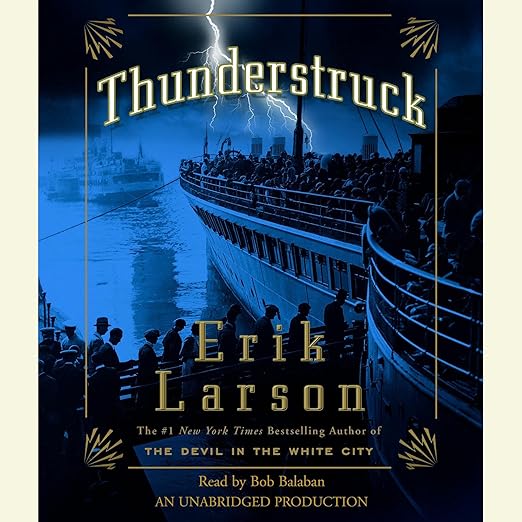
In Brief
- Narrator: Bob Balaban brings tonal intelligence to both timelines, sustaining technical enthusiasm for Marconi's experiments and quiet dread for the Crippen sections across twelve hours.
- Subjects: Technological obsession, the nature of evidence, domestic horror in respectable settings, and the strange ways invention and crime can intersect.
- Tone: Intelligent and suspenseful, with the particular satisfaction of two completely separate narratives converging on a single point of historical drama.
- Bottom line: Larson at full craft, and Balaban's narration makes this twelve-hour audiobook one of the most satisfying narrative nonfiction listening experiences available.
Erik Larson builds his books the way a composer builds a symphony: two completely separate melodic lines developed in parallel until they converge, and the convergence justifies everything that came before it. In Thunderstruck, that structural commitment is as deliberate as anything in his earlier Devil in the White City, and the audiobook format, with Bob Balaban's narration sustaining the dual timeline across nearly twelve hours, reveals how dependent the experience is on a listener's trust in the architecture. You spend long stretches with Guglielmo Marconi as he perfects wireless telegraphy through relentless setbacks, then long stretches with the quiet, mild-mannered Dr. Hawley Crippen as his life in Edwardian London darkens toward catastrophe, and you simply have to accept that the lines will meet. When they do, on the North Atlantic, it is worth every hour of the build.
Balaban is a genuinely thoughtful narrator for this material. His voice has the quality of an intelligent man explaining something he finds fascinating, which is exactly the register Larson's prose requires. He handles the scientific exposition around Marconi's wireless telegraphy experiments with enough enthusiasm to make the engineering details genuinely engaging, and he shifts to a more subdued, even slightly ominous cadence for the Crippen sections. That tonal flexibility across nearly twelve hours is what separates a good audiobook narrator from a great one, and Balaban earns his credit here.
The Edwardian setting is rendered with real sensory vividness. Larson does the kind of research that produces the specific, telling detail: the smell of a particular London club, the exact sea conditions on the Atlantic crossing, the social codes that made Crippen's behavior invisible for so long. His forty-eight pages of notes and references are not merely credential; they are the foundation of a narrative that never feels speculative or inflated. Every set piece is grounded in documented evidence, and the confidence of the writing rests on that foundation.
One note for completists: the book does not discuss Nikola Tesla's prior wireless transmission work or the Supreme Court's 1943 ruling invalidating Marconi's patent in Tesla's favor. If you know that history, you will notice the gap. Larson's focus is on Marconi as a figure of the Edwardian era, as a man whose personality drove his invention through sheer obsession, rather than as the subject of a patent dispute, and that editorial choice shapes what the book is and is not.
What Works
The audiobook format is arguably the ideal medium for Larson's particular brand of narrative nonfiction. His chapters are constructed for sustained attention with natural breaking points, and Balaban's narration sustains momentum in ways that are difficult to replicate when reading at irregular intervals. The twelve-hour runtime becomes a companion across a week or two of commuting, and the story's structural logic, the dual timeline building toward convergence, is easier to hold in mind when you are experiencing it in contiguous listening sessions rather than reading in fragmented sittings.
The Marconi storyline functions almost as a thriller in its own right. The competitive race to establish wireless telegraphy between competing shores, the relentless skepticism of the scientific establishment, the setbacks and recalibrations, all of this has genuine narrative drive. Understanding Marconi's invention as the direct ancestor of everything wireless in modern life gives the historical material contemporary resonance that Larson deploys without overdoing it.
The Crippen storyline operates in a different register entirely. It is quieter, more domestic, and deeply unsettling precisely because Crippen is, by all accounts, the most agreeable of men. The horror of his situation arrives gradually, through accumulation of detail, and Balaban's performance of his sections has exactly the right quality of surface calm over deepening darkness.
The historical context of the Edwardian era, the great ocean liners, the ostentatious wealth, the scientific optimism of the period, provides a backdrop that Larson inhabits fully without allowing it to overwhelm the dual narrative. The era is always present but never becomes the subject. The two men are the subject, and the era explains them.
Before You Commit to Thunderstruck
Listeners who require narrative symmetry between their parallel storylines may find Thunderstruck slightly unbalanced. The Marconi sections carry more page time and more technical texture than the Crippen sections, which are shorter and more impressionistic. This may be a reflection of available historical documentation rather than an editorial preference, but the effect is that Marconi's story feels more fully inhabited than Crippen's for much of the runtime.
The scientific exposition in the early Marconi chapters requires sustained attention. Larson explains wireless telegraphy for a general audience, and Balaban handles the material well, but the first two hours of the audiobook are the most information-dense and least narratively propulsive. Listeners who work through that initial period will find the story accelerates considerably once both characters are established.
The love affair at the narrative's center, Crippen and his younger companion Ethel Le Neve, is described by Larson as sad and tragic, and it is both of those things. But the audio experience of those passages has an emotional weight that some listeners may find unexpectedly affecting. Larson is not sentimental about Crippen, but he is fair to both him and Ethel in ways that do not simplify the moral situation.
Who It's For
Fans of Larson's earlier work, particularly Devil in the White City and Dead Wake, will find Thunderstruck operating in the same mode with equivalent craft. The parallel timeline structure is less dramatically convergent than some of his other books until the final act, but the patience it requires is rewarded in proportion.
History enthusiasts interested in the technological transformation of the turn-of-the-century period will find Marconi's story both instructive and absorbing. The book manages to make the birth of wireless communication feel like what it actually was: one of the most consequential technological achievements in human history, pursued by a man who combined visionary obsession with a useful disregard for the established consensus on what was possible.
True crime listeners who are patient with historical context will find the Crippen case genuinely compelling. It was one of the most sensational criminal cases of the Edwardian era, and Larson's reconstruction of the investigation, including the chief inspector who found himself sympathetically drawn to the very man he was hunting, is as carefully managed as anything in the true crime genre.







