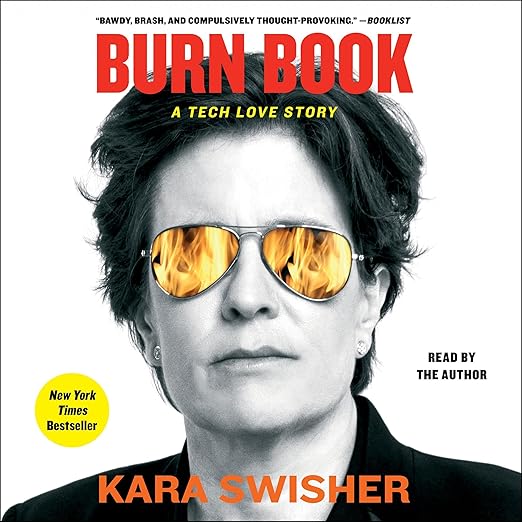
Listening in the heating ducts is the accusation one furious tech CEO leveled at Kara Swisher, and that paranoid compliment sets the tone for her Burn Book audiobook from the very first chapter. Swisher spent three decades reporting on Silicon Valley's rise, from the early digital sector coverage she did for The Washington Post through her Wall Street Journal years alongside Walt Mossberg and the influential D: All Things Digital conference the two of them built together, and this memoir-history hybrid collects the sharpest material from that entire run. Sheryl Sandberg herself is quoted describing internal Facebook memos written with the specific hope that 'Kara never sees this,' which tells a listener almost everything they need to know about Swisher's reputation inside the rooms she covered.
Part memoir, part institutional history, this book works because Swisher never pretends to be a neutral observer of the industry she spent thirty years covering; she names her own access, her own relationships, and her own evolving frustration with an industry that promised to change the world and, by her own account, broke a fair amount of it instead. The interview list alone is remarkable: Steve Jobs, Jeff Bezos, Elon Musk, Bill Gates, Sheryl Sandberg, Bob Iger, Larry Page, Sergey Brin, Meg Whitman, Peter Thiel, Sam Altman, and Mark Zuckerberg all appear, and Swisher writes about each encounter with the specificity of someone who was actually in the room rather than reconstructing it secondhand.
Reviewer Steve Willard describes the book as an autobiographical chronology of the personalities who delivered the modern internet, and that framing captures something real: this is less a chronological history of Silicon Valley than a personal account of watching it happen up close, with all the opinions that proximity naturally produces. A new afterword extends the book's reach into the current AI moment, keeping Swisher's ongoing argument, that the industry can still choose better, more thoughtful paths even after decades of damage, current rather than frozen at the book's original publication.
The book's title itself nods to the old high-school 'burn book' concept, a running ledger of who deserves credit and who deserves blame, and Swisher applies that same ledger logic to an entire industry rather than a single social circle, naming both the genuine innovations and the specific individual failures of judgment that turned utopian promises into monopolistic, occasionally reckless power.
Swisher also uses her own career arc as a structural device, tracking how the industry's ambitions shifted from her early Washington Post years covering an emerging technology as a curiosity through the wealth-creation boom she later documented as an established, feared industry voice, giving the book a genuine before-and-after shape rather than a flat chronological list of encounters.
The Strengths
Swisher narrates her own material, and this is a strong case for self-narration specifically because her public voice already exists at enormous volume, through her podcasts and years of on-camera interviews, so listeners already know exactly what register to expect before pressing play. That familiarity is an asset rather than a limitation: broadcast-honed pacing translates directly into an audiobook built from anecdote after anecdote, and her own comic timing, dry, needling, unimpressed by powerful people who expect deference, carries jokes that a neutral hired narrator would likely flatten.
Reviewer Jack Spain brings his own multi-decade tech career, going back to programming mainframes with punch cards in the 1970s, to his review, and specifically frames the book as an entertaining walk through territory he lived through himself, which is a useful signal that Swisher's account rings true even to listeners who do not need her to explain the basics. The book earns that kind of reader from both directions, insiders checking her account against their own memory and newcomers getting the story for the first time.
Her Washington Post and Wall Street Journal training also shows up structurally: chapters move with a reporter's instinct for the telling anecdote over exhaustive backstory, which keeps a seven-and-a-half-hour runtime feeling dense with material rather than padded to hit a target length.
Her years co-hosting tech podcasts and, more recently, her own shows give her a practiced sense of how to hold a listener's attention across a full-length audio project, distinct from the skill set a purely print-focused journalist would bring to narrating their own material for the first time.
Before You Commit to Burn Book
Not every listener wants quite this much personality in a business history. Reviewer Ckalba22 enjoyed the book overall but found some passages too snarky, a fair characterization of Swisher's voice throughout: she is opinionated on purpose, and readers wanting a more restrained, dispassionate account of the same decades should know upfront that restraint is not the register on offer here.
At seven hours and forty minutes, this runs shorter than a fully comprehensive Silicon Valley history would need to be, and that brevity is deliberate: Swisher is working from her own direct experience and specific encounters rather than attempting an exhaustive institutional account of every company and founder in the industry's history. Listeners wanting a complete reference-style tech history should look elsewhere; this stays personal and selective by design.
Listeners expecting equal, evenly distributed coverage of every major tech company should adjust expectations too; Swisher's own beat and access shaped which stories she tells in the most depth, so this reflects her specific reporting history rather than a comprehensive survey built from outside research.
Recommended For
Tech industry followers, journalism fans, and anyone who already listens to Swisher's podcasts will find the audiobook format a natural extension of a voice they already know, and hearing her deliver these specific anecdotes herself adds real value over reading them cold on the page. Listeners curious about how the internet's biggest personalities actually behave behind closed doors, rather than in their own carefully managed public messaging, get a genuinely rare vantage point here.
Readers wanting a neutral, academic account of Silicon Valley's rise, without a strong personal voice steering every chapter, should look toward more traditional business history instead. For anyone who wants three decades of tech history filtered through a reporter's own direct access rather than secondhand corporate messaging, this is close to definitive.