
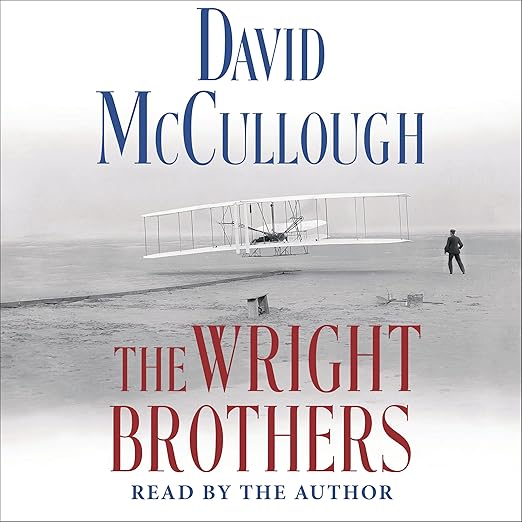
Powered flight began on a winter day in 1903, on the Outer Banks of North Carolina, and the world then took its time believing it had happened at all. That gap between the event and its acceptance is the real subject of this book, and the audiobook gives it ten hours and two minutes. The recording also carries a credit worth pausing over: the narrator field and the author field hold the same name. David McCullough reads his own account of Wilbur and Orville Wright, two bicycle mechanics from Dayton, Ohio, who had a public high school education between them and, by the description's own admission, little money.
McCullough's Own Prose, Filed Under Technology
McCullough's prose gets the compliment it deserves from a four-star assessment logged on the very day the recording was released, which calls the writing concise, thorough and unpretentious, and says plainly that it was easy to move through and easy to learn from. That last quality carries more weight in audio than on paper, because a sentence you cannot glance back at has to land the first time, and this one generally does. The same response goes on to make the case that the brothers were a product of their household before they were anything else, which turns out to be the argument the whole book is built on. What none of the five written responses touch is the reading itself. Not one line about pace, delivery, or what it is like to hear a historian speak his own sentences, which is an odd silence when the credit is the most distinctive thing on the page.
Filed under biographies and memoirs, this record also carries a second genre: computers and technology. Nothing in the book supports it. The story runs on two bicycle mechanics, a family in Dayton, and the first powered machine to carry a pilot, and it is built out of the Wright family papers rather than any engineering literature. Whoever tagged the listing seems to have reasoned backward from the general idea of invention and landed several centuries off. It is a small error with a real cost, because it drops a 1903 aviation biography into a category browsed by people looking for something else entirely, and it does nothing for the listener who would actually want this. The Historical tag attached alongside it is the only classification here doing honest work.
Katharine Wright Keeps This From Being a Two-Hander
Handwritten letters and diary entries are what a five-star assessment filed from India singles out, alongside what it describes as a very detailed account of the road to the first controlled flight. That is a fair description of the method. McCullough had the family papers and he leans on them hard, which means long stretches of this recording are people writing to each other about problems they have not solved yet, in their own words, with no idea how it turns out. Correspondence is already a spoken form, so it survives the move to audio better than summary does. The effect is that the difficult years are the ones that feel closest, and the triumph, when it comes, arrives with the flatness of something logged rather than celebrated.
Katharine Wright is the reason this never settles into a two-hander. She is in the book by name, and the case made for her is that without her things might well have gone differently for her brothers, which is a stronger claim than most family biographies risk. A five-star assessment from December 2015 comes at the story from the opposite end, framing flight as something enthusiasts had chased long before, often at the risk of their lives, so that the Wrights arrive as the pair who finally converted a shared obsession into a machine. Both framings live inside the same ten hours, and the second is the one that explains why the news travelled so slowly once the thing actually flew.
The Last Forty Percent Turned Very Boring
Fame is where one listener's interest fell off a cliff, and the four-star assessment from the Netherlands puts numbers on the drop: the first sixty percent or so held up, and the last forty percent, once the brothers had become famous, turned very boring. That is a structural warning worth taking seriously in a format where skimming is not really available to you. The later stretch trades workshop problems for receptions, honors and public recognition, and the tension that powered the early chapters does not have an obvious replacement. If the appeal for you is watching two people solve something nobody had solved, be aware that the solving finishes well before the recording does.
Ten hours and two minutes is a genuine commitment, and the listing does surprisingly little to help you judge it. The final paragraph of the description hands a pull quote to four separate publications in a row, which is a bestseller's copy rather than a listener's: you come away knowing the book was admired without knowing much about its shape. For the record, the shape is chronological, close to the household, and stops while the story of aviation is still in its opening act.
The Joy of Flying Coming Back, in One Line
Bicycle mechanics with a public high school education and almost no capital are an unlikely pair of protagonists, and that is precisely the appeal for the audience this suits: anyone who enjoys watching competence assemble itself out of nothing in particular. A five-star assessment from Germany reduces the whole effect to one line about the joy of flying coming back, which is about as concise a recommendation as this kind of history gets. If you have ever stayed at an airport window longer than you needed to, that reaction is the one this recording is chasing, and it earns it in the middle third.
Skeptics of the great-man story will find less to argue with here than they might expect, because the household does real work in the telling and Katharine stays in the frame rather than appearing once as a footnote. Where the recording will lose people is the back half and the runtime working against each other: ten hours is a long time to give a narrative that front-loads its tension, and the world's slowness to believe what had happened is itself part of that back half. Listeners who want the invention and not its reception should weigh that before starting, and should probably accept that they will finish this one in the middle rather than at the end.
- Voice: The byline and the reading credit are the same person, David McCullough, which is uncommon for a ten-hour trade biography.
- Big ideas: Invention against long odds, family as workshop, the slow public acceptance of a proven fact
- Atmosphere: Patient and workmanlike, with real lift through the middle third
- Worth it?: Worth the ten hours if the problem-solving is what draws you, though the fame chapters are a longer sit.







