
Quick Take
- Read by: Jacques Roy narrates over 17 hours of research reviewers repeatedly call thriller-paced despite covering settled history.
- At its heart: NASA institutional failure, exclusion of women and Black astronauts from the space program, real-time disaster reconstruction
- Vibe: Tense and thoroughly researched
- Short version: A meticulously researched, thriller-paced history best paired with the author's earlier Midnight in Chernobyl.
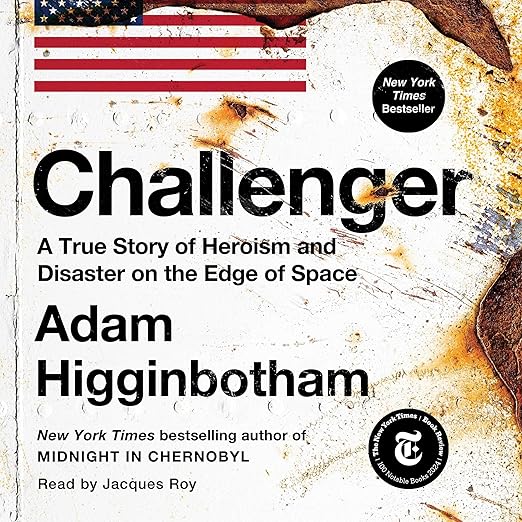
Challenger arrives with an unusually loaded resume for an audiobook: winner of the National Book Critics Circle Award in Nonfiction, winner of the Kirkus Nonfiction Prize, shortlisted for the Andrew Carnegie Medal for Excellence in Nonfiction, and a New York Times Notable Book, on top of bestseller status. Jacques Roy narrates just over 17 hours covering the shuttle disaster that killed all seven people aboard on January 28, 1986, published by Simon & Schuster Audio, billed as the 'definitive' account of the disaster.
Critical reception matches the awards just as well. The Atlantic called it 'Stunning' and 'a heart-pounding thriller,' declaring 'Challenger is a remarkable book.' The New York Times called it 'Devastating' and 'a universal story that transcends time.' The Wall Street Journal went with 'Dramatic' and 'a moving narrative.' The Washington Post's blurb gets more specific about the reporting itself, praising work that is 'compelling, and exhaustively researched.'
That synopsis leans on the scale of the story as much as its details, comparing it directly to a defining national trauma: 'Like the assassination of JFK, the Challenger disaster is a defining moment in 20th-century history,' one that, as the synopsis puts it, 'forever changed the way America thought of itself and its optimistic view of the future.' The account is built on 'fascinating and new archival research,' and follows, among others, 'each of the seven members of the doomed crew,' including New Hampshire schoolteacher Christa McAuliffe, whose death millions of Americans witnessed.
Reviewers keep reaching for thriller comparisons despite this being a work of history. matt calls both this book and the author's previous one, Midnight in Chernobyl, 'superbly written and researched,' adding that 'it's not an exaggeration to say they are page turners that can keep the reader up late at night.' William de Rham goes further, placing Challenger alongside 'The Right Stuff,' 'Apollo 13,' 'A Man on the Moon,' and 'The Six' as comparable reportage, though that same review misnames the author as 'Andrew Higginbotham's' rather than Adam Higginbotham.
M. Chapman's five-star review makes a similar slip, crediting 'Adam Higgenbotham's account' rather than spelling the surname correctly, before praising the level of technical detail: 'the shockingly cold morning of launch day immobilized the rubber seals in the solid rocket boosters, letting hot gasses escape and causing the disintegration of the shuttle and the loss of the crew.' Tyler Keay's review adds a third small discrepancy to the pile, referring to the author's earlier book as 'Midnight at Chernobyl' rather than Midnight in Chernobyl, though the underlying recommendation is unambiguous: 'If you have read Midnight at Chernobyl it's as good or better.'
Roy Narrates Seventeen Thriller-Paced Hours
Jacques Roy narrates over 17 hours of research reviewers consistently describe as thriller-paced despite the outcome being historical record. JS's more measured review still concedes 'the story is passionately told and hits all the important notes,' even while noting 'Nothing in this book overturns the accepted wisdom on Challenger.' That combination, familiar facts delivered with genuine narrative drive, is exactly what a strong audio narrator can amplify.
JS's review also highlights a specific thread some listeners might not expect from a book centered on one disaster: 'the additional story of why women and African Americans didn't go to space seemed unrelated to the disaster but was a very important thing to learn.' matt's review supplies the personal-history angle from the other side, remembering being 'a child of the space program' when 'the TV carts were wheeled in the classroom so the class could watch' the era's launches, a detail that dates the book's likely core readership as much as it evokes the period. matt's review adds one more specific personal memory from the same stretch: growing up, 'NASA, and the accomplishments of our astronauts were idolized by me and so many of my generation,' context that helps explain why a story this well documented still lands emotionally for readers who lived through the era.
Beyond the human toll, the synopsis also promises an investigation narrative, describing 'an investigation driven by leakers and whistleblowers determined to bring the truth to light,' plus attention to 'the designers, engineers, and test pilots who struggled against the odds to get the first shuttle into space,' figures usually left out of a disaster's headline story.
A Single Vote Beside Five Written Reviews
A rating counter here shows a single vote at 4.7 beside five separate written reviews, worth a quick, plain mention: a lone whole-star vote cannot mathematically produce that decimal average, so the badge and the review section are clearly out of sync. More noteworthy than the arithmetic is the pattern in the name errors above: two different reviewers get the author's name wrong in two different ways, and a third gets the earlier book's title wrong, a small but consistent sign that these are genuine, quickly typed reactions rather than polished, fact-checked write-ups. The synopsis is also candid about the disaster's most damning thread: 'the ominous warning signs of a tragedy to come, recognized but then ignored, and later hidden from the public.' That framing sets up institutional failure, not just mechanical failure, as the book's real subject, which tracks with JS's point about NASA's resistance to change.
JS's review closes on a format preference worth passing along: 'I wouldn't want to squeeze this book into my physical library but I enjoyed reading it on Kindle,' a reminder that a 17-hour, detail-dense history like this one carries real physical or storage weight in print that audio and e-readers simply sidestep.
Closer to Comprehensive Than to Concise
Readers of Midnight in Chernobyl are the obvious next step, and reviewers treat the two books as a matched pair: Tyler Keay's recommendation, typo in the title aside, applies to exactly that audience. Anyone drawn to detailed disaster histories that read like thrillers, per matt and JS both, without needing invented drama layered on top of real events, should find this one delivers. Listeners who prefer character-driven history to a dry procedural should also find that structure appealing: the synopsis promises a story built around 'a handful of central protagonists,' not just a timeline of mechanical failures, which matches how reviewers describe the actual experience.
Those wanting new revelations that overturn the established record should calibrate expectations against JS's specific caveat that nothing here contradicts 'the accepted wisdom on Challenger.' Anyone who prefers a slim, tightly focused account should know this runs over 17 hours, closer to comprehensive than concise.
Does Challenger assume listeners already know the outcome of the disaster?
Yes, and that is by design. The synopsis and every review treat the Challenger disaster as well-known history, with reviewers like JS confirming 'nothing in this book overturns the accepted wisdom.' The value here is in the minute-by-minute reconstruction and new archival detail, not narrative suspense about what happens.
Why do so many reviewers misspell Adam Higginbotham's name or the title of the earlier book?
It happens twice with the author's name: William de Rham writes 'Andrew Higginbotham' and M. Chapman writes 'Adam Higgenbotham.' It happens once with the earlier book's title, which Tyler Keay calls 'Midnight at Chernobyl' instead of Midnight in Chernobyl. All three read like quick typing slips rather than confusion about which book is being discussed.
Is the Challenger audiobook worth it if I've already read Midnight in Chernobyl?
Reviewers treat the two as a natural pair rather than redundant. matt, who read both, calls each 'superbly written and researched,' and Tyler Keay's recommendation assumes a reader moving from one to the other. The subject matter is unrelated, so familiarity with one book does not reduce the value of the other.
Does the Challenger audiobook cover more than just the 1986 disaster itself?
Yes. JS specifically calls out a thread on why women and African Americans were excluded from early spaceflight as a highlight, calling it 'a very important thing to learn' despite being 'unrelated to the disaster.' The synopsis also frames the book around the broader shuttle program and its engineers, not just the disaster itself.







