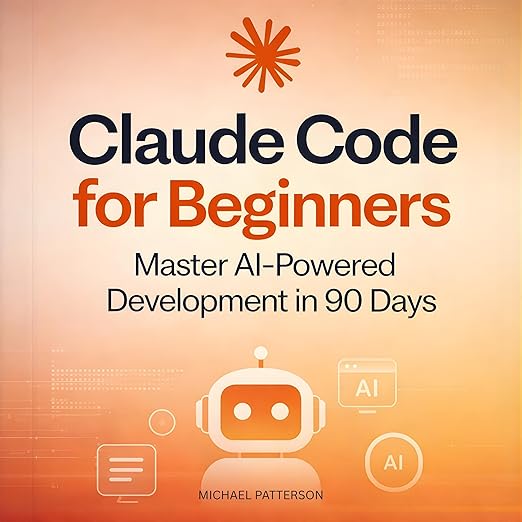
Michael Patterson's Claude Code for Beginners arrives with a specific and ambitious promise: a complete roadmap to AI-assisted development for complete beginners, structured across a ninety-day curriculum, delivered by someone who leads 120 engineers at a major tech company. This audiobook, narrated using Jon Mills's voice replica, an AI-generated narration disclosed in the metadata, is aimed at a broad audience: entrepreneurs with software product ideas, career changers seeking entry to the tech industry, and professionals who want to automate their workflows without hiring a developer. The scope is genuinely wide, covering responsive websites and React Native mobile apps through to database design, Stripe payment integration, and professional DevOps practices.
That scope is both the book's selling point and its most significant challenge in audio. Technical education in any format requires the learner to see what the instructor is doing. In print, that means screenshots, diagrams, and code samples. In video, it means watching a terminal and seeing the output update in real time. In audio, it means describing those same things verbally and hoping the description is precise enough to be useful. Patterson attempts this across four hours and fifty-three minutes, and the single available review is specific about where the attempt falls short.
Melvin Neo's Complaint Is About Format
The sole review, a one-star rating, is direct: 'An AI topic explained without images or code examples makes it almost useless in practice.' Reviewer Melvin Neo is not critiquing the book's conceptual content; he is critiquing the format decision. The absence of visual supplements in a coding tutorial is a structural problem that no amount of skilled narration can fully compensate for. A listener who has never written code cannot follow an audio description of a React component's file structure or a database schema with the same clarity they would gain from seeing it rendered on a screen.
This is a real limitation worth acknowledging directly. Patterson's credentials are not in question, and the curriculum he outlines, moving from fundamentals to full-stack web development to mobile apps to monetized products across ninety days, reflects genuine expertise in how modern AI-assisted development actually works. The framework he proposes, using Claude Code as a development partner rather than a magic code generator, is the right frame. But the delivery mechanism of audio-only instruction for a hands-on technical skill has a ceiling that this book appears to hit in its first available review.
Mills's Voice Replica Is Disclosed Upfront
The AI-generated narration using Jon Mills's voice replica will be audible to listeners familiar with Mills's human performances; the texture is not identical to a live human reading. For listeners who are not familiar with Mills as a narrator, this distinction is less significant, and the voice replica delivers the instructional content with clarity and appropriate pacing for a technical guide. This is worth disclosing rather than obscuring: AI-generated narration is a production choice with quality implications that vary by implementation.
The audiobook's strongest use case is as conceptual orientation rather than hands-on instruction. Listeners who already understand the technical domain in broad strokes and want a framework for thinking about AI-assisted development workflows may find more value than absolute beginners who need to see what they are building. The ninety-day structure, breaking into month-long phases of increasing complexity, provides a useful mental scaffold for self-directed learning even if the audio format cannot deliver the granular code-level instruction the title promises.
Prompt Engineering Translates, Payment Setup Doesn't
The sections on prompt engineering for developers are the most audio-friendly material in the book. The conceptual principles of instructing an AI coding assistant, clarity, specificity, iteration, are verbal skills rather than visual ones, and Patterson's treatment of this is the dimension of the curriculum that audio can deliver effectively. Listeners who focus on this section and treat the rest as a high-level map of the technical territory may leave with more practical value than those who expect full instructional coverage.
The payment integration and DevOps sections in the ninety-day curriculum are worth particular attention for listeners with product ambitions. Patterson's background leading engineering teams gives these sections a practitioner's specificity that distinguishes them from generic intro-to-coding content. The challenge, again, is format: the specific commands, file structures, and configuration steps that make these sections actionable in practice are not fully transferable through description alone. The audiobook works best as a companion to hands-on experimentation, not a replacement for it.
Mental Framework Wins Over Step-by-Step Coding
Listeners who want a conceptual overview of AI-assisted development and a mental framework for the ninety-day learning arc will find more value here than those expecting a step-by-step technical tutorial. The book describes a plausible path from no coding knowledge to production-ready applications, and Patterson's credibility as a practitioner gives that description genuine authority.
Absolute beginners who have never written code and are hoping to follow along with a coding audiobook in real time should proceed with caution given the single available review. The absence of visual supplements is a real constraint that reviewer Melvin Neo identified accurately. Those committed to learning AI-assisted development would likely benefit more from video tutorials with accompanying repositories where the code is visible, perhaps using this audiobook as a planning document rather than an instructional one. The ninety-day curriculum is a genuinely useful framework for thinking about the learning arc; the audio format is not the right delivery mechanism for the hands-on work that curriculum requires.
Questions Listeners Ask
What is Jon Mills's voice replica, and does it affect the audiobook experience?
Jon Mills is a well-known audiobook narrator, and this production uses an AI-generated replica of his voice rather than a live human performance. Listeners familiar with Mills's natural delivery may notice the difference in texture. For those unfamiliar with him as a narrator, the distinction is less significant, and the voice replica delivers the instructional content with adequate clarity for a technical guide.
The book promises to take complete beginners to production-ready apps in 90 days. Is that achievable just from this audiobook?
The single available review gives it one star specifically because the audiobook format cannot deliver the visual instruction that hands-on technical learning requires. Code examples and visual references are absent. The 90-day transformation is a curriculum framework the audiobook describes conceptually, but the actual skill-building will require visual tools, code editors, and practice environments that the audio format cannot provide.
Is Claude Code for Beginners appropriate for someone who already knows how to code?
It may offer more value to someone with existing technical context. The conceptual framework of using Claude Code as a development partner and the discussion of prompt engineering for developers are the most audio-accessible sections, and someone who already understands the technical domain can treat the audiobook as a planning document for an AI-assisted workflow rather than a foundational tutorial.
Given the single one-star review, is this audiobook worth listening to?
Proceed with caution. The reviewer's specific objection, no images or code examples in a coding tutorial, identifies a real structural limitation of the audio format for this type of content. Patterson's credentials are genuine and the 90-day curriculum is coherent in concept, but listeners expecting step-by-step technical instruction deliverable through audio alone should adjust their expectations before purchasing.