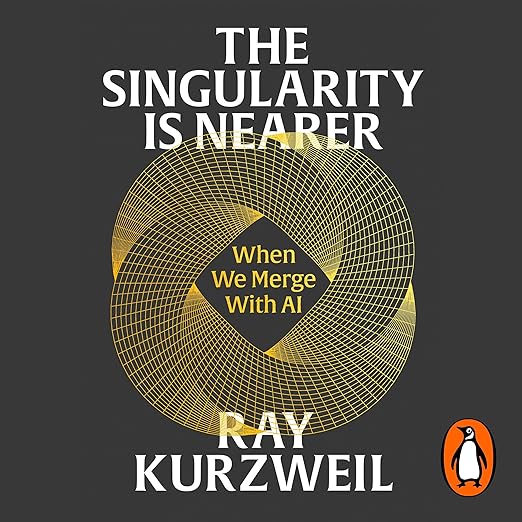
Ray Kurzweil has been making long-range predictions about artificial intelligence for more than sixty years, and his track record is unusual enough to demand serious attention. The Singularity Is Nearer, the updated successor to his landmark 2005 work and narrated by Adam Barr as an audiobook for Penguin Audio, arrives at a moment when several of Kurzweil's earlier predictions about AI capability have landed on or ahead of schedule. The central argument is specific: by the end of this decade, AI will exceed human intelligence across most domains; by the 2030s, it will become superintelligent, vastly outstripping human capabilities; by 2045, brain-computer interfaces will enable cognitive enhancement on a scale that makes current human intelligence look like a first draft.
The craft of this book lies in how Kurzweil builds his case. Rather than asserting these timelines speculatively, he grounds them in historical data on computational growth, biological research trajectories, and the demonstrated acceleration of multiple converging technologies. The foundation is what he calls the Law of Accelerating Returns, the observation that exponential improvement curves, once established, tend to maintain their trajectory regardless of the specific technology involved. Whether you find this compelling or overconfident will likely determine your experience of the entire audiobook.
Kurzweil is both the book's greatest strength and its central limitation. His depth of knowledge across neuroscience, computer science, and biotechnology is genuinely exceptional, and the historical data he marshals in support of his predictions is more rigorous than most popular science books manage. Bill Gates' endorsement of him as the best predictor of AI's future is not mere blurb copy; it reflects a track record that genuinely distinguishes Kurzweil from futurists who work primarily from intuition.
But one reviewer on record identified what is perhaps the book's most significant blind spot with precision: Kurzweil downplays risks because he wants to live forever. That observation deserves more than dismissal. Kurzweil has been explicit for decades about his personal investment in the Singularity arriving before his death, and that motivation does appear to shape his risk assessments. He engages with concerns about superintelligent AI, but consistently lands on optimistic resolutions that critics focused on alignment risk would find insufficiently rigorous. Yuval Noah Harari, a blurb contributor, is on record raising profound philosophical questions about these trajectories, and Kurzweil's answers to those questions are not always fully satisfying in this audiobook. Mustafa Suleyman's endorsement as essential reading reflects a different set of priorities, more interested in understanding the trajectory than in weighing its risks.
Barr's Measured Authority Suits Extraordinary Claims
Adam Barr is a strong choice for this material. He brings the kind of measured authority that suits a book making extraordinary claims through methodical evidence, never performing excitement in ways that would undermine the analytical tone Kurzweil maintains throughout. The more technical sections, particularly those covering neurological architecture and computational substrate, are dense even in print; Barr's clarity of diction and deliberate pacing make them navigable in audio.
At ten hours and twenty-five minutes, the audiobook is significantly condensed from the full scope of Kurzweil's argument in print. Listeners coming to these ideas for the first time will find this an efficient introduction. Those already familiar with the original Singularity Is Near may notice where the update substantiates earlier claims with more recent data versus where it revisits older arguments without substantial revision. Both responses are reasonable, and the audiobook serves both audiences well with Barr's consistent, authoritative delivery throughout.
Nanobots and Immune Enhancement Spark Debate
The sections covering biological intervention in the 2030s are where Kurzweil's argument becomes most provocative and most contested. His claims about nanobots, immune system enhancement, and cognitive augmentation are not science fiction; he grounds them in current research trajectories. But the leap from current capability to 2030s deployment involves assumptions about regulatory, economic, and social adoption that Kurzweil treats more optimistically than the evidence strictly supports.
Also worth careful attention is his treatment of consciousness and subjective experience. The question of whether a digitally stored mind is the same person who was scanned is one that Kurzweil addresses directly, and his answer is more nuanced than critics of digital immortality typically acknowledge. Reviewer Michael E. Martin praises the book for examining historical trends to project forward, and that methodology is worth tracking consciously as Barr reads it, since understanding the logical structure makes the predictions more evaluable on their own terms.
Essential for the Optimistic Case on AI
This audiobook is essential for anyone in technology, policy, or research who wants to engage seriously with the most influential optimistic case for artificial intelligence's near-term trajectory. Agreeing with Kurzweil's conclusions is not required to benefit from understanding his argument at depth; knowing the best version of the case for rapid AI advancement is useful regardless of your own position on the risks.
Listeners who want a counterweight to Kurzweil's optimism would do well to pair this with more risk-focused work on AI alignment before forming conclusions. Those primarily interested in practical implications of current AI tools rather than forty-year projections may find the timescales too remote for their immediate concerns. But as an exercise in rigorous long-range thinking about technology backed by a genuine track record, The Singularity Is Nearer sets a benchmark that other futures books struggle to match. The act of listening to Barr read Kurzweil's compounded certainties across ten hours is its own kind of challenge to assumptions, whether you finish it persuaded or more skeptical than when you started.
In Brief
- Read by: Adam Barr brings measured authority to Kurzweil's dense predictions, making the technical sections navigable without losing the book's sense of accumulated urgency.
- At its heart: Exponential AI growth, cognitive enhancement, the ethics of superintelligence
- Vibe: Dense and visionary, occasionally vertiginous
- Short version: The most influential optimistic case for near-term AI transformation, read skeptically and with awareness of the author's personal stakes in the outcome.
Good to Know
How does The Singularity Is Nearer compare to Kurzweil's original The Singularity Is Near?
It functions as an update rather than a revision. Kurzweil incorporates developments since 2005, particularly in AI capability and biotechnology, to substantiate earlier predictions that have since proven accurate. Listeners familiar with the original will notice where the new data strengthens the case versus where older arguments are revisited without substantial revision. New listeners can engage this audiobook without the earlier book.
Does the audiobook edition handle the technical material well?
Yes. Narrator Adam Barr brings measured authority to material that is genuinely dense in neuroscience, computer science, and biotechnology. Barr's clarity of diction and deliberate pacing make the technical sections navigable in audio without oversimplifying the content. Reviewer Michael E. Martin praises the book as a page-turner despite its complexity, and that quality comes through in the audio production.
Is this audiobook's optimism about AI a problem if I'm more concerned about AI risks?
One reviewer identifies this limitation directly: Kurzweil downplays risks because of his personal investment in the Singularity arriving during his lifetime. That bias is real and worth keeping in mind. The audiobook is most valuable if read as the strongest available case for AI optimism, engaged critically rather than accepted uncritically. Pairing it with alignment-focused perspectives will give a fuller picture.
Can someone without a technical background follow this audiobook?
Reviewer Mike Dillemuth, describing himself as a reader who wanted better AI understanding, found it accessible and broader in scope than expected. The Law of Accelerating Returns framework is explained conceptually rather than mathematically, and the biological and social sections are written for general audiences. Technical background helps with some sections but is not required to follow the core argument.