Before You Press Play
- Narrator: Megan Tusing delivers a clean, authoritative read that keeps the Silicon Valley drama moving at pace, her pacing suits the book's journalistic rhythm without overplaying the corporate intrigue.
- Subjects: Platform power and corporate control, creativity vs. growth-at-all-costs, the cost of acquisition
- Tone: Sharp and propulsive, with the weight of something larger than a company story
- Bottom line: Sarah Frier's account of Instagram's rise and absorption into Facebook is one of the most precise pieces of tech journalism to land in audio form, required listening for anyone who has ever used the app and wondered how it became what it is.
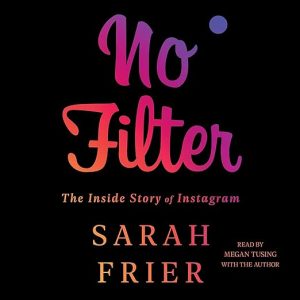
Sarah Frier's No Filter won the 2020 Financial Times and McKinsey Business Book of the Year Award, and this audiobook version narrated by Megan Tusing makes it easy to understand why. I came to it skeptical, Instagram origin stories have a way of flattening into hagiography or boardroom gossip, but what Frier has built here is something closer to an autopsy of a culture, not just a company. The question she really wants answered is not how Instagram became worth a billion dollars. It is what happened to the thing Kevin Systrom and Mike Krieger actually built, and whether it could have survived contact with the machine that bought it.
Thirteen Employees at a One-Billion-Dollar Price
Frier's access is remarkable. She spoke to the founders themselves, to Kris Jenner of the Kardashian empire, to Anna Wintour of Vogue, to influencers across multiple industries, and to people inside Facebook who watched the dynamic shift in real time. What No Filter does well is show the collision between two very different ideas of what a platform should be. Systrom and Krieger believed in restraint. They resisted the grow-at-all-costs mandate that made Facebook a juggernaut, preferring instead a strategy built around beauty, creativity, and what the book describes as the company's relationship to celebrity culture. That resistance is what makes the story fascinating, and Frier never lets you forget that the people involved were trying to protect something they genuinely believed in.
The Facebook acquisition at one billion dollars, when Instagram had just thirteen employees, is the hinge on which everything turns. Reviewers who called this the best acquisition since Microsoft bought a comparable property are not wrong on the business logic. But Frier is less interested in the deal memo and more interested in what Zuckerberg's deepening control meant for the people who stayed on to run the company they had built. The moment when his support of the founders' autonomy curdled into something more threatening arrives with genuine narrative force, even for listeners who already know the broad outlines of what happened.
Tusing's Journalist Authority Beats Performer Color
The audio format suits this book particularly well. Frier's prose is direct and propulsive, and Megan Tusing reads it with the authority of a journalist presenting documented facts rather than a performer adding color. The chapter structures are tight, each one moves between reported scenes and analytical passages without losing momentum. At eleven hours and twenty minutes, it covers an enormous amount of ground: the cultural impact of the square photo format, the evolution of the influencer economy, the psychological architecture of likes and filters, and the broader question of how a platform designed around aspiration shaped the way people understand beauty, travel, food, and identity in daily life.
One reviewer called it the sequel to The Social Network, which is a useful frame. But No Filter is less interested in founding mythology and more in what happens after the triumph, when the thing you built becomes a tool in someone else's hands. Frier's reporting on how Instagram functioned inside Facebook, with employees trying to maintain the brand's distinctiveness against a parent company that wanted deeper integration, is the section that lingers longest after the listening ends. The phrase about Instagram's relationship to our desire for perfection is not rhetorical packaging. It is the actual thesis of the second half of the book, pursued through reporting rather than assertion.
Structural Analysis Outweighs a Simple Villain Sketch
Pay attention to the section on the influencer economy's emergence as a distinct professional ecosystem. Frier traces how Instagram created an entirely new category of career, and how the platform's choices, algorithmic and aesthetic, shaped who could build an audience and how. The dynamic between the founders and Zuckerberg deserves close listening in the middle third: the moments where the co-founders thought they had protected their independence, and the moments where that protection quietly eroded, land harder because Frier lets the timeline do the work rather than editorializing around it.
One reviewer noted that No Filter is an affirmation that Facebook is powerful but not good. That is a reasonable reading, but it undersells the nuance Frier brings to the question. Her portrait of Zuckerberg is not a villain sketch. It is a study of a particular kind of ambition, and the way scale changes what a product can afford to care about. The book is most valuable not as a takedown but as a structural analysis of what gets lost when a community platform becomes a global infrastructure product. Listeners who came up in the early years of Instagram, when accounts were smaller and the aesthetic still felt genuinely distinct from what followed, will recognize exactly what Frier is describing.
Corporate History Where Creators Are Evidence
If you work in tech, media, or marketing and have not read No Filter, this audiobook is the efficient way to close that gap. It is equally well-suited to anyone who watched Instagram change over the past decade and wants a rigorous account of why. Readers who enjoyed Brad Stone's The Everything Store or John Carreyrou's Bad Blood will find Frier's forensic approach familiar and satisfying. Those expecting a deep dive into the creative side of influencer culture should know this is primarily a corporate and cultural history, the individual creators appear as evidence of larger dynamics, not as protagonists in their own right. But as a piece of reported journalism about how a single platform shaped a decade of visual culture, No Filter remains the definitive account.
Frequently Asked Questions
Does the No Filter audiobook cover events after Kevin Systrom and Mike Krieger resigned from Instagram?
The book primarily covers the arc from Instagram's founding in 2010 through the founders' departure in 2018. Frier focuses on the buildup to that departure rather than the aftermath, making the exit feel like the natural culmination of everything she has reported.
How does No Filter compare to other audiobooks about social media companies?
It sits closest to Nick Bilton's Hatching Twitter in its focus on founder relationships and internal tension, but Frier's cultural analysis, how Instagram changed aesthetics, food, travel, and celebrity, gives it a wider scope than most tech company histories.