Quick Take
- Narration: Paul Boehmer brings a confident and warm professional delivery that suits Kawasaki’s friendly-but-direct advisory voice, keeping the eight-hour runtime from feeling padded.
- Themes: Entrepreneurship and venture creation, the social media era startup, building meaning into organizations
- Mood: Energizing and pragmatic, with a California-tech optimism that is neither naive nor hollow
- Verdict: A substantially updated and still-useful startup guide, and Boehmer’s narration makes it one of the more listenable business titles at this length.
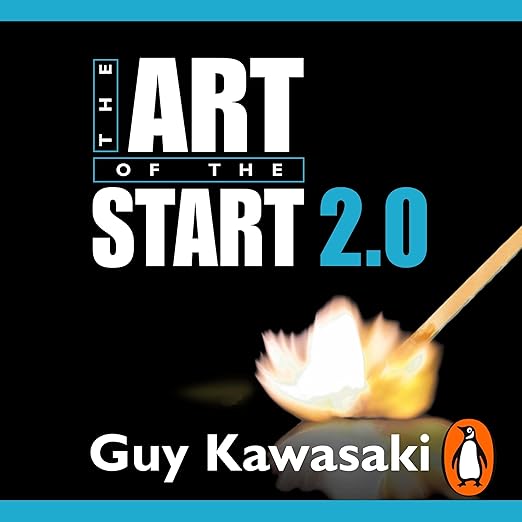
The first edition of The Art of the Start was published in 2004, which means Guy Kawasaki wrote the original at a moment when YouTube did not exist, Facebook was still a college network, and the iPhone was three years away. The 2015 revision, this second edition, caught up with a decade’s worth of startup infrastructure, including social media, crowdfunding platforms, and cloud computing. Whether that update holds up a decade later is a fair question, and the honest answer is: mostly, with some visible age around the edges.
I worked through this one over the course of a week of morning walks, which turns out to be a particularly good format for Kawasaki’s chapter structure. He writes in a way that forecasts what he is about to cover, covers it, then summarizes, which one reviewer described as particularly helpful for reading through distractions and interruptions. In audio during a commute or walk, that structure means you can tune back in after losing focus without losing the thread. It is not accidental design; Kawasaki clearly understands how people actually consume this material.
What Holds Up from the 2015 Update
The book’s enduring contribution is not the platform-specific tactics, which age regardless of how frequently revised, but the principles underneath them. Kawasaki’s insistence that a business has to mean something beyond making money before it can generate the kind of employee and customer loyalty that survives hard periods remains accurate. His description of what a pitch deck actually needs to communicate to investors, which he grounds in real experience from his time at Apple and as a venture capitalist, is less crowded with caveats than most pitch advice because it comes from someone who has been on both sides of those conversations many times.
The chapters on social media are where the 2015 update shows its age most clearly. The specific platforms and tactical recommendations for Twitter, Google+, and the early Instagram era have been overtaken by algorithmic changes, platform deaths, and the arrival of TikTok and newer distribution channels. Listeners who understand that these sections require updating will still extract value from the strategic principles underneath the tactics; listeners who take the specific recommendations literally may find some guidance now counterproductive.
The Entrepreneurship Framework That Actually Works
Kawasaki structures the book around the full startup life cycle, from the initial idea and positioning through building a team, making a pitch, recruiting, fundraising, and eventually managing growth. This comprehensiveness means no single section goes as deep as a specialized book on any one topic, but the value is in the integrated picture. One reviewer described their head nearly exploding halfway through from the density of information, which is the intended effect: Kawasaki is trying to give you the complete map rather than a deep dive on one road.
The section on making meaning rather than just making money is probably the most frequently cited by readers and listeners who return to it over years of building things. Kawasaki’s argument that you need a cause worth the effort before you can recruit the people and sustain the commitment required to succeed is neither idealistic nor commercial; it is pragmatic. Companies that do not have an answer to the meaning question tend not to survive their first serious crisis.
Paul Boehmer’s Narration and the Eight-Hour Ask
Boehmer is a reliable professional narrator with a clean, warm delivery that suits Kawasaki’s accessible and informal register. The writing is described in one review as “friendly and informal without being cutesy,” and Boehmer matches that quality. He does not overperform the energy in more exhortatory passages, which keeps the motivational moments from tipping into self-parody. At 8 hours and 43 minutes, the runtime is long enough for a full-length business book, and Boehmer’s steady pacing prevents it from feeling longer than it is.
Who Should Listen and Who Should Skip
Valuable for: aspiring entrepreneurs at the idea or early stage, people working within organizations who want to think more entrepreneurially about internal initiatives, and anyone who wants an integrated startup framework rather than point-specific advice. Those further along in building a company may find some sections cover ground they already know; the sweet spot is the genuinely early stage. Some tactical content around social media will require mental updating, but the principles framework around it is worth the eight hours.
Frequently Asked Questions
Is The Art of the Start 2.0 significantly different from the original 2004 edition?
Yes. The 2015 revision adds substantial new content on social media, crowdfunding, and cloud computing, which did not exist or were not mainstream when the first edition was published. The core principles around building meaning, making pitches, and managing growth carry over from the original, but the tactical chapters were substantially rewritten for the current startup environment.
Does the social media content from the 2015 revision still apply in 2025?
Partially. The strategic principles around building audience and community online hold up, but specific tactical recommendations for particular platforms reflect 2015 conditions. Google+ no longer exists, Twitter has changed fundamentally, and new platforms have emerged. Listeners should treat the platform-specific content as a framework requiring mental updating rather than current best practice.
Does Guy Kawasaki narrate this himself, or is the narration handled by Paul Boehmer throughout?
Paul Boehmer narrates throughout. Kawasaki does not self-narrate this edition. Boehmer’s delivery is clean and appropriately energetic for the material, and his voice suits Kawasaki’s friendly-direct advisory style.
Is this book useful for someone building within a large organization rather than a startup?
Yes, and Kawasaki addresses this explicitly. The subtitle’s reference to making ideas stick within any organization reflects his awareness that entrepreneurial thinking applies to intrapreneurs and change agents inside existing companies. The sections on making meaning, recruiting, and pitching translate to internal contexts with modest adaptation.