Quick Take
- Narration: Virtual Voice, and at 2.5 hours of SQL tutorial content, the synthetic narration is a significant impediment to the step-by-step instructional format this material requires.
- Themes: SQL fundamentals, beginner database setup, practical query building
- Mood: Aspirationally warm, practically limited
- Verdict: A short SQL primer whose audio format works against its core purpose; the hands-on learning the synopsis promises requires a screen, not headphones.
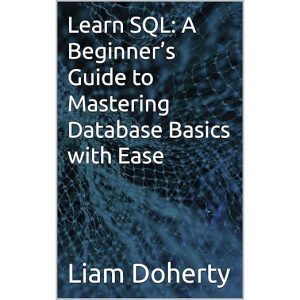
There’s a recurring tension in technical audiobooks that this title crystallizes particularly sharply. Learning SQL is fundamentally a hands-on activity. You write a query, you run it, you see what the database returns, you modify the query, you run it again. That feedback loop is how the skill actually develops. An audiobook narrator, synthetic or otherwise, can describe that process but cannot replicate it, and at 2.5 hours, Learn SQL by Liam Doherty doesn’t have enough runtime to do much more than gesture toward the concepts before the recording ends.
The synopsis is written in an enthusiastic register that promises quite a lot. The phrase zero to SQL hero appears. There are references to building practical tools like a task tracker and troubleshooting with ease. The book is described as the only resource you’ll ever need. That kind of promotional language in a synopsis is worth reading with some skepticism, particularly for a short beginner’s guide to a skill that takes sustained practice to develop.
The Structural Contradiction of SQL in Audio
The synopsis explicitly recommends keeping the Kindle edition open on one device while coding on another, which is an honest acknowledgment that the book works best as a visual companion to hands-on practice. That’s a reasonable design for the ebook format. For the audiobook, that same recommendation becomes an unintentional admission: the audio component is, at best, secondary. You can listen while you read and code, but the listening adds relatively little that the text itself doesn’t already provide.
Virtual Voice narration compounds this. The synthetic reading of SQL syntax, table definitions, and query examples lacks the natural pacing that a human narrator would use to signal which parts of a code example deserve more attention. When you hear SELECT * FROM customers WHERE country = ‘Ireland’, a human narrator might give that line a beat, a small pause that signals this is the thing you should type. Virtual Voice presents it with the same flat cadence as the surrounding prose. For a syntax-sensitive technical language where spacing and keywords matter, that flatness is a real pedagogical limitation.
What the Content Covers in 2.5 Hours
To its credit, the book appears to cover a reasonable scope for a true beginner introduction: basic SELECT queries, table creation, joins, aggregate functions, indexes, and a project chapter focused on building a task tracker with SQLite. SQLite is a genuinely good choice for beginners, a free, serverless database that runs locally without the configuration overhead of MySQL or PostgreSQL. Recommending it reflects practical teaching experience.
At 2.5 hours, however, the coverage of each topic is necessarily light. A listener hoping to emerge from this audiobook with enough SQL to work with real data will need to supplement substantially. The book describes itself as covering everything from basics to advanced tricks, but 2.5 hours is not enough runtime to achieve that, regardless of how efficiently the material is organized. More realistic framing would describe this as a conceptual orientation to SQL, not a complete course.
The Rating Situation
A single review, at 3.0 stars, with no review text available, tells us very little and should be treated as essentially no rating data. This is a self-published title with minimal review history, which doesn’t automatically indicate low quality but does mean listeners are evaluating it without the signal that a larger review pool would provide. The book’s credentials rest almost entirely on the synopsis and the author’s self-described experience as a seasoned coder and teacher from Galway, Ireland, claims that can’t be verified from the available metadata.
What a Better SQL Audiobook Looks Like
The SQL QuickStart Guide by Walter Shields, available in this same genre, offers a useful comparison point. It runs to 4 hours, has a larger review pool with verified positive ratings, and benefits from a human narrator whose pacing can signal which examples deserve attention. The format limitations are similar, but the execution is more trustworthy based on available evidence. For someone committed to learning SQL through audio, the QuickStart Guide represents a better-validated choice.
Who Should Listen, Who Should Skip
Listen if you want a very brief conceptual orientation to SQL before diving into hands-on practice, and if you understand going in that the audio will not be your primary learning vehicle.
Skip if you expect to emerge from this audiobook with functional SQL skills. Skip if the Virtual Voice narration is a dealbreaker for technical content. And skip if you’re choosing between this and a more established SQL primer with actual reviewer validation.
Frequently Asked Questions
Can I actually learn SQL from an audiobook, or is this format inherently a bad fit for the subject?
Audio is a poor primary format for learning SQL specifically because the skill requires active practice with a database. A good SQL audiobook can introduce concepts and frame your understanding before you sit down to practice, but it cannot replace the query-debug-iterate loop that actually builds the skill. Treat any SQL audiobook as a complement to hands-on practice, not a substitute for it.
How significant is the Virtual Voice narration as a limitation for this particular content?
More significant than for most topics. SQL requires listeners to hear the difference between code syntax and surrounding prose, to notice when a query example ends and explanation begins. Virtual Voice’s flat cadence doesn’t make those distinctions well, which means a listener following along without the text will frequently lose track of what’s example and what’s explanation.
Is 2.5 hours enough time to cover SQL fundamentals meaningfully?
For a conceptual orientation, barely. For functional skill development, no. The book’s synopsis describes coverage from basics to advanced tricks, but 2.5 hours is realistically only enough to introduce foundational concepts like SELECT, WHERE, JOIN, and aggregate functions at a surface level. Expect this to be an introduction rather than a course.
How does this compare to the SQL QuickStart Guide as an option for beginner SQL learners?
The SQL QuickStart Guide has a significantly larger and more positive review pool, runs slightly longer at 4 hours, and benefits from human narration. Based on available evidence, it’s the better-validated choice for a beginning SQL listener. Both have similar format limitations relative to hands-on learning, but the QuickStart Guide has more signals of quality to evaluate.