Quick Take
- Narration: Russell Newton delivers the QuickStart Guide material with a teaching-focused clarity that matches the book’s step-by-step aspirations, though SQL examples in audio remain an inherent challenge.
- Themes: SQL fundamentals, relational database concepts, practical query construction
- Mood: Encouraging and methodical, like a patient instructor who assumes nothing and explains everything
- Verdict: The most approachable SQL primer in this format, with a well-validated review record and a structure that makes conceptual sense in audio even where hands-on practice requires a screen.
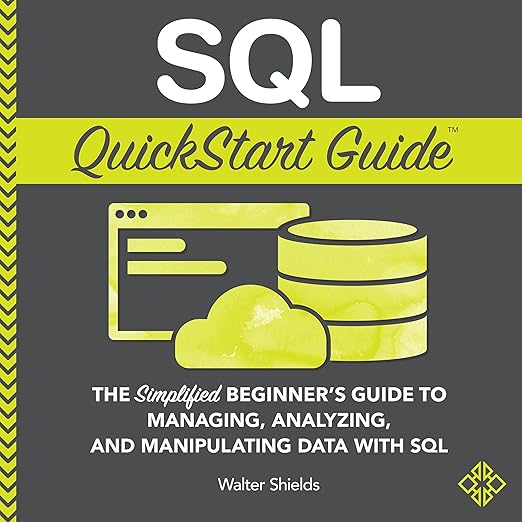
I’ve sat through enough beginner programming books that assume too much, the ones that leap from hello world to recursion in three chapters, to appreciate what Walter Shields has done differently in the SQL QuickStart Guide. He writes as someone who has watched beginners get lost and has worked backward from those failure points to construct an explanation that doesn’t take shortcuts. That quality comes through in audio in a way it doesn’t always on the page.
The book is part of the ClydeBank Media QuickStart Guide series, a series that has built a reputation for readable, well-organized beginner technical guides. The SQL entry has a 4.6 rating from a meaningful sample of reviewers, and the review content is specific: people describe it as an exceptionally accessible approach that simplifies complex concepts, a perspective written as if the reader has no prior database knowledge, and a good reference for returning SQL users who need to come back to fundamentals. That range of use cases is a good sign for a beginner guide.
The Zero-Assumption Starting Point
The reviewer who was a former database programmer returning to SQL after years away described the book as written from the perspective that the reader will have no clue on databases or SQL. That’s the right instinct for a QuickStart Guide, and Shields executes on it consistently. The book doesn’t assume you understand what a relational database is, what a schema means, or why you’d query a table instead of just opening a spreadsheet. These foundational questions get answers before the syntax does.
This matters in audio particularly. When a narrator introduces SELECT without first establishing what you’re selecting from, or why querying exists as a concept at all, listeners without prior database exposure will fall behind immediately. Shields builds that context first, and Newton’s narration maintains the explanatory patience the material requires.
The SQLite Choice and What It Enables
Like the Liam Doherty SQL primer reviewed alongside this, the QuickStart Guide uses SQLite as its practice environment. This is the right choice for a beginner guide, and both books deserve credit for making it. SQLite runs on any machine without installation complexity, doesn’t require network access to a database server, and is syntactically close enough to other SQL dialects that what you learn transfers cleanly. A reviewer specifically highlighted the free SQLite database as a feature that allowed them to follow along with examples.
That ability to follow along is where the audio format faces its recurring challenge. Newton can narrate a SELECT statement clearly, can describe what each clause does and what the expected output looks like, but the listener following exclusively in audio can’t run that query and see the result. The book’s step-by-step structure, which a reviewer praised as ensuring the listener knows what they’re doing and why every step of the way, is most valuable when you’re at a keyboard with a database open. The QuickStart Guide acknowledges this limitation implicitly by being designed to accompany active practice rather than replace it.
How the QuickStart Structure Handles SQL’s Cumulative Logic
SQL has a learning curve that’s relatively gentle at first and steeper later. Basic SELECT queries are genuinely simple. Multi-table JOINs with aggregate functions and subqueries are not. The QuickStart Guide is careful about this curve. It introduces concepts in the order they build on each other, starting with simple data retrieval, adding filtering with WHERE, introducing aggregation with GROUP BY, and then tackling JOINs as a distinct chapter with its own conceptual foundation.
This sequential design helps in audio because each chapter assumes only what the previous chapters have established. You don’t encounter a JOIN example before you understand what a table is. That sounds obvious, but many introductory SQL books violate it, rushing to sophisticated examples before the foundations are stable.
Four Hours and What They Cover
At 4 hours and 9 minutes, the QuickStart Guide is longer than the Doherty beginner’s guide but still compact for the scope it addresses. The coverage includes basic retrieval, filtering, aggregation, joins, and enough additional material to give a beginner a functional vocabulary for working with relational databases. It won’t prepare you for complex analytical SQL or database administration, but for someone who needs to write basic queries against business data, it covers the necessary ground.
The series is part of the Coding and Programming QuickStart Guides line, which means there are companion volumes for adjacent topics. The SQL guide works as a standalone, but the series context suggests it was designed to fit into a broader technical curriculum rather than serve as a comprehensive reference.
Who Should Listen, Who Should Skip
Listen if you’re new to databases and SQL and want a conceptual introduction with enough structure to support parallel hands-on practice. Listen if you’re returning to SQL after time away and want a refresher that doesn’t condescend. Listen if you want the most reliably reviewed SQL beginner guide in this format.
Skip if you already have SQL experience and are looking for intermediate or advanced material. Skip if you expect the audio alone to develop your query-writing skills without parallel practice on an actual database.
Frequently Asked Questions
How does the SQL QuickStart Guide compare to Learn SQL by Liam Doherty for a complete beginner?
The QuickStart Guide is the more established choice based on available evidence. It has a larger and more positive review pool, a human narrator whose pacing supports step-by-step instruction better than Virtual Voice, and a structured series context that suggests editorial investment. Both books serve similar audiences, but the QuickStart Guide has more to validate its quality.
Does Russell Newton’s narration handle SQL syntax well?
Better than a synthetic voice would, which matters for technical content where pacing and emphasis signal what’s important. Newton treats code examples with appropriate care, giving key clauses and keywords enough space to register. That said, SQL in audio always requires the listener to work harder than SQL on a page, regardless of narrator quality.
Is 4 hours enough to learn SQL from this audiobook?
Enough to learn the foundational concepts, not enough to develop practical skill without parallel practice. Think of the audiobook as providing the conceptual map and the vocabulary. Developing actual SQL fluency requires running queries, making errors, and correcting them, which the audio can support but not replace.
Does this audiobook come with any supplementary materials?
The book is part of the ClydeBank Media QuickStart Guide series, which typically includes access to a digital companion. The audio itself references the SQLite practice environment and step-by-step examples that are designed to accompany hands-on work. Check your Audible purchase for any included materials.