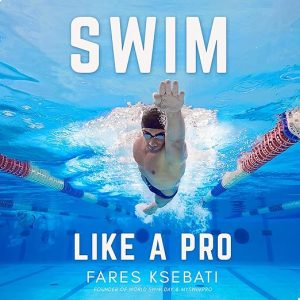
Coaching is a physical trade, taught at the side of a pool with a stopwatch and a hand on a shoulder. Turning it into an audiobook means surrendering the two things that make it work, the demonstration and the correction, and trusting the explanation to carry the rest. Fares Ksebati is billed in the description as one of the most trusted swim coaches in the world, with a program said to have helped hundreds of thousands of swimmers. Five hours and nineteen minutes, read by the coach who wrote it.
The Review
Two responses were filed on February 26, 2021, both at five stars, more than three months before this recording arrived in June of that year. That timing tells you they were formed on a text edition, and it also tells you what the earliest buyers valued. A triathlete of more than ten years credits the book with reaching well past stroke technique into the physics and psychology of swimming. The other insists the accompanying videos are essential rather than optional.
Holistic is the word the description uses and it turns out to be accurate. Technique fundamentals sit alongside strength and conditioning, nutrition, injury prevention and mental training, plus a strategy for setting SMART swimming goals. The through-line is efficiency: swim faster with less effort and more enjoyment. That is a coherent premise, and it explains why a book about one sport needs more than five hours to make its case rather than one long chapter of drills.
Scores run high and the written sample runs higher still. A display of 4.4 covers 239 ratings, while the five written responses average 4.8 between them, a single four star pulling against four top grades. With a pool that size, five written verdicts cannot represent it, so treat 4.4 as the real number. What those five are genuinely good for is not the score but the specificity, because each one states what its writer brought to the book.
What Makes Swim Like a Pro Worth Hearing
A sixty-six-year-old new swimmer, writing at five stars in February 2022, gives the clearest picture of how this material actually gets used. Able to avoid drowning but unable to imagine swimming as lifetime fitness, that buyer took a course, bought bags and goggles and fins to little effect, found the coaching operation through video, and then describes listening to the book while driving and returning to the text afterward for better comprehension. Two passes, two formats.
Explanation is the half that survives the format, and it survives well. Why a catch fails, what stroke rate does to efficiency, how nutrition and dryland work feed a pool session: all verbal material, all fine through headphones. Motivation transfers too, and this book carries a great deal of it, including the run of inspiring stories the description promises. You can absorb the reasoning on a drive, in a gym, or walking to work.
Author, reader and publisher all carry the same name, which makes this a fully self-produced release. Nothing about that is a fault, and for coaching material it brings a real advantage, since the person explaining the drill is the person who designed it and the emphasis lands where it was meant to. What it also means is no editorial layer, no house standard, and no second opinion sitting between the recording and you.
The Caveats
Elsewhere is where four of the five written responses keep pointing. One from May 2022 at five stars recommends the book, the app and the video channels together, as though they formed a single product. Three more point at external material of one sort or another, and none of it arrives inside a sound file. Audio is one component of a package here, and it is not the component that can show you what a stroke actually looks like.
Form is a visual problem and no recording solves it. A swimmer cannot hear a high elbow, cannot hear hip rotation, and cannot check a flip turn against a spoken description. The listing itself says the resources in the book and the online course together expose you to the fundamentals, which is a quiet admission that the two halves were built to work in tandem. Buying the audio alone gets you the theory and leaves the correction on the table.
Listing copy is careless in two visible ways. One sentence repeats a phrase inside itself, telling you the resources in this book in this book and the online course, which is a proofreading miss nobody caught before publication. And the description signs off with a retail instruction to take action and order the title now, which is print marketing language sitting on a product the buyer is already looking at. Neither affects the content, both suggest how much editorial attention it received.
Should You Listen to Swim Like a Pro?
Lap swimmers who have plateaued and returning athletes are the sweet spot. A former competitive swimmer coming back after two decades away, four stars in May 2025, describes the book as the equivalent of the old coach you respected and slightly feared pulling you aside to get you back into it sensibly. That framing is exactly right. Anyone who already knows what a hard set feels like and needs the reasoning updated will take the most from this.
Pure audio buyers should think twice before committing. If you have no intention of watching the videos, opening the course or following the channels, you are buying perhaps two thirds of what the program was designed to deliver. Hold off too if you are learning to swim from nothing, because water confidence and safety are taught in person. And any competitive swimmer already inside a squad will find the fundamentals well below their level.
Ksebati has built something larger than a book, and this file is one entrance into it. The explanation is clear, the scope is genuinely wide, and the material on nutrition, dryland work and mental training earns its place beside the technique chapters. Go in knowing that the strongest enthusiasm on this page keeps pointing at a screen. Take the reasoning from the recording, then find a pool, a mirror or a camera for everything else.
A Few Questions About Swim Like a Pro
Do I need the online course to get value from this audiobook?
Not strictly, but the book was designed alongside it. The description pairs the two explicitly when setting out what the resources cover, and the audio on its own gives you reasoning, programming and motivation without the visual correction that stroke work depends on. Budget for both if form is the thing you need fixed.
What does the audiobook cover besides stroke technique?
Considerably more than the title suggests. Dryland strength work, what to eat, how to avoid getting hurt, the mental side of training and a goal-setting method all get their own space, alongside a run of inspiring stories. Roughly half the material sits outside the pool, which is what makes it work as listening rather than as poolside reference.
Will this help a triathlete whose swim leg is the weak one?
That is among the clearest use cases here. The book treats efficiency rather than raw speed as the target, which matters most to anyone who still has to ride and run afterward, and the structured training approach transfers directly to a swim leg. Expect programming logic rather than race-day tactics.