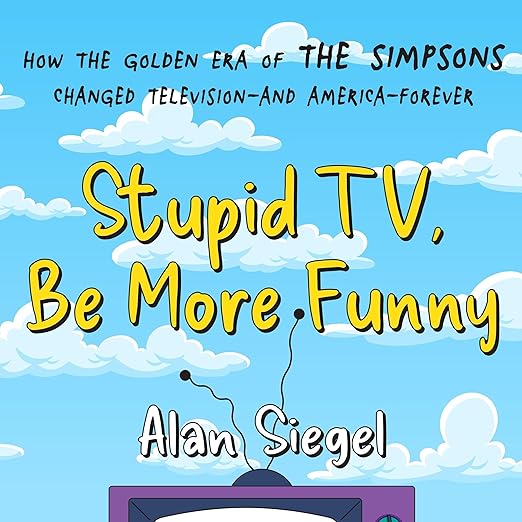
How did The Simpsons go from a crude animated short to reshaping how an entire generation joked, talked, and watched television? That is the question driving Alan Siegel's audiobook, and it is a sharper question than the ones most nostalgia-driven pop culture books bother asking. Rather than simply cataloging classic episodes for fans to nod along to, Siegel treats the show's first decade, 1990 to 1998, as a genuine historical case study in how Fox became the network we know today, and how one writers' room absorbed an entire post-Cold War American mood and reflected it right back at the country.
The Show's Chronological Spine, One Decade Long
Eric Jason Martin narrates with the same controlled, measured delivery I have heard him bring to dense scholarly nonfiction covering large casts of named historical figures, and that skill transfers here more directly than you might expect. A book built around interviews with dozens of writers, producers, and cast members, threaded through incisive pop culture criticism, needs a narrator who can keep names and voices straight without losing momentum, and Martin manages that even though a Simpsons oral history is genre territory well outside his more typical dense-nonfiction work.
Siegel's structural choice to focus specifically on one decade rather than all thirty-plus years the show has been on air is the book's smartest move. It avoids the completism trap that swallows most too-broad pop culture histories, where a show's entire run gets flattened into a highlight list. Instead, this treats 1990 to 1998 as a bounded, analyzable era with its own arc, beginning, middle, and consequence.
Siegel's chapter structure follows the show's own production calendar closely, moving season by season through the 1990 to 1998 run rather than organizing thematically around topics like syndication strategy or character development in isolation. That chronological spine keeps the analysis grounded in specific, dateable creative decisions rather than drifting into abstract commentary about the show's importance in general terms, which keeps the book feeling more like a documentary than a thesis paper stretched to book length.
Martin's Pacing Separates Fact From Interview
Martin's steady pacing also serves the book's critical passages well, the sections where Siegel is making an actual argument about the show's cultural significance rather than just relaying an anecdote from an interview subject. Distinguishing between reported fact, quoted interview material, and Siegel's own critical analysis through vocal pacing alone is a genuine narration challenge, and Martin manages the distinction cleanly enough that a listener rarely loses track of whose voice is actually driving a given passage.
Runtime-wise, this sits at a comfortable middle length for a single-subject pop culture history, roughly comparable to a binge rewatch of a full season and a half of the actual show it covers, which feels like a fitting proportion for a book this focused on one specific creative era.
A Christmas Gift That Started a Rewatch
One reviewer's family story captures the book's cross-generational pull well: their son grew up addicted to the show while his wife was not, and after the reviewer gave the couple this book as a Christmas gift, the two of them started rewatching original episodes together, with his fandom finally becoming something they shared. Another reviewer put the show's cultural weight in blunt personal terms: 'no show or product of pop culture resonates or informs my comedic senses quite as much as The Simpsons.'
The interview access is real, not just marketing language. Siegel draws on conversations with figures including Conan O'Brien and Yeardley Smith, giving listeners direct insight into the writers' room decisions and creative arguments that shaped specific episodes, rather than relying purely on outside critical analysis reconstructed after the fact.
The book's account of Fox's own transformation runs in genuine parallel to The Simpsons' rise, and Siegel treats the two as inseparable: a struggling fourth network needed a signature hit, and the show's writers needed a network willing to take creative risks a more established competitor would never have approved. That mutual dependency, explained clearly, gives the book real stakes beyond simple show-business trivia.
The book also gives real weight to the writers themselves as individual craftspeople rather than treating the show as an anonymous cultural product that simply happened. Specific creative disagreements, specific pitches that got rejected, specific jokes that almost did not make it to air, all get room to breathe, which is exactly the kind of granular detail an oral-history-adjacent format in audio can deliver better than a purely analytical text might, especially for listeners who already appreciate the craft of half-hour comedy writing as its own specialized skill.
Assumes You Remember the Original Nineties Episodes
One reviewer describes Siegel as 'a freelance writer superfan who started watching the show as a first grader,' which is both an asset and worth flagging honestly. That level of genuine devotion produces real access and granular knowledge, but it can also mean the book leans generous rather than critical at moments where a more detached historian might push harder on the show's occasional missteps during its celebrated early run.
This is squarely about the show's formative years, not its full three-decade-plus run. The synopsis itself describes the current Simpsons as an occasionally sharp yet ultimately safe sitcom, and listeners hoping for coverage of that later era, or of the show's present-day cultural standing, will need to look elsewhere; this book's attention stops at 1998.
Listeners who know the show mainly through its increasingly memed later-season moments, rather than the specific 1990s episodes under discussion, may find some references land without full context. Siegel assumes real familiarity with specific early-run episodes and characters as they existed during that decade specifically, not the flattened, meme-ified version of the show that circulates online today. A quick refresher on the show's first several seasons before starting, even just a handful of representative episodes, will make the specific writers'-room anecdotes land with considerably more impact than going in relying purely on general cultural memory of the characters.
More Than Casual Viewers Bargained For
Simpsons superfans, pop culture historians, and anyone curious about how a single animated sitcom helped reshape 1990s network television and Fox's rise specifically will find this a substantial, well-sourced listen worth the eight and a half hours.
Students of television history and media studies more broadly, not just Simpsons fans specifically, will find genuine value in how clearly the book traces network economics, creative risk-taking, and cultural timing intersecting around one specific show at one specific moment.
Casual viewers who only catch occasional reruns may find the granular writers'-room detail more than they bargained for, since the book rewards existing familiarity with specific characters, running gags, and individual episodes rather than offering a general-audience introduction to the show.