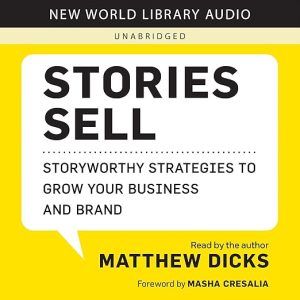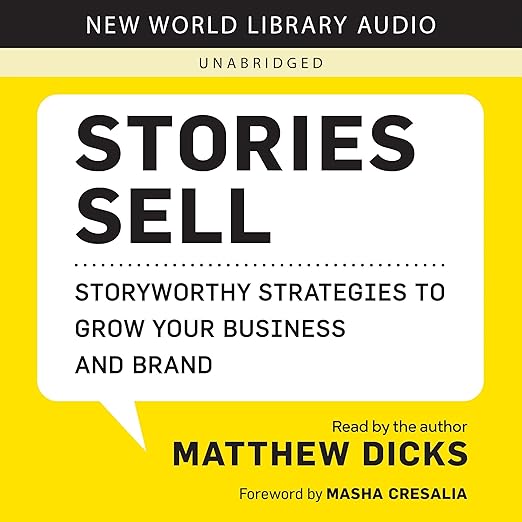
Matthew Dicks holds the all-time record for victories at the Moth StorySLAM competition, which means he has tested his storytelling ideas in the most unforgiving possible environment: in front of a live audience that has heard everything. Storyworthy, his audiobook on the craft and business application of storytelling, carries that competitive credibility throughout. The audiobook runs 12 hours and 33 minutes narrated by Dicks himself, and the format makes an argument the print edition cannot quite replicate: that a storytelling teacher who narrates poorly undermines their own premise. Dicks undermines nothing. His narration is sharp, self-aware, and continuously funny in ways that feel organic rather than performed, which is itself evidence for everything he argues in the book.
The synopsis positions this primarily as business storytelling guidance, and that is accurate but incomplete. Dicks spent ten years consulting with startups and Fortune 500 companies, and the professional applications are well-developed, several reviewers who work in design, marketing, and sales describe using his frameworks directly. But the deeper current of the book is personal: how to locate the story worth telling in your own life, how to understand what a story is actually about rather than what it describes on the surface, and how to perform that story in a way that creates genuine human connection. The business applications are downstream of that human core, not the other way around.
The Five-Second Moment Framework
Dicks's central framework is built around what he calls the five-second moment, the realization, decision, or change that every good story must contain. This sounds simple, and in his formulation it is, but the implications are significant: most people, when asked to tell a story, describe a sequence of events rather than a transformation. The difference between those two things is exactly what makes some stories land and others disappear. Dicks uses examples from his own Moth stories and from his consulting work to demonstrate the principle, and the examples are specific enough to be genuinely instructive rather than illustrative hand-waving. One reviewer put it plainly: you will become a better storyteller and you will definitely sell more if you incorporate even a couple of his concepts. The Moth StorySLAM context also matters beyond credentialing. Dicks competed publicly, repeatedly, in an environment where failure is immediate and visible. That real-world testing gives his craft principles a different weight than ideas generated entirely in the workshop or seminar room, these are techniques that survived the stage.
Listened First, Then Bought It in Print
Multiple reviewers specifically mention that they listened to the audiobook first and then bought a print copy for reference, which tells you something important. The content is dense enough to reward re-reading, but the audio version is where Dicks's teaching lands most fully. His timing demonstrates exactly what he is telling you: he knows when to pause, when to accelerate, when to let an uncomfortable truth sit in the air. One reviewer who works in design and marketing described the audiobook as having so much value that the exercises and examples required a physical copy for ongoing reference. That dual-format recommendation is worth noting for listeners deciding how to engage with the material. The listening experience itself is teaching you things the text alone does not convey in the same way. One additional reason to choose the audiobook: Dicks occasionally demonstrates storytelling techniques in real-time by telling actual stories rather than just describing them. Those passages are where the audiobook earns its edge over the print edition most clearly, you are not reading about good storytelling, you are experiencing it.
Woven Throughout, Not Isolated in One Section
The marketing orientation of the synopsis may set slightly wrong expectations. Yes, Dicks addresses corporate communication, presentations, and sales contexts, the companies-with-the-best-stories-win argument is made explicitly. But the actual instruction is rooted in personal narrative first, which means some of the most useful chapters involve locating authentic stories from your own life rather than constructing brand narratives. Listeners who want a pure business communication manual may find the personal storytelling emphasis more expansive than expected. The inverse is also true: listeners who come for pure literary craft and want to skip the business applications will find those threads woven throughout rather than isolated in a section they can jump past. The book integrates both genuinely, which is its strength, but knowing that integration upfront helps set proper expectations before the first chapter. The book is also structured with a generosity that is somewhat unusual in the craft guide genre: Dicks genuinely wants his readers to succeed, and the absence of gatekeeping or mystification around storytelling skill is refreshing. He treats the reader as capable of learning these techniques rather than as someone who either has the gift or does not.
A Guide That Proves Its Own Argument
The primary audience is anyone who communicates professionally and feels that their presentations, pitches, or conversations fail to connect the way they should. Dicks's framework is practical and immediately applicable, and the Moth StorySLAM credential gives it a stress-test that purely theoretical guides cannot claim. The secondary audience is anyone who has been told they are a good storyteller and wants to understand why, Dicks's analytical framework will help you see the mechanics beneath your instincts and give them conscious form. Where the audiobook is less well-suited is for listeners wanting extensive written exercises or worksheets; the material rewards active engagement, and listeners who want to pause and do the work may find they need the print companion that several reviewers mention. At 12 hours and 33 minutes with Dicks narrating, this is the storytelling guide that actually demonstrates its own argument, and that self-proving quality is rarer than it should be in a genre crowded with theorists who cannot tell a story to save themselves. The book will also serve anyone whose professional role requires them to give presentations, lead teams, or pitch ideas, not because it is a presentation skills guide but because it fundamentally changes how you think about what you are trying to communicate. The five-second moment framework alone is worth the full 12 hours.
Is the Storyworthy audiobook primarily aimed at business professionals or general storytellers?
Both, with the balance tilting toward general storytelling craft. Dicks spent a decade consulting with companies and the business applications are real, but his teaching is rooted in personal narrative, finding the authentic story, before applying it in corporate contexts.
Does listening to the audiobook replace buying a print copy, or do reviewers recommend both?
Multiple reviewers explicitly recommend both. The audio version is where Dicks's narration demonstrates his principles most effectively, but the exercises and frameworks benefit from a physical reference copy. The audiobook is the better starting point if you have to choose one.
Does Matthew Dicks narrate his own audiobook, and does that choice matter for the content?
Yes, he narrates it himself, and it matters considerably. A storytelling guide narrated poorly would undermine its own thesis. Dicks is genuinely skilled at performance and his narration serves as a running demonstration of what he argues throughout the book.