At a Glance
- Narrator: Hunter Prosper narrates his own collection, and that choice is essential, his ICU nurse's ear for the weight of what people say in extremity gives the readings a quality no third-party narrator could replicate.
- Subjects: shared humanity across difference, love and loss as universal languages, the intimacy of the stranger's confession
- Tone: Warm and quietly urgent, with an undercurrent of grief that makes the joy more resonant
- Bottom line: At just over three hours, this audiobook delivers an emotional concentration that longer books rarely achieve.
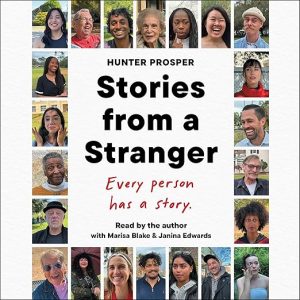
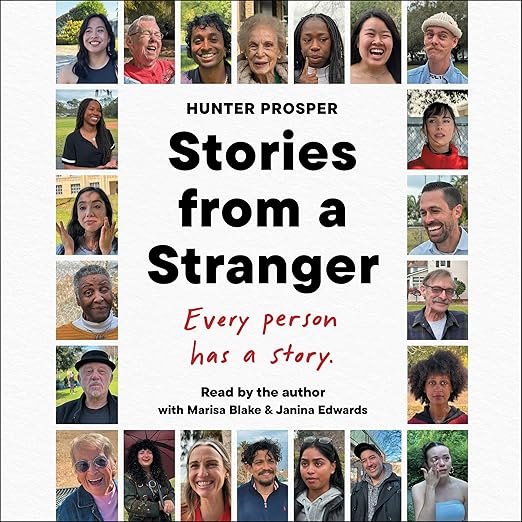
Hunter Prosper's Stories From a Stranger is an audiobook that works differently from most collections of short human narratives, and the difference starts with who is reading to you. Prosper, ICU nurse, TikTok creator, and author of this New York Times bestselling gathering of 100 stranger interviews, narrates the book himself, and that decision shapes the entire listening experience. These are not anecdotes curated by a journalist from a comfortable remove. They are collected by someone who has held space, professionally, for people at the edge of their lives, and that experience is audible in every reading.
Dick, Nathalia, and Ghada Answer the Same Questions
The structure of the book is deceptively simple: 100 people, 100 answers to questions like "Who was your greatest love?" and "What's the most painful thing you've been told?" and "What do you see when you look in the mirror?" The people who answered those questions include Dick, who saw Nancy across church steps and married her a week later and has been with her for more than fifty years; Nathalia, whose first boyfriend told her that her facial scars made her more beautiful; and Ghada, who refused to stop fighting for her ill son and watched him thrive twenty years later. These are not representative samples. They are specific people with specific memories, and the specificity is the point.
Prosper's origin story matters here. He turned to storytelling first as a way to process what he witnessed in the ICU, the whispered confessions, the final goodbyes, the unexpected grace of people who knew they were running out of time. The @HunterProsper TikTok account became a phenomenon because something in the format resonated with an audience hungry for exactly this kind of unmediated encounter. The book extends that format into a longer form, giving each story room to breathe in a way that a 60-second video cannot. And Prosper's narration gives them room to land, not as content, but as the specific lives of specific people.
The collection is also notable for what it does not include: no framing thesis, no sociological argument, no attempt to interpret the interviews through any particular lens of human behavior. Prosper trusts the stories to carry themselves and trusts the listener to make their own connections. That restraint is a deliberate craft decision, and it is the right one. The moment the collection becomes an argument about what human beings are like, it loses the quality of genuine encounter that makes it worth listening to.
An ICU Nurse's Ear for Silence, Now Narrating
The self-narration question in audiobooks is real: not every author who narrates their own work serves it well. Prosper is an exception. His professional experience with people in extremity has trained him to listen without projecting, to hold silence without filling it, and those are exactly the skills that make a narrator of short emotional pieces effective. He does not editorialize over the stories. He delivers them with the same quality of attention he brought to the original interviews, present but not imposing.
At 3 hours and 8 minutes, the audiobook is short enough to listen to in a single sitting, and there is a genuine argument for doing so. The accumulation of voices, the way Dick's love story sits beside Nathalia's self-acceptance sits beside Ghada's fierce maternal determination, builds something that no single story achieves alone. Reviewers have described the experience as a reminder of what we share across vastly different lives, and that description is accurate without being sentimental. The book earns its warmth through specificity rather than through generalizing claims about human connection.
Why Do We Confess to Strangers?
Listeners accustomed to longer narrative arcs should adjust expectations. This is a collection of flashes, not a sustained story, and the emotional payoff is cumulative rather than climactic. The best approach is to treat each entry as complete in itself while allowing the sequence to build. Some stories will reach you immediately; others will settle over time. Prosper has organized them with a reader's ear for rhythm, alternating heavier emotional material with lighter moments in a way that prevents the collection from becoming exhausting.
The questions Prosper asks his subjects are worth attending to as craft decisions. "What do you see when you look in the mirror?" is not a self-help prompt, it is an invitation to a kind of self-reckoning that most conversations never reach. The willingness of strangers to answer honestly, to trust someone they have just met with their most private assessments, is itself part of what the book is examining. Why do we confess to strangers? What does it cost, and what does it release? Prosper does not theorize these questions explicitly, but they are present in the listening, beneath the surface of each individual story.
A Book for Anyone Willing to Sit With Others
This audiobook suits almost any listener willing to sit quietly with other people's lives for a few hours. It is not genre-specific, it does not require interest in any particular subject matter beyond human experience at its most direct. Listeners who have followed Prosper's TikTok account will find the audio format a natural extension into more spacious territory. Those encountering his work for the first time will find that the collection stands entirely on its own. The only listeners likely to be unsatisfied are those who need a conventional narrative arc or who find emotional directness uncomfortable. The book asks you to feel what the subjects felt, and it does not apologize for that request. At just over three hours, the ask is brief enough to honor it.
Does Hunter Prosper narrating his own audiobook add something that a professional narrator would not?
Yes, in a meaningful way. Prosper's background as an ICU nurse, someone trained to witness human experience at its most raw, gives his readings a quality of grounded attention that is audible throughout. His relationship to these stories is personal in a way that shapes the delivery, and that personal quality is central to what makes the collection work.
Is this audiobook structured as a continuous narrative or as separate short pieces?
It is 100 separate interview-based stories, each complete in itself, organized by Prosper with an ear for cumulative effect. There is no single narrative thread, the payoff is emotional and thematic accumulation rather than plot development. The 3-hour runtime makes it manageable in one or a few sittings.
How does the audiobook version compare to reading the print book?
Self-narration by Prosper makes the audio format genuinely distinct. His delivery carries the ICU-nurse attentiveness that shapes his interviewing style, and that quality cannot be replicated on the page. For this particular collection, hearing the author read is part of the work rather than a secondary option.