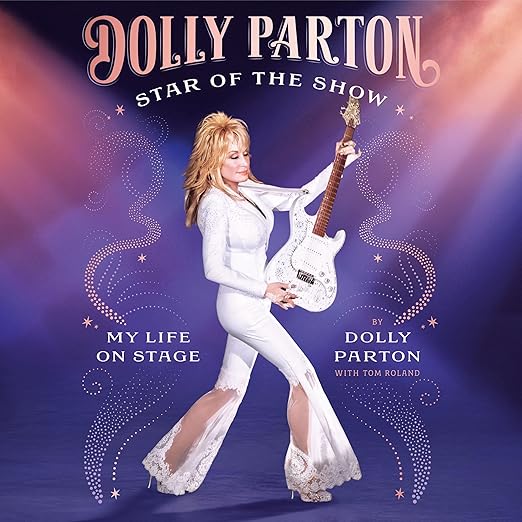
Seven decades on stage. From singing in front of her family in the Smoky Mountains to playing the Dallas Cowboys' 2023 Thanksgiving halftime show before 42 million viewers. Dolly Parton's Star of the Show audiobook, which she narrates herself at seven hours and nine minutes, is the third volume in her photographic trilogy following Songteller, which focused on her lyrics, and Behind the Seams, which examined her fashion. This final volume turns to performance itself, and Parton treats that subject with the same combination of wit, warmth, and genuine craft-awareness that has defined her public presence for half a century.
The audiobook companion to a lavishly illustrated coffee table book always faces a particular challenge: the text was written to coexist with photographs that the audio listener cannot see. Star of the Show handles this honestly by providing a companion PDF with select images from the hardcover edition, accessible through the audiobook library. That disclosure matters, because the book's structure follows a roughly chronological arc through Parton's career as a performer, and some of the specific moments she describes, particular concerts, stage setups, or collaborations, will land more fully for listeners who have access to the visual context.
That said, Parton's prose, delivered in her own voice, does not feel diminished by the absence of the images. Reviewer Jen notes that she is someone whose voice you can almost hear even when reading silently. In the audiobook format, that observation becomes literal. Her delivery of the backstage stories from her years performing with Porter Wagoner, who mentored and shaped her early career before their notorious professional split, carries exactly the kind of retrospective complexity that you would expect from someone who has had fifty years to process that relationship.
One of the more revealing passages in the audiobook concerns Parton's experience performing at major international festivals during periods when country music was not a globally dominant genre. She describes adapting her set and her stage persona for audiences who knew her primarily through crossover pop hits rather than through her country catalog, and her account of how she read a crowd and adjusted in real time is one of the most concrete descriptions of professional performance craft in the book. That kind of specific, experiential knowledge is what makes this audiobook worth listening to for anyone interested in the craft of live performance rather than just in Parton specifically.
Parton Performs the Stories, Never Just Reads
Parton narrating herself is the primary reason to choose the audiobook over the print version, and it is a substantial reason. She does not read these stories in a flat informational tone. She performs them. When she describes learning hard lessons from life on the road, the phrase has weight because she delivers it from inside that experience. When she talks about touring the world and playing arenas and stadiums and festivals, the cumulative scope of it is registered in how she says it, not just in what she says. Reviewer Michael H. describes the book as containing lots of details of her life and her life story by her, and the emphasis on by her is the operative phrase for the audiobook specifically.
The content spans from the Grand Ole Opry, where she had her first major national stage debut, through the 9 to 5 film, through decades of touring and festival performances and collaborations with Kenny Rogers, Linda Ronstadt, Emmylou Harris, and others. Parton is notably direct about the discipline required to maintain a career of this length. She is not presenting a mythology of effortless stardom. The sections on what sustained touring requires, physically and personally, are honest in the way that career retrospectives from someone still active and confident can afford to be.
The 9 to 5 material, covering her transition into film acting and the particular demands of performing for a camera rather than a live audience, is a useful companion to the touring sections because it documents a genuinely different set of skills being deployed. Parton is characteristically matter-of-fact about the learning curve: film was not her primary medium, she knew it, and she approached it as craft rather than instinct. That pragmatic self-awareness about her own limitations and learning process is one of the more appealing dimensions of her voice as a narrator.
Wagoner's Split Handled With Firmness and Care
The Porter Wagoner material is the historical center of the audiobook's early sections, and listeners who know that relationship's history will get more from it. Wagoner was instrumental in launching Parton's national profile, and their eventual separation, which Parton handled with both legal firmness and personal care, was one of the formative professional episodes of her career. She does not relitigate it, but she does not soften it either, and those passages reward attention.
The Dallas Cowboys halftime show and other recent performances bookend the retrospective and give it a present-tense quality that is more unusual in career retrospectives than it should be. Parton is not writing from retirement. She is writing as someone still actively performing, and the audiobook's energy reflects that. Reviewer Minerva Jayne Van Allen describes the career as absolutely stunning, and while that response is fan enthusiasm rather than critical analysis, it captures the cumulative effect of seven hours of Parton taking stock of what she has built and finding it worth examining closely.
This Reflects Parton's Own Memoir Framing
Parton fans who want her own account of her performance career will find this audiobook the most complete version of that story available in her voice. Listeners interested in country music history, particularly the evolution of the Grand Ole Opry tradition through arena touring and mainstream crossover, will find the career arc substantive and specific. Those who want a comprehensive biography with third-party perspective should know this is a memoir, not a critical biography, and it reflects Parton's own framing throughout. Listeners who expect the audiobook to replicate the full photographic experience of the hardcover should download the companion PDF. The hardcover is a collector's item and the audiobook is a different but valid experience of the same material.
Common Questions
Does Dolly Parton narrate the Star of the Show audiobook herself?
Yes. The audiobook is entirely in her own voice, which is the primary reason to choose it over other formats. She delivers her career stories with the warmth and performative energy of someone who has been telling stories from a stage for seven decades.
Is the companion PDF necessary to get full value from the Star of the Show audiobook?
The audiobook stands alone as a listening experience, but the PDF companion including select photographs from the hardcover edition adds meaningful visual context for specific performances and collaborations Parton describes. Downloading it before starting is recommended.