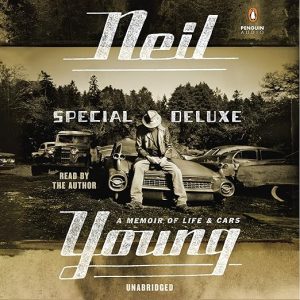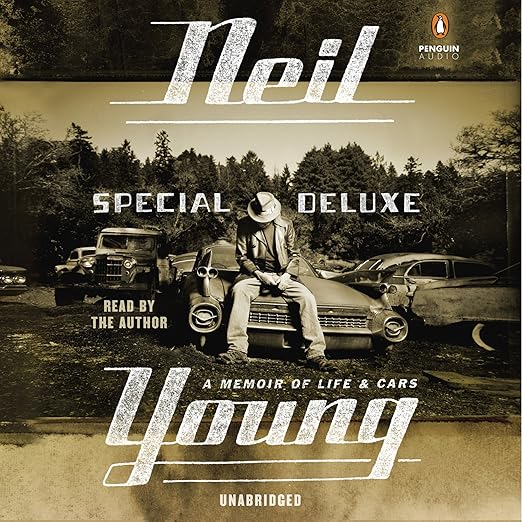
Neil Young narrating his own memoir Special Deluxe is not a neutral production decision, it's the only configuration that makes the book work. Young's voice, with its familiar cadences and unscripted quality, transforms what might otherwise read as a loose assemblage of car memories and environmental hand-wringing into something that feels like sitting across from the man himself at his ranch. The audiobook, running just under nine and a half hours, is Young's follow-up to Waging Heavy Peace, and it shares that book's virtues and its particular brand of structural looseness. Where Waging Heavy Peace was organized loosely around music and songwriting, this one finds its organizing conceit in machinery.
The Silence Carries What Illustrations Cannot
The organizing premise, each chapter anchored by one of the many cars Young has owned, driven, or loved, works better in theory than in practice, and that's actually fine. What Young really uses the cars for is to triangulate moments in his life: the LincVolt project and his environmental conversion, the years of touring, the relationships that formed and dissolved around his music, the guilt of a man who has spent decades burning fossil fuels while caring deeply about the planet. The cars are mnemonic devices more than subjects. Each one unlocks a period, a feeling, a specific stretch of road or stage or relationship that Young would not necessarily have found his way to through direct narrative.
Reviewer Jacquelyn Oldham described the book as working for fans and for car lovers alike, with each chapter anchored by the author's own drawing of one of the vehicles. That visual element doesn't survive the audio translation, which is a genuine loss, the illustrations gave the print version a handmade quality that matched the text's sensibility. But what audio listeners gain is Young's voice reading his own words with the pauses and inflections he intended, and those pauses carry real meaning. When he talks about his son Ben's cerebral palsy, or about the end of his marriage to Pegi Young, the silence between sentences does more than any professional reading could replicate. Some of the memoir's most affecting passages are almost wordless in the audio.
Reviewer R. Ruddock's assessment, probably a must-buy for fans, maybe not for everyone else, is the most precise critical evaluation in the record. Young has never been interested in writing a conventional memoir, and Special Deluxe is not organized around narrative arc or biographical completeness. It circles. It doubles back. This is consistent with how Young makes albums, and listeners familiar with records like Zuma or Comes a Time will recognize the associative logic immediately.
A Lincoln Continental and an Environmental Reckoning
What Special Deluxe does particularly well, and what the audio format amplifies, is the texture of Young's environmental awakening. His account of converting the LincVolt, his 1959 Lincoln Continental, to run on alternative fuel is specific and oddly moving: a man trying to reconcile a lifelong love of large, beautiful, fuel-hungry machines with the reality of what those machines cost the planet. The project failed commercially but not spiritually, and Young's account of that failure is more honest than most celebrity environmental conversion narratives. He is not celebrating a solved problem; he is describing an ongoing struggle with his own desires.
The Buffalo News review quoted on the cover, that the book reads like a great Neil Young song plays, captures something real. Young's prose has the same quality as his most personal recordings: unpolished in ways that feel intentional, repetitive in ways that build rather than bore, and emotionally direct beneath an apparently casual surface. The audiobook format activates all of those qualities in a way that silent reading cannot.
Young Returns to the Same Themes Often
The book demands tolerance for repetition. Young returns to the same themes, authenticity, the contrast between commercial music and his own stubborn creative path, his love for the people around him, from multiple angles across multiple chapters, and the structure doesn't resolve so much as rest. Listeners who want a memoir with a clear arc and a satisfying conclusion will find Special Deluxe frustrating. Young is not writing toward a destination. He's recording what he notices.
The environmental content can also feel didactic at moments, Young is genuinely passionate about the LincVolt project and fossil fuel dependency, and he returns to those concerns repeatedly. Listeners who share his concerns will find it energizing; those who don't may find the repeated returns heavy-handed. At nine and a half hours, the rambling earns its runtime only if you are already invested in the voice doing the rambling.
Car Lovers Get a Legitimate Entry Point
Committed Neil Young fans, listeners who connected with Waging Heavy Peace, and readers drawn to memoir that operates more like personal essay than formal autobiography will find this audiobook rewarding. Car lovers with even passing Young interest have a legitimate entry point here, the mechanical specificity is real, not decorative. Young's descriptions of particular vehicles are grounded in genuine knowledge rather than borrowed automotive atmosphere.
Skip it if you have no prior attachment to Young's work and need a memoir organized around clear narrative progression. The pleasures here are genuine, but they are not self-evident to someone coming in cold. Young's voice as a narrator is one of the most recognizable in rock music and one of the most idiosyncratic in memoir; if you have spent any time with it in the context of his music, the audiobook will feel like a natural extension of that relationship.