Quick Take
- Narration: Geoffrey Wawro narrates his own work, and the self-narration is an asset: the passion of a historian who genuinely believes his revisionist argument is audible throughout.
- Themes: America’s decisive WWI contribution, the myth of Allied self-sufficiency, the Doughboys’ overlooked battlefield performance
- Mood: Impassioned and detailed, like a scholar making a case at the lectern with evidence spread across the table
- Verdict: A serious revisionist history that forces a reconsideration of American WWI mythology; strongest for listeners willing to engage with its twenty-hour argument on its own terms.
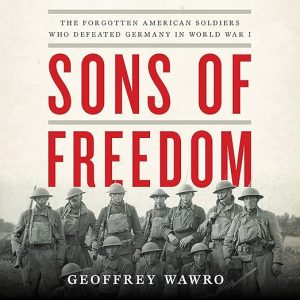
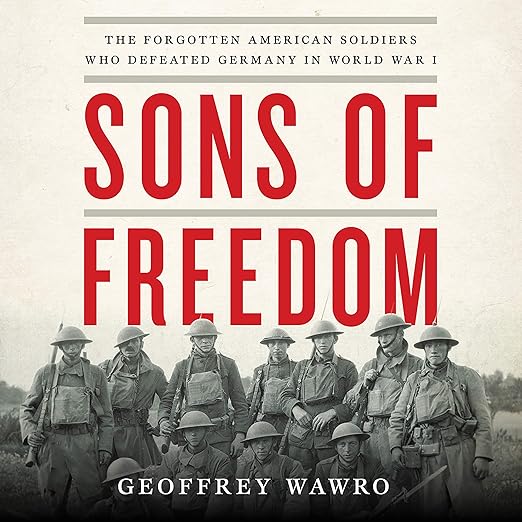
I grew up thinking of World War I as a European tragedy that America entered late and left quickly, a brief interruption in the national story rather than a decisive episode. Sons of Freedom, Geoffrey Wawro’s revisionist account of the American Expeditionary Forces, spent twenty hours dismantling that assumption. I finished it on a Sunday with the odd feeling you sometimes get from a very good work of history: that something you thought you knew turned out to be a story you had never actually been told.
Wawro is a prize-winning military historian at the University of North Texas, and he self-narrates this audiobook in a way that makes the revisionist argument feel personally invested rather than academically detached. This is his case to make, and you hear that in the delivery. He is not presenting received wisdom. He is correcting it. The Wall Street Journal called the book stirring, and that word captures something real about the listening experience: this is military history written with the urgency of someone who thinks the standard account is wrong in ways that matter.
The Myth Being Dismantled
The standard account, as Wawro characterizes it, holds that America’s contribution to World War I was largely economic and symbolic: loans, supplies, moral support, and finally a declaration of war that came after the main fighting had been decided. In this version, the Doughboys arrived late, saw limited action, and the war ended before they were truly tested.
Wawro’s counter-argument is direct and documented: in 1918, the French and British armies were on the verge of collapse. The German Spring Offensive had broken through Allied lines in ways that the previous years of trench warfare had not, and the Allies were running out of men and will to resist. Without the American forces , not just their presence, but their actual battlefield performance in the Meuse-Argonne and Belleau Wood and Saint-Mihiel , the war would have continued into 1919 at minimum, and its outcome was not guaranteed. Field Marshal Haig called the Allied victory a miracle. Wawro calls it an American miracle, and he spends twenty hours building that case with evidence drawn from Allied command records, unit diaries, and contemporaneous accounts from both sides of the line.
The Doughboys in the Field
What gives the audiobook its weight is the battlefield granularity. Wawro doesn’t just argue at the strategic level; he follows individual divisions, regiments, and companies through their engagement with German forces. The Meuse-Argonne Offensive, the largest American military operation until the Second World War, receives particularly detailed treatment. One listener described the battle descriptions as emotionally tough because the author made them feel present in the action, and that’s accurate: Wawro writes combat with the specificity of a historian who has spent serious time with unit diaries and regimental histories.
The human cost is not softened. Another listener noted that the detailed descriptions were tedious at times but necessary, and that’s a fair characterization of what serious military history requires. The Meuse-Argonne killed more Americans in ten weeks than Vietnam killed in ten years. Wawro keeps that arithmetic visible throughout, refusing to let the strategic argument float free of the physical reality it cost.
Where the Revisionism Has Its Limits
The self-narration is an asset overall, but it means the audiobook occasionally takes on the character of a sustained argument rather than a balanced history. Wawro’s thesis is clearly stated and well supported, but the book is less interested in testing the counterargument than in making its own case. Listeners who want the revisionist position challenged more rigorously against alternative interpretations may want to supplement with other accounts. The audiobook is also challenging in the way that all serious operational history is challenging: many place names, unit designations, and commanders to track, and the battles can blur together without a map to hand. One listener specifically recommended it as a corrective for the geographic confusion that WWI history often generates, which is a fair characterization of its function.
Who Should Listen and Who Should Know What They’re Getting
This is a book for listeners who want to reconsider what they know about American involvement in the First World War and are willing to invest twenty hours in a sustained, documented argument. It’s particularly valuable for anyone who found standard WWI histories focused on the European theater without much American perspective. Listeners looking for a broader narrative history of the entire war will need to supplement. For the American AEF specifically, this is among the most thorough accounts available in audio, and Wawro’s self-narration gives the argument an energy that a professional narrator reading the same pages might not have been able to match.
Frequently Asked Questions
Does Geoffrey Wawro’s self-narration work for a book of this academic density?
Yes, more than you might expect. His delivery has the energy of someone making a case he genuinely believes in, which makes the revisionist argument feel driven rather than dry. He is clearer and more engaged than many professional narrators handling dense military history.
Does the book cover the full scope of WWI, or is it specifically about the American contribution?
Specifically the American contribution. Wawro gives context for the European situation, particularly the state of the French and British armies in 1918, but the book’s focus is the AEF and what it actually did militarily. It is not a general history of the war.
How detailed is the operational military content? Will it be accessible to listeners without a military history background?
The operational detail is genuine and sometimes dense. Unit designations, geographic positions, and command structures feature throughout. Listeners with some WWI background will follow more easily, though Wawro does work to explain each engagement’s significance in the larger campaign.
What is Wawro’s evidence for claiming the Allies were on the verge of collapse in 1918?
He draws on Allied command records including Haig’s own diary and correspondence, French army morale reports from the period after the 1917 mutinies, and operational analysis of what the German Spring Offensive achieved before American reinforcements arrived in sufficient numbers. The documentation is presented throughout the early chapters.