- Narrator: William Hughes brings a music journalist's fluency to the material, navigating technical recording sections without losing narrative pace and keeping the interpersonal dynamics between the four Beatles from flattening into received mythology.
- Subjects: Studio innovation as creative act, collaboration under interpersonal strain, the making of a final definitive statement
- Tone: Warm and technically engaged, specific enough to satisfy the dedicated fan and accessible enough for the curious newcomer
- Bottom line: Womack's account of the Abbey Road sessions is the most granular studio history of that album currently available in audio - specific, researched, and made easy by Hughes's knowledgeable delivery.
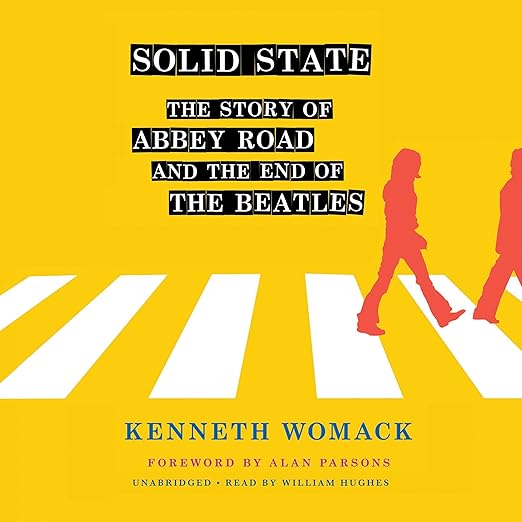
Abbey Road as a finished artifact is so deeply embedded in the musical consciousness of the past five decades that restoring it to contingent status - a record that almost did not happen, made under conditions of significant interpersonal strain, using equipment that was new enough to be genuinely experimental - requires deliberate effort from the writer doing the restoration. Kenneth Womack's Solid State, narrated by William Hughes, makes that effort on every page. This audiobook is the most detailed studio history of Abbey Road's creation available in audio form, organized around the solid state transistor mixing desk that EMI installed at Abbey Road Studios in 1969 and that gave the album its layered title. The technology is Womack's organizing conceit, but the book it anchors is primarily about four people, their producer, and what they chose to make when everything else was falling apart.
Hughes Manages the Dual Registers With Skill
Womack's Beatles scholarship spans multiple volumes, and Solid State benefits from the depth of archival access and testimony that long engagement enables. The book covers the February-to-August 1969 recording window with precision: the specific session dates, the technical decisions, the contributions of George Martin and his engineering team, and the interpersonal dynamics that shaped which ideas got developed and which got abandoned. The focus is deliberately narrow in chronological scope, which is the book's main editorial strength. Rather than re-narrating the Beatles' full history - thoroughly covered elsewhere, including by Womack himself - Solid State treats Abbey Road as a specific creative problem that specific people solved under specific conditions.
Hughes's narration manages the dual registers of the material with skill. The technical sections - Moog synthesizer deployment, multitrack recording decisions, the specific capabilities and limitations of the new console versus its predecessor - arrive with the same authority as the biographical and interpersonal narrative. This is genuinely unusual for music biography audio. Narrators who can track technical recording history and maintain listening momentum simultaneously are not common, and Hughes does it throughout the 8-hour-and-8-minute runtime without the technical passages feeling like mandatory homework before the interesting parts. One reviewer described the book as light reading packed with details I've never seen anywhere, which is accurate: Womack has done heavy archival work and made it feel effortless.
Harrison's Compositional Leap Nobody Quite Predicted
The account of George Harrison's creative emergence on Abbey Road is among the book's strongest extended sequences. Something and Here Comes the Sun, both released on the same LP, represent a compositional leap that the previous Beatles recording history did not fully predict, and Womack traces how this happened - the specific conditions of the 1969 sessions that gave Harrison space to develop material that would on most previous albums have been sidelined by Lennon-McCartney priority. The chapter on Harrison's navigation of the band's internal politics as a songwriter who had always operated in the shadow of the principal songwriting partnership is more nuanced than the standard narrative of grudging acceptance usually provides. Hughes gives it the pace and weight it earns.
The Moog synthesizer sections are what generate the most enthusiastic responses from technically minded listeners. Womack's account of how George Martin used the instrument to construct the sonic palette of the medley on Side Two - particularly the orchestral textures that appear in the sequence from You Never Give Me Your Money through The End - provides context for listening choices that most casual fans absorb without understanding. After spending time with Solid State, Abbey Road sounds different in specific ways, which is the practical test of whether a studio history has done its work.
Something Solid in the Face of Dissolution
The book does not attempt to resolve the contradictions of the Beatles' final year - the management disputes, the legal conflicts, the fraying personal relationships - but rather shows how those pressures coexisted with genuine creative collaboration in the studio. Womack's position is not that the tensions were irrelevant but that the studio remained a space where the four could still function together in ways they could no longer manage outside it. This is more honest and more interesting than the standard narrative of heroic collaboration-despite-everything. The title's double meaning - the mixing desk technology and the recording's quality of solidity in the face of dissolution - is something Womack returns to throughout without overworking it as a metaphor. Listeners who are dedicated fans familiar with Ian MacDonald's Revolution in the Head or Mark Lewisohn's extensive Tune In will find Womack working in the same tradition of archival precision with a narrower and more accessible focus.
The title's double meaning - the mixing desk technology and the recording's ambition to make something solid in the face of the band's dissolution - is something Womack handles with restraint. He returns to it without overworking it as metaphor. The account does not sentimentalize the contradiction of four people producing their finest collective work while their personal and legal relationships were fragmenting around it. It simply shows, in session-level detail, that both things were simultaneously true, and lets that truth carry whatever weight it actually carries rather than editorializing about it.
Abbey Road as a Studio Achievement
Solid State is for Beatles listeners who want to understand Abbey Road as a studio achievement rather than simply a beloved cultural object. It rewards anyone interested in how recording technology shapes artistic output, and it works equally for casual fans and committed enthusiasts. Listeners with no prior Beatles knowledge will find it accessible but will benefit from basic familiarity with the four members and their dynamic. Those who have already read extensively in the Beatles literature will find this a focused and specific contribution to that body of work rather than a redundant overview. At just over 8 hours, it asks a proportionate commitment for what it delivers.
Good to Know
Does this audiobook cover all four Beatles equally, or does it focus mainly on Lennon and McCartney?
Womack gives substantial attention to George Harrison, whose Abbey Road contributions receive extended treatment that reflects his actual stature on this particular album. Ringo receives less coverage, which reflects the compositional dynamics of the sessions rather than editorial bias. John and Paul's creative tension and their ability to set it aside in the studio is a consistent thread throughout.
Is the audiobook accessible to listeners who are interested in recording history but are not primarily Beatles fans?
Yes. The technical sections on the solid state console, multitrack decisions, and Moog synthesizer use are detailed enough to interest listeners focused specifically on recording craft and studio history. Womack situates the innovations within 1969 studio practice more broadly, giving those sections relevance beyond the specific album.
Does the audiobook discuss how Abbey Road was received after its release and why its reputation has developed as it has?
Yes. Womack covers the album's initial reception, including the aspects of its studio-bound sound that were controversial among some fans and critics at the time, and traces how its critical and popular standing evolved over subsequent decades. The final section contextualizes Abbey Road within the Beatles' catalog and within the broader history of rock recording.