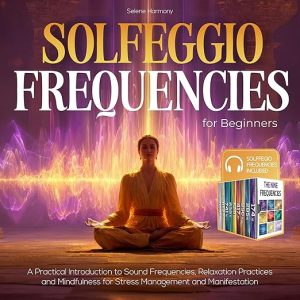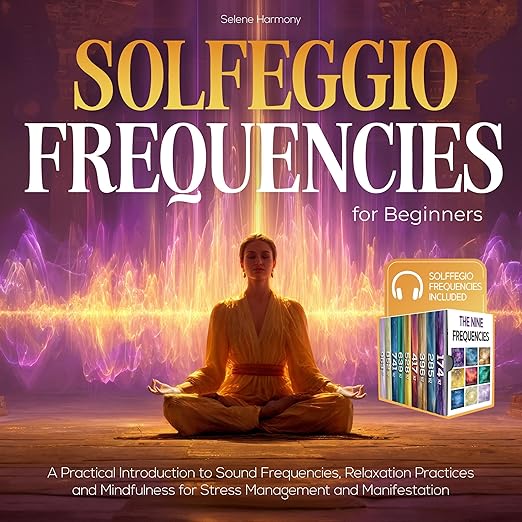
Nine frequencies, nine guided meditations, nine soundscapes and a companion document running past 120 pages. Is that an audiobook or a piece of software? The question is not rhetorical, because it determines whether twenty hours and one minute is an absurd length for a beginner's introduction or exactly the right one. Selene Harmony has built something closer to a boxed course than to a book read aloud, and the runtime only makes sense once you understand that.
Spoken chapters cover the history and origins of the Solfeggio tones and the principles behind sound, vibration and mindful listening, with "no prior experience required". Around that sits the practical material: a meditation for each of the nine core frequencies, from 174 Hz for grounding and deep relaxation up to 963 Hz for stillness and inner calm, plus nine immersive soundscapes intended for focused listening or relaxation. Rae-Ann Gammon holds the narration credit.
A Library You Keep Returning To for Listening
Most wellness titles ask you to listen to a book about a practice and then go and do the practice somewhere else. This one puts the practice inside the file. That is a structural choice with real consequences: you are buying a library rather than an argument, and the value depends far more on whether you keep returning to the meditations and the soundscapes than on whether you agree with the opening chapters.
Worth being clear-eyed about the framing, though. The description assigns each frequency a specific function, 396 Hz for emotional release, 639 Hz for connection and interpersonal awareness, 741 Hz for clarity and self-expression, and so on down the list. That mapping belongs to a tradition rather than to a laboratory, and the book presents it as heritage rather than as clinical fact. Melanie Pendleton, whose review is the most recent on the page, reads it the same way, praising a work that "blends ancient traditions with modern explanations, so it feels grounded and practical rather than vague".
Pendleton's notice also identifies the audience precisely: someone "curious about sound healing but doesn't want anything overly mystical or complicated". That is a narrower target than it sounds. Sound-practice material tends to split between vague spiritualism and dense acoustics, and a title that lands between the two has genuine shelf space to occupy.
For Anyone Who Feels Stuck In a Rut
Everything you need sits inside one purchase, and that self-containment is the strongest practical argument for it. You get the explanation, the guided sessions and the ambient material together, which removes the usual scramble for a separate meditation app once the theory is finished. For someone starting from zero, having a session for each frequency sitting in order removes every excuse not to try one. Teresa Rutrough, who filed the only four-star notice, describes the target state plainly: the book is for anyone "stuck in life, stressed out, and just feeling in a rut", and it "will tell you how to fix it".
Reviewers are unusually consistent about what the material actually does. Guga calls it a "Clear and calming guide" that introduces the frequencies "with simple exercises, blending mindfulness and relaxation to ease stress, deepen focus". A notice filed three days before release describes "simple relaxation and mindfulness practices to reduce stress, enhance focus, and support emotional balance through sound-based wellness techniques". John reports it as "a great practice for reducing anxiety and relieving stress" and mentions breathing exercises you can run alongside the tones. That same summary reaches past stress relief to something broader, describing practices that "gently encourage intentional living". That is a larger claim than most sound-healing material makes and a more honest one, since nothing here promises a cure for anything.
Written companion material is the third argument and the one buyers most often miss. More than 120 pages of accompanying material is substantial, and for a subject with numbered frequencies and specific associations, having something you can consult rather than rewind to is genuinely useful. Verify it is attached to your copy before purchase, because none of the readable reviews mentions it at all.
Three of Five Reviews Predate the Release
Check the dates before you check the score. Three notices out of the five, dated February 7, 12 and 13, 2026, were filed ahead of the February 16 release, and four of the five give five stars. I want to be plain that nothing about that is improper; early access happens constantly in this category. It simply means the 4.9 average sitting on 22 ratings rests partly on responses written ahead of general availability, and 22 is a very small base to begin with.
A Binaural Beats Claim the Book Never Makes
Reviews here are also thin on the thing that most distinguishes this product. Not one of the five mentions the soundscapes, the guided meditations, the companion document or any individual frequency by number. One does mention binaural beats, which the description never claims to include. That is a lot of unverified surface area for a purchase this size. The binaural mention is the one I would check hardest, since the description lists nine Solfeggio frequencies and never uses the word binaural anywhere. If binaural beats are specifically what you are shopping for, confirm before buying rather than after.
Twenty hours is the obvious objection, and a very large commitment for something billed for beginners. If you want a compact explanation of what Solfeggio tones are, this is not that; a good chunk of the runtime is ambient audio you will either use repeatedly or never open. And check the filing, since this sits under arts and entertainment with a music tag as well as under spirituality, which undersells how much of it is straightforward stress-reduction practice.
Keep Returning, or Don't Buy At All
Curious beginners are the natural buyers, particularly anyone who wants the explanation and the practice in the same place and does not want to be preached at. It suits anyone who has tried meditation apps and bounced off the subscription model, since this is one purchase you keep. And it suits people who already use ambient sound to work or sleep and want a structured library organized around a system rather than a mood.
Give it a miss if you want evidence-based claims about what specific frequencies do to a nervous system, because that is not the register this operates in. Skip it if you only wanted the history, since a short article covers that ground in a fraction of the time. Buy it as a practice library you will keep returning to, or do not buy it at all.
Questions Listeners Ask
Why is a beginner audiobook twenty hours long?
Because most of it is practice rather than explanation. The package includes nine guided meditations, one for each core frequency, plus nine immersive soundscapes for focused listening. The instructional portion covering history, principles and mindful listening is a small share of the total runtime.
Does the audiobook claim scientific proof that these frequencies work?
It presents them as tradition. The description pairs each frequency with a function such as grounding, emotional release or clarity, and one reviewer describes the approach as blending ancient traditions with modern explanations. Read the frequency associations as inherited vocabulary rather than as clinical findings.
Should I be concerned that some reviews predate the release?
Be aware of it rather than concerned. Three of the five readable notices are dated in the nine days before the February 16, 2026 release, and the overall average rests on only 22 ratings. Early responses are routine in this category; the small base is the more important caution.