The Short Version
- Read by: Tyler Darby reads with the measured pace Orr's investigative prose requires; no atmospheric overreach, which is the correct choice for a myth-correction project.
- At its heart: Historical myth versus documented record, legal and institutional failure in early America, local history as forensic investigation
- Vibe: Precise and corrective, with genuine historical texture rather than spooky atmosphere
- Short version: A rigorous investigative account that reveals the Lavinia Fisher legend as legally murky and historically contested, told by a former homicide investigator who knows how to read a case file.
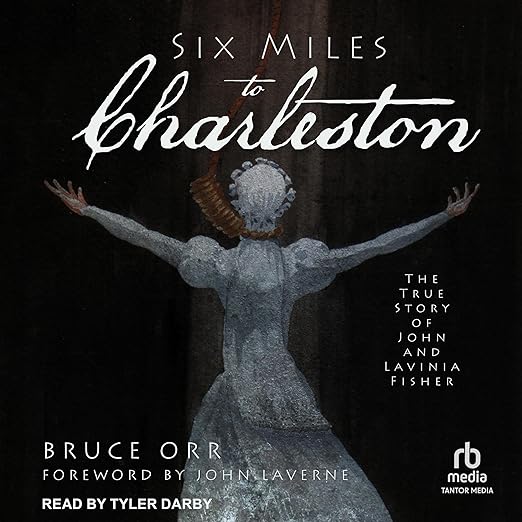
Lavinia Fisher's legend in Charleston, South Carolina is familiar to anyone who has ever done a ghost tour of the city: the beautiful innkeeper who poisoned her guests, the woman hanged in 1820 who reportedly declared she would go to heaven if anyone in the crowd would marry her. The legend, as good legends always are, is partly accurate and largely invented. Bruce Orr, a former homicide investigator who grew up in Charleston, has spent years separating the documented history from the sensational mythology, and Six Miles to Charleston: The True Story of John and Lavinia Fisher is his account of what he found. As an audiobook narrated by Tyler Darby and running four hours and thirty-eight minutes, it delivers something rarer in true crime history than the genre might suggest: a story where the real facts are more complicated and arguably more interesting than the legend they generated.
Orr Reads the Case File Like an Investigator
Orr's professional background as a homicide investigator gives this book a specific quality. He reads the historical record the way an investigator reads a case file: with attention to what the documents actually say versus what people have claimed they say, and with particular interest in the institutional failures that complicated the original prosecution. The Six Mile Inn, which stood approximately six miles outside Charleston and gave the case its name, was the site of a police raid in 1819. The raid turned up enough evidence to initiate a legal process but not enough to convict on the specific charges the legend describes. Orr's investigation of what actually happened in that reportedly grisly cellar, and what the evidence can and cannot support, is the book's most forensically interesting section.
Reviewer Cody noted accurately that the true story is "full of prison escapes, corrupt government, and years of bitter land disputes," which is a fair summary of what makes this more than a ghost story debunking. The social and legal history of the case alongside the criminal one situates John and Lavinia Fisher in the specific political environment of early nineteenth-century Charleston rather than treating them as stock serial killer archetypes. An overzealous sheriff, corrupt local officials, and recently discovered documents all figure in Orr's analysis, and each layer makes the case both more complicated and more human than the sensational version allows.
Orr's argument that Lavinia Fisher may not have been guilty of the specific crimes for which she has been mythologized is the book's most provocative claim, and he handles it carefully. He does not exonerate her or John Fisher wholesale. What he argues is that the evidence for their conviction of serial murder, as opposed to robbery, gang leadership, and related offenses, is significantly weaker than the legend suggests. The distinction matters both legally and historically. Reviewer wootiskayla, who came to the book while researching Lavinia Fisher for a speech, noted being "left with profound grief" by what she found, which suggests Orr's analysis hits harder than simple myth-correction would account for.
Darby Keeps It Steady, Not Spooky
Tyler Darby's narration is workmanlike and appropriate for the material. This is not a book that calls for dramatic atmospheric performance. Orr writes as an investigator presenting findings, and Darby reads with the steady, serious pace that kind of prose requires. The book does not try to be spooky. It is trying to be accurate. Darby's delivery respects that distinction without tipping into monotony over the four-and-a-half-hour runtime.
The period details of the Old City Jail, the legal proceedings, and the execution itself are rendered with enough specificity to satisfy readers who want historical texture alongside forensic analysis. Reviewer Kathy L. Murphy, who lives near Charleston and had done the Old City Jail tour before reading the book, found the detail genuinely satisfying. That specificity is Orr's local knowledge at work, and the audiobook carries it well. At under five hours, the book is efficient without feeling abbreviated. Orr makes his arguments clearly and does not pad for atmosphere.
Filed as Entertainment, Really Legal History
The book's classification under arts and entertainment reflects its catalog placement more than its content and methodology, which are closer to historical nonfiction and true crime. Listeners expecting a purely narrative account of the murders will find the book's legal and documentary analysis more prominent than the scene-setting that true crime readers typically expect. The balance reflects Orr's background. He is an investigator writing for readers who want to know what the evidence actually shows, and the book delivers that rigorously.
The transition from the ghost-tour legend to the documented history may produce the specific kind of disappointment that always comes with good myth-correction: the real story is more morally ambiguous and less cinematically satisfying than the one people have been telling for two centuries. Orr acknowledges this implicitly by letting the documentary evidence speak rather than trying to compensate with narrative embellishment. The result is a more honest account than most true crime in the supernatural-legend subgenre delivers, and that honesty is the book's defining quality.
A Compatible Sensibility to Michelle McNamara's Work
This audiobook is ideal for listeners interested in the intersection of historical true crime and myth-correction, particularly those with a connection to Charleston or an interest in the social and legal history of the early American South. Readers who enjoy Michelle McNamara's forensically grounded approach to cold cases will find a compatible sensibility here, even though the cases differ significantly in scale and era. Listeners seeking a heavily narrative, atmospherically driven true crime experience will find Orr's investigative approach more clinical than they may want. At under five hours, the book is efficient enough to serve as a solid starting point for anyone who wants to understand what actually happened at the Six Mile Inn before reaching for the ghost tour version of the story.
Questions Listeners Ask
Does this audiobook debunk the Lavinia Fisher serial killer legend, or does it confirm it?
It largely debunks the serial killer mythology. Orr, a former homicide investigator, argues that the evidence for the specific crimes attributed to the Fishers by legend is substantially weaker than commonly presented. He documents what the historical record actually shows, including prison escapes, land disputes, and institutional corruption, which complicates the sensational version significantly.
Is the Six Miles to Charleston audiobook suitable for someone who has no prior knowledge of the Lavinia Fisher case?
Yes. Orr provides enough context about the legend and the historical setting that listeners who have never heard of Lavinia Fisher before can follow his investigation without difficulty. The myth-correction is most satisfying for those who know the ghost-tour version, but it does not require that familiarity.
How does Tyler Darby's narration suit this kind of investigative true crime history?
Well. Darby reads with the steady, serious pace appropriate for Orr's investigative approach. The book does not aim for atmospheric effect, and Darby does not attempt to supply one artificially. The narration respects the documentary nature of the material throughout the runtime.
Does the audiobook cover the Old City Jail where the Fishers were imprisoned, and in enough detail for someone who has visited the site?
Yes. Orr's local knowledge is evident throughout, and the period details of the Old City Jail and the legal proceedings around the Fishers' incarceration and execution are specific enough to satisfy listeners who have visited the site or done the associated ghost tour.