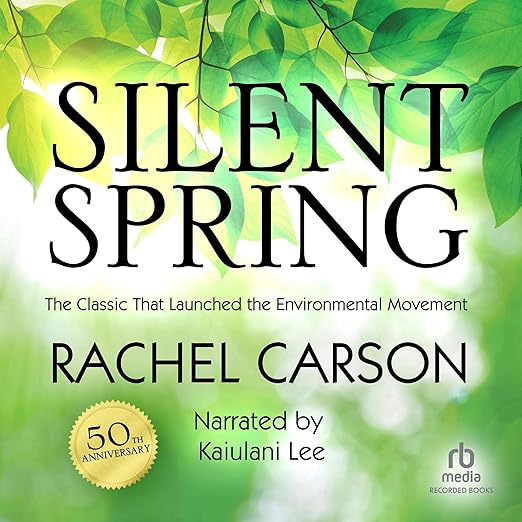
No category on this page fits, and the one the record settled on is sports and outdoors. Rachel Carson's 1962 account of what synthetic pesticides were doing to water, soil, and air sits in this audiobook catalog under a heading built for sport and recreation, with a secondary tag reading Outdoors and Nature. The second label is at least adjacent to the subject. The first looks like keyword shelving that nobody ever went back to inspect, the first sign of a listing assembled by machine.
The Verdict, Briefly
Rachel Carson gets one paragraph of description here, and it is a paragraph about reputation, not about content. First published in 1962, it says, Silent Spring can single-handedly be credited with sounding the alarm and raising awareness of humankind's collective impact on its own future through chemical pollution, and no other book has so strongly influenced the environmental conscience of Americans and the world at large. Probably true. Also of no use whatsoever to somebody deciding whether to spend ten hours and thirty-six minutes here.
Two entries in this column arrive in other languages, and neither is reviewing the text. Nadja Koch, posting from Germany in 2013, calls the book lovely, informative, and fluently written, then reports that the quality of the physical copy matched the listed description. Top, the review concludes. That is a verdict on a parcel. A reviewer in Mexico, posting under a company name in 2023, describes it as a foundational work and mentions giving copies to colleagues who handle environmental matters.
Kevin Kitchens supplies the most efficient sentence on the page: this book prompted the organization of the EPA, find out how. That is the case for listening in the present day, compressed into two lines. The review is dated October 19, 2025, making it the most recent entry on the listing, and it is written from inside the profession, recommending the book as great information for people in environmental fields of work. Set beside a description that offers only reputation, those two lines do more practical work than the publisher copy manages in a full paragraph.
Why Listen to Silent Spring
Kaiulani Lee holds the only credit on the recording, and this is a demanding book to read aloud. Chongyean Cheang describes it accurately as an immensely powerful scientific book for general readers, packed full of verifiable research and data, tracing what chemical pesticides did to the water, the atmosphere, the soil, and the earth in the decades following the experiments conducted during World War II. Sustained technical argument in a single voice across ten and a half hours is a specific proposition, and worth knowing about in advance.
Ten hours and thirty-six minutes is the stated length, and the book's construction gives a listener something to grip. Carson opens with a short chapter containing an imaginary scene, as Chongyean Cheang begins to explain, and the choice does real structural work: an invented picture placed ahead of the evidence, so the evidence has somewhere to land when it starts arriving. A reader who knows only the book's reputation tends to expect a polemic and meets something closer to a slow, documented case.
What has survived from 1962 is the argument itself. Liz Cole, writing in November 2016, calls the book as relevant today as it was 50 years ago and then itemizes why: ground, air, food, and bodies bombarded with chemicals, carcinogens, and products of every sort made to kill weeds and bugs and perfectly capable of killing us. Laws requiring that testing be done are on the books, the review adds, and get disregarded because the chemicals make our grass greener.
What Gives Us Pause
Expect a 2007 recording of a 1962 text, and expect the page to say nothing about how that distance was handled. Recorded Books issued this edition on January 26, 2007. Whether it carries an introduction, an afterword, a note on which of these compounds have since been restricted, or no framing at all is stated nowhere. For a book whose subject is chemical regulation, the absence of any editorial apparatus in the description is a genuine gap.
Half of the review column cannot help you judge the recording. Two entries are written in other languages about the physical object, one is a handful of lines, and the two substantial ones were posted years apart and are responding to the text itself, never to a particular edition. None of that is dishonest. It is simply a set of reactions to a book that has existed in many forms, pooled onto a single audio page. What it means in practice is that the strongest praise here comes from people who found the book decades after publication, which is its own quiet evidence about how well the argument has kept.
Liz Cole's phrasing deserves a pause. Writing in 2016, the review places the book 50 years in the past; the record dates first publication to 1962. The slippage is small and entirely human, and it is a reminder that these responses were written at scattered moments across the book's long afterlife, from 2013 through to late 2025, and then presented together as though they described one purchase on one day.
The Right Listener for Silent Spring
Environmental history is the obvious way in, and the column is unusually specific about who benefits. Kevin Kitchens points at people already working in environmental occupations. Chongyean Cheang frames it as a scientific book aimed at general readers, which is the harder trick and the reason the thing worked in the first place. The reviewer in Mexico treats it as something you hand to colleagues, which says it still functions as a founding document and not a historical curiosity.
Nobody should come to this expecting a nature ramble, whatever the shelving implies. It is an argument assembled from case histories and citations, delivered at length, about poisoning. A listener who wants the outdoors as consolation will get the exact opposite. A listener who wants to understand where modern environmental regulation came from, and who can sit through the full running time while the evidence accumulates, will find that the book has not softened with age.
Narrative nature writing is not on offer here, and a single-voice reading of technical material across ten and a half hours will feel like homework to plenty of people. The shelf label is wrong, the review column is a patchwork of editions and languages, and the book underneath both is still the one that started the argument.
In Brief
- Performance: Kaiulani Lee takes the only credit on a long single-voice reading of chemistry, case history, and argument.
- What it covers: chemical pesticides, regulatory failure, public health, the origins of environmental awareness.
- Feel: Measured and cumulative, closer to a legal brief than a nature walk.
- Our call: The argument holds up; the listing wrapped around it does not.