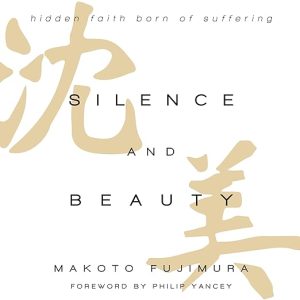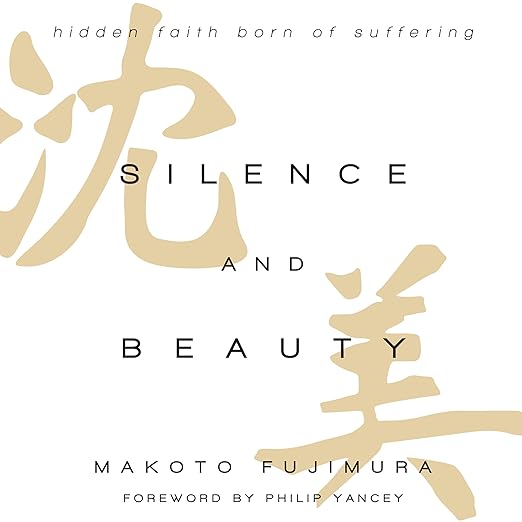
A 17th-century Portuguese missionary's crisis of faith anchors Shusaku Endo's 1966 novel Silence, and Makoto Fujimura builds this audiobook as a visual artist's extended meditation on that same terrible choice, decades later and an ocean away.
Endo's Silence endures as one of the essential works of twentieth-century Japanese literature, built around the persecution of Christians in Japan and the excruciating question of what faith means once it stops being safe to practice. Fujimura's book is not a retelling of that novel; it is a personal and critical response to it, written by a visual artist who found his own creative and cultural inheritance reflected back at him inside Endo's pages. Listeners entirely new to Endo's novel should not worry about missing crucial context; Fujimura recaps the essential plot and stakes clearly enough early on that the book functions as a legitimate entry point into both works at once, not just a companion piece requiring prior homework.
Nihonga's Pulverized Minerals as a Metaphor
What makes the book distinctive is the way Fujimura braids three different threads together: close literary reading of Endo's novel, memoir material about his own Japanese-American identity and artistic formation, and theological reflection on suffering, silence, and what he calls 'Christ-hidden cultures.' None of the three threads dominates for long before yielding to the others, which mirrors the layered, indirect way the book argues that meaning survives even in cultures where faith has to stay hidden to survive at all.
Fujimura works in Nihonga, a traditional Japanese painting technique using pulverized minerals rather than conventional paint, a slow, materially demanding practice that itself becomes a running metaphor throughout the book for patience, hidden process, and beauty that takes real time to surface. Readers unfamiliar with the medium going in will come away understanding not just what it looks like but why an artist committed to something this deliberate would be drawn to Endo's equally patient, equally demanding novel. That material specificity, the actual physical process of applying and layering mineral pigment, gives Fujimura's prose a groundedness that keeps the more abstract theological passages tethered to something concrete and sensory rather than drifting into pure abstraction, a detail worth knowing before starting.
Saopeng Lets Each Register Breathe
Ova Saopeng narrates with an unhurried, contemplative pace that matches material moving constantly between registers: art criticism, personal memoir, and theological argument rarely sit comfortably together in one book, let alone one narrated performance. Saopeng does not rush the transitions or flatten them into a single uniform tone; each mode gets space to breathe before the book pivots to the next. Both reactions, arriving from clearly different vantage points on faith and art, converge on the same basic claim: this is a book that changes how attentive listeners see suffering itself.
Hidden Faith Is Not Failed Faith
Reviewer Adam Shields, who says he rarely goes 'more than a couple weeks without referencing' Endo's original novel, calls Fujimura 'a very well known artist' whose reach extends well beyond the evangelical circles where he is most celebrated. Another listener, David, went further, calling the book 'revelatory' and crediting it with reshaping his own perspective on beauty, suffering, and silence together, which captures the book's ambition better than a plot summary ever could, since no plot exists here to summarize, only accumulating insight.
Even readers outside any Christian faith tradition may find real value in how directly the book engages cultural translation: what happens when a belief system arrives in a culture already possessing its own deep aesthetic and spiritual traditions, and has to find new, sometimes hidden forms in order to survive contact with that culture rather than simply overwrite it. That question extends well past the specific historical case Endo's novel covers. Fujimura is explicit that hidden faith is not failed faith, a distinction with real resonance for anyone who has had to practice any deeply held belief, religious or otherwise, quietly rather than openly.
A Working Artist Describing Unseen Paintings
This is unmistakably a book written from inside a specific Christian faith framework, and Fujimura does not pretend otherwise or soften his theological commitments for a broader secular audience. Listeners uninterested in questions of faith and suffering specifically, as opposed to Japanese art and literary history generally, may find the theological material asks more patience of them than the art criticism does.
A second, related caveat: Fujimura is a working visual artist discussing his own paintings and other artworks throughout, and audio necessarily strips away the images themselves. He is a skilled enough writer to describe color, texture, and technique in ways that partially compensate, but listeners who want to actually see the pieces under discussion should keep a device handy to search for images of his work alongside listening.
Spaced-Out Sessions, Not One Long Sitting
Given how deliberately the book moves, more meditation than argument in long stretches, it likely rewards shorter, more spaced-out listening sessions over binging the full runtime in one extended sitting. Material this dense with reflection benefits from time to actually sit with a listener between chapters, closer to how someone might read a chapter of devotional writing and then set the book down for a day, rather than how most nonfiction gets consumed. Listeners who prefer to consume nonfiction quickly, in long single sittings during a commute or a workout, may find this specific title fights against that habit more than most audiobooks in this genre do.
Not an Art-Heals-Trauma Narrative
Readers of Endo's Silence looking for a serious critical and spiritual companion piece, along with anyone interested in Japanese Christian history or the intersection of visual art and theology, will find nine hours and forty-four minutes genuinely rewarding rather than padded.
Working artists in any medium, not just visual art, who are looking for a serious treatment of how creative practice and personal suffering actually intersect, rather than a simplified art-heals-trauma narrative, will likely find Fujimura's specific honesty about the slowness and difficulty of that intersection more useful than more inspirational, easier books on the same general subject. The book resists tidy resolution throughout, which is itself part of its integrity as a serious meditation rather than a self-help title in disguise. Art history readers specifically interested in cross-cultural artistic exchange between Japan and the West will also find real substance here beyond the theological framework, even if that framework remains the book's central organizing lens throughout. That crossover value is easy to overlook given how the book is marketed.
Anyone picking this up expecting a straightforward literary biography of Endo himself, or a secular art-history survey without theological content, has the wrong book; Fujimura's own faith is the lens the entire project is built through.
Before You Press Play
- Read by: Ova Saopeng's unhurried, contemplative pacing holds together a book that shifts constantly between memoir, criticism, and theology.
- At its heart: faith amid suffering, Japanese Christian history, art as spiritual inquiry
- Vibe: Contemplative and searching
- Short version: A serious, faith-grounded companion to Endo's Silence for listeners genuinely interested in art, suffering, and belief together.
Do I need to have read Shusaku Endo's novel Silence before listening to this audiobook?
It helps but is not strictly required; Fujimura recaps enough of Endo's novel that newcomers can follow along, though prior familiarity deepens the experience considerably.
Is the Silence and Beauty audiobook written from a specifically Christian perspective?
Yes. Fujimura writes openly from within a Christian faith framework, and the theological material is central rather than incidental to the book's argument.
Does this audiobook include descriptions of Makoto Fujimura's own artwork?
Yes, in verbal form. Fujimura describes his paintings and creative process in detail, though listeners wanting to see the actual images will need to look them up separately.