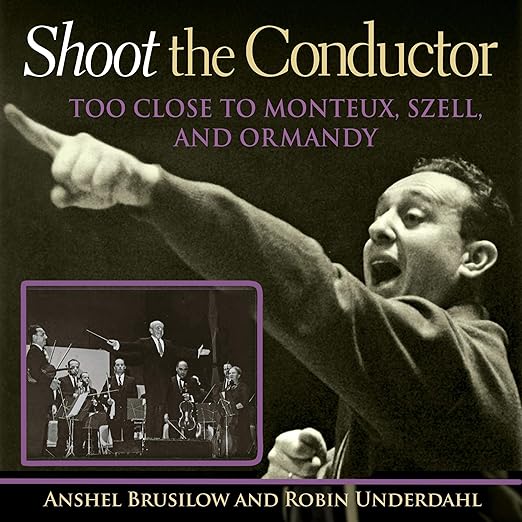
Anshel Brusilow was five years old when he started playing violin in a Russian Jewish neighborhood of Philadelphia, and by sixteen he was soloing with the Philadelphia Orchestra. That trajectory alone would be enough for a memoir worth spending time with. What makes this audiobook, Shoot the Conductor: Too Close to Monteux, Szell, and Ormandy, something considerably more than a prodigy’s success story is everything that came after: the decade as concertmaster of one of the most prestigious orchestras in the world, the tumultuous relationships with three of the most demanding conductors in American classical music history, and the decision to put down the violin and pick up the baton at a professional cost that reshaped the rest of his career. Narrated by John Burlinson and running twelve hours, it is a rare document of a world most listeners have never seen from this angle.
Szell Watched From the Severance Hall Lot
The book’s title announces its sensibility from the first page. Brusilow is not writing to settle scores in the conventional vengeful sense, but he is writing with the frankness of someone who spent decades in close proximity to powerful, difficult men and who no longer has any professional reason to soften what he observed. Pierre Monteux, George Szell, and Eugene Ormandy were three of the defining conductors of American orchestral life in the mid-twentieth century, and Brusilow writes about each of them with the specificity of someone who watched them operate from the first chair of the orchestra, closer than almost anyone else in the room.
Szell’s behavior during pre-concert walks, monitoring his orchestra members from the parking lot of Severance Hall in Cleveland, and Ormandy’s fierce protectiveness of Brusilow as his concertmaster in Philadelphia followed by equally fierce resentment when Brusilow moved toward conducting: these are not the kinds of observations that appear in official biographies or program notes. They are the texture of a professional life lived inside an institution, and they make the book genuinely valuable as historical record as well as compelling personal memoir. Co-written with Robin Underdahl, the voice is precise and sometimes wry in a way that Burlinson captures well throughout the twelve hours.
Founding the Philadelphia Chamber Symphony, Then Dallas
John Burlinson narrates with the cultivated restraint that suits the material. Brusilow’s account is precise and sometimes darkly funny, and Burlinson captures that combination without exaggerating the drama that the anecdotes contain or leaning into the moments of personal conflict in ways that would feel exploitative. The memoir’s structural decision to organize around Brusilow’s relationships with the three conductors gives the book shape and forward movement across its twelve hours: each relationship represents a stage in his development and a different kind of professional pressure, and the transitions between them feel like genuine turning points rather than arbitrary chapter divisions.
The section describing Brusilow’s formation of the Philadelphia Chamber Symphony and his subsequent tenure at the then-troubled Dallas Symphony Orchestra rounds out the portrait with evidence that his conducting ambitions were not simply about escaping the orchestra’s first chair but about building something of his own from the ground up. The Foreword Reviews INDIEFAB Book of the Year Award in Performing Arts and Music reflects the memoir’s standing in its field, and the recognition is warranted: this is a serious contribution to the oral history of American classical music that happens to be consistently engaging as a personal story.
Hermetic in Places, Demands Sequential Listening
One reviewer appreciated the book’s depth while also noting honestly that it could be hermetic for someone wanting a colorful story without the specialized context, and this assessment is accurate. Brusilow writes from inside his world rather than translating it for outsiders at every turn. He assumes a degree of familiarity with orchestral hierarchy, with the specific professional dynamics of a concertmaster’s role, and with the relative weight of Ormandy’s Philadelphia versus Szell’s Cleveland in the hierarchy of American orchestras at the time. Listeners who arrive without that context will still find the human stories accessible, but some of the professional stakes will require inference rather than being made fully explicit.
The audiobook demands sequential listening: the biographical arc builds meaning from one section to the next, and dipping into individual chapters out of order will flatten the effect of the larger narrative. The memoir also touches on recordings Brusilow made during his Philadelphia years, and listeners who seek out those recordings alongside the audiobook will find the two experiences mutually enriching. Brusilow played with or conducted virtually every significant figure in American classical music during his career, and his observations about those encounters, informed by decades of reflection, give the book a scope that extends well beyond his individual story.
Insider Material, Met on Its Own Terms
This audiobook is most richly rewarding for listeners who grew up with classical music, who have attended orchestral concerts with any regularity, or who are curious about what happens behind the scenes of an institution that presents a polished public face. Reviewers who grew up in Philadelphia specifically describe a quality of recognition in the book, encountering a figure from their musical childhood from a completely new angle. But the memoir’s appeal is not geographically limited. Anyone interested in the dynamics of creative ambition, in how working-class immigrant backgrounds shape professional identity across decades of institutional life, and in the specific way that artistic organizations manage hierarchy and succession will find Brusilow’s account both absorbing and illuminating. Those who want a mainstream celebrity music memoir should look elsewhere. Shoot the Conductor is insider material, written for readers willing to meet it on its own terms, and for those readers it is among the more honest and revealing accounts of professional musical life available in audio form.
Do you need to know classical music to appreciate this audiobook?
Some familiarity helps considerably. Brusilow writes from inside the orchestral world and assumes acquaintance with its hierarchy and key figures. The human stories, particularly the dynamics with Ormandy and Szell, are accessible to any engaged listener, but the professional stakes are richer for listeners who know the landscape he is describing.
Is Shoot the Conductor audiobook primarily about Brusilow’s violin career or his conducting ambitions?
Both, with the tension between them as the book’s central subject. The memoir is structured around his evolution from prodigy and concertmaster to conductor, and that transition and the cost it imposed on his relationship with Ormandy is where the book’s dramatic and emotional energy is most concentrated.
How candid is this audiobook about the personal behavior of Monteux, Szell, and Ormandy?
Quite candid. Brusilow writes with the frankness of someone no longer constrained by professional proximity to powerful figures, and the anecdotes about all three conductors have the specificity of direct observation rather than diplomatic summary. This candor is one of the memoir’s primary values as a historical document.
Does the audiobook format suit a classical music memoir like this, or is it better experienced in print?
The memoir translates well to audio. Burlinson’s narration suits the material’s measured, wry tone, and the biographical arc benefits from sequential listening across a single medium. Listeners who want to mark or reference specific passages may prefer to have the print edition available alongside, but the audiobook stands fully on its own.