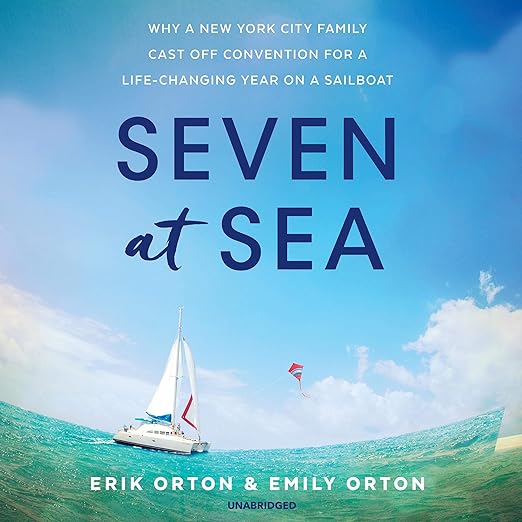
Eight and a half hours is not much room for a year at sea, and that compression is the first thing worth knowing about this audiobook. Erik Orton was working night shifts as a temp in a high-rise cubicle, watching sailboats on the Hudson River during his sunset dinner breaks, when he decided that a family of seven with no sailing experience would spend a year on a boat. The publisher's copy puts the distance at 5,000 miles between New York City and the Caribbean. What it does not put a number on is the part that fills most of the runtime, which is what happens to a marriage and five children once the plan stops being a daydream and starts costing money.
Shadow Mountain released this file in March 2019, and the byline is the first thing on the page that disagrees with the book underneath it. The author field reads Erik Orton and stops. The closing line of the same publisher copy says the story is told alternately by Erik and Emily. A four-star filed on March 22, 2019 does not treat that as a question at all, referring to Seven at Sea by Erik Orton and Emily Orton and describing a book that moves through acceptable risk, doing hard things, parenting, marriage and the meaning of home. That same response adds a warning worth repeating: the memoir never suggests you should take up sailing yourself.
Shelving is the second problem. This sits under sports and outdoors with a Water Sports tag attached, and anyone browsing that category will arrive expecting passage planning, weather routing and the mechanics of a shorthanded crew. Some of that arrives. Most of the eight and a half hours goes elsewhere: a father counting rent money, a wife with a phobia of deep water agreeing to live on top of it, an oldest daughter whose departure for college is the clock the entire plan runs against, and a youngest child with Down syndrome for whom the boat is simply where the family lives. Filed honestly, this is a domestic memoir with a boat in it.
The Best Parts of Seven at Sea
Practical value shows up anyway, and the warmest endorsement on the record frames the book as preparation rather than entertainment. A five-star from May 2024 calls it the one book to read before a sailing trip, describes the family crossing from Saint Martin to Florida, and credits the husband and wife duo with storytelling that holds up. Worth noticing that the copy sells the route in the other direction, as a run out of New York City toward the Caribbean, so the leg that response remembers most vividly is the one the marketing spends least time on. Either way, the recommendation arrives from someone treating the book as a working document.
Why it functions that way has little to do with seamanship. Orton had never sailed when the plan began; the household was already stretching every dollar for rent and groceries; the risk list the copy commits to writing includes going broke, injury and death, and, worst of all by the family's own accounting, humiliating themselves by trying something audacious and failing. That last item is the honest one, which is why the book works for people who will never own a boat. The decision under examination is not nautical. It is the decision to do a hard thing in public, with your children watching, and to keep going once the first weeks prove you underestimated it.
Before You Commit to Seven at Sea
None of the written responses on this record describe listening to anything. A five-star from April 2019 opens by admitting to reading only a few books a year, then describes the copy arriving in the mail and being opened the same day, with every spare minute going to it across the two weeks that followed. Another describes reading passages out loud to a spouse who kept asking what was so funny. That reception is genuine and it is affectionate, and it is also entirely about a physical object. Whatever George Newbern does across eight and a half hours, the 190 ratings stacked on this page were not visibly earned by the recording, and nothing written here tests it.
The structural question is larger. A memoir told alternately by two people, in two first-person voices, arrives credited to a single reader. That is an ordinary production choice rather than a defect, but it does mean the seam between one author's chapters and the other's has to be carried by the prose and by one voice instead of by casting, and a listener who loses track of who is speaking loses the thing the book is built on. Nothing on this record mentions a supplementary download either, so if you came for charts, a route map or a provisioning list, understand that you are buying the story and not the logistics.
Should You Listen to Seven at Sea?
This suits people who are stalling on something. A five-star filed in January 2026, nearly seven years after release, puts it plainly: you learn as much about marriage and family here as about the adventure. That is the audience. Parents weighing a disruptive decision, couples where one person wants the leap and the other is quietly terrified of it, anyone who has priced out a plan, found the number impossible, and kept thinking about it regardless. The Down syndrome thread is handled as part of ordinary family life rather than as a lesson, which will matter to some listeners more than any of the sailing does.
Sailors after the sea itself should look elsewhere. A technical account of a first ocean passage is not what this is; the boat functions as a setting rather than a subject, and the water sports tag will have promised something the book never sets out to deliver. The other group worth warning is anyone for whom uncredited work spoils the experience, since the byline problem does not resolve itself when you press play. What remains is a specific and unusually candid account of a household that decided the years before their oldest child left home were worth spending badly rather than safely, then had to live inside that decision for twelve months.