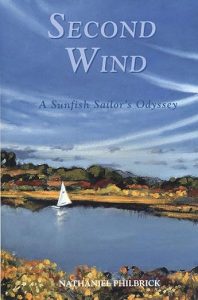
Can a 37-year-old sailor really relive a championship he won at 22? That is the question this short audiobook sets out to answer, as Nathaniel Philbrick returns to Sunfish racing fifteen years after his first North American title to see whether the old instincts, and the old ponds of his native Nantucket, still have anything left to teach him.
Is Second Wind Worth Your Time?
At four hours and twenty-five minutes, Second Wind is one of Philbrick's slightest books by runtime, and it reads that way too: a personal, small-scale account rather than the sweeping historical narrative he is best known for elsewhere. The synopsis calls it "a warm, funny, often moving story of a sailor, his family, and an island," and that description undersells how specific the material gets. This is a book about one particular class of small sailboat, one particular island's ponds, and one specific tournament in the American heartland, not a broad sailing memoir aimed at a general audience.
Sitting with the title for a moment pays off. "Second wind" describes a real thing that happens mid-race, a burst of renewed energy after the body seems spent, but it is also doing double duty as the book's whole premise: a sailor fifteen years past his first title getting a second chance at the same kind of win. The synopsis frames the trip from Nantucket's ponds to a heartland championship as "a personal voyage of discovery," language that suggests Philbrick is as interested in what changed about him in fifteen years as he is in the racing itself.
Reviewer Kevin, who shares roughly Philbrick's age and background, calls the result "light, airy and fun," the kind of book that sits on a nightstand on Cape Cod waiting to be picked up again. That is a real endorsement of the book's tone, but it also hints at the audience it is actually written for: readers already inclined toward Nantucket's own sailing culture rather than newcomers to it.
The Best Parts of Second Wind
Philbrick's larger reputation carries real weight here, even on a book this small. Reviewer John W. Stahl notes that this particular title lacks the "universal appeal" of 'Mayflower,' 'Last Stand,' or 'Heart of the Sea,' while still calling the author "an extraordinary writer" and this specific book an enjoyable read. That kind of qualified praise from someone clearly familiar with the rest of Philbrick's catalog is a useful signal: Second Wind is the minor, personal entry in a body of work built mostly on major historical narratives, and it rewards listeners on different terms than those books do. Where a book like Mayflower has to hold a general reader's attention across an entire nation's founding myth, Second Wind only has to hold the attention of someone who already cares about one man, one boat class, and one island, which is a much narrower bet to make on a listener's patience.
Family is a real presence in the book too. Stahl's review ends with a short, affectionate aside: "His wife is a saint!" The synopsis itself frames the voyage as something that brought "a sailor, his family, and an island" together rather than a solo athletic quest. Amazon Customer's review backs that up from a sailor's own perspective, describing the pleasure of "reading accounts with others I had sailed with" and the memories the short chapters brought back. That reviewer's short, chapter-by-chapter structure comment is a useful preview of the audiobook's likely pacing too: a series of contained episodes rather than one continuous dramatic arc, which suits a shorter commitment better than a single sustained story would.
Before You Commit to Second Wind
Two listing details are worth flagging before you buy. First, the narrator field on this audiobook reads only "a great writer," not an actual name, leaving no credited performer to evaluate and no way to tell from the listing itself who is actually reading the book. Second, the ISBN, publisher, and language fields on this same listing all carry small invisible formatting marks, the kind of leftover debris typically seen when data gets pulled from a print or Kindle listing rather than entered fresh for an audio edition. A 256-page count sits alongside a runtime of four hours and twenty-five minutes, which is plausible for that page count but is one more sign this listing may be blending print and audio metadata rather than describing the audio edition cleanly.
Content-wise, the steepest warning comes from Demarest S.Newman's three-star review: the book "quickly became boring" to a reader unfamiliar with Nantucket's ponds or the rules of small sailboat racing, since Philbrick "must have assumed anyone reading his book would be totally familiar with the nuances of racing and boat handling." John W. Stahl makes the identical point from the four-star side of the fence, saying the material rewards listeners who are already "interested in/familiar with Nantucket" and "somewhat experienced with small sailboat racing." Two reviewers landing on the same specific gap, from opposite ends of the rating scale, is a pattern worth taking seriously. Neither reviewer is describing a badly made book, only a book that was not written with an outsider in mind, and that distinction matters when deciding whether four and a quarter hours of racing detail is going to land as immersive or as impenetrable.
Should You Listen to Second Wind?
This is a book for sailors, specifically small-boat and Sunfish sailors, and for readers with some existing connection to Nantucket and Cape Cod, more than it is a book for general Philbrick fans looking for another Mayflower or In the Heart of the Sea. Anyone who already knows what a Sunfish is and has an opinion about racing tactics will likely find exactly the warm, specific, insider's account that Kevin and Amazon Customer both describe.
Readers hoping for one of Philbrick's big historical narratives should look toward his other titles instead, since reviewers are consistent that this shorter, personal book does not have that same universal pull, and unfamiliar racing terminology is a genuine risk for anyone easily pulled out of a story by jargon. Sailors, or anyone who has spent real time on the water around a small island like Nantucket, are the listeners this one was actually written for, and the narrator-credit and print-metadata oddities on the listing are worth a second look before you commit either way.
At a Glance
- Narrator: The listing's narrator field reads only "a great writer," not an actual name, which rules out any credited performer to evaluate.
- Subjects: Small-boat sailboat racing, a return to a childhood sport in middle age, Nantucket and Cape Cod life
- Tone: Light, warm, and a little wry rather than dramatic
- Bottom line: A slim, insider's sailing memoir that rewards readers who already know Sunfish racing, on a listing with real metadata oddities worth noting.