In Brief
- Narration: Edoardo Ballerini brings warm Italian authority to the material, pacing the wartime urgency against the weight of centuries-old art with convincing steadiness.
- Themes: Art preservation under occupation, wartime heroism, cultural identity under threat
- Mood: Urgent and reverent, with the tension of a heist thriller framing a true story
- Verdict: Robert Edsel's account of the Monuments Men in Italy is one of the most compelling nonfiction audiobooks about WWII art rescue, and Ballerini's narration gives it the gravitas it deserves.
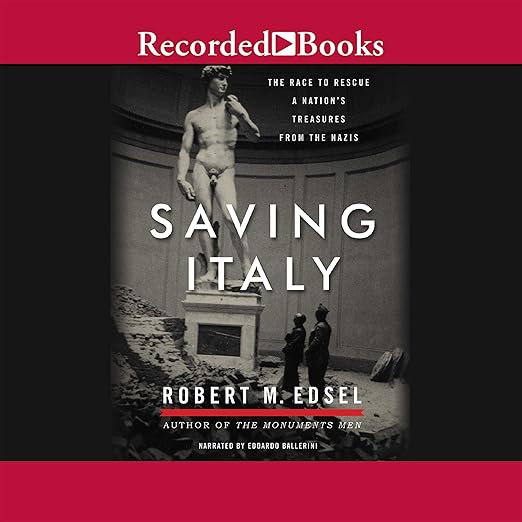
Deane Keller and Fred Hartt are not household names, and that is precisely the problem Robert Edsel set out to correct. Saving Italy, narrated by Edoardo Ballerini and running just under twelve hours, is the audiobook companion to Edsel's broader Monuments Men project, but it narrows its focus to the Italian theater with results that feel both more urgent and more personal than a survey of the whole European campaign would allow. The stakes here are almost absurdly high: Michelangelo, Donatello, Titian, Caravaggio, Botticelli. The Nazis had seized them all, and two American art scholars with army commissions were sent to do something about it.
Edsel's premise is disarmingly simple. When the Allies invaded Italy in 1943, they faced a problem no military planner had fully anticipated: the country they were liberating was also the repository of a significant share of Western civilization's greatest artistic achievements. General Eisenhower's response was to commission a handful of art historians, architects, and museum curators to follow the frontlines and do what they could. Keller, a Yale sculptor and art professor, and Hartt, a Renaissance scholar, set out from Naples in May 1944 on what Edsel describes as the treasure hunt of a lifetime. The audiobook tracks their progress through bombed cathedrals, abandoned villas, and chaotic wartime bureaucracies, always keeping the human stakes audible beneath the institutional machinery.
Ballerini Gives the Germans Equal Attention
What Edsel does well, and Ballerini's performance reinforces, is refuse to let the art become mere inventory. Each recovered work gets its context restored: why this Donatello matters, what the loss of this Titian would have represented, how the looting networks functioned at a bureaucratic level. One reviewer on Amazon noted feeling that the Monuments Men's own fieldwork was less completely described than the political and military background surrounding them, and that is a fair observation. Edsel is at his strongest explaining how institutional decisions, German high command debates, and Italian civilian courage shaped the trajectory of the art's survival. The moments when Keller and Hartt themselves appear as protagonists are vivid but sometimes frustratingly brief.
Ballerini is a strong choice for this material. His Italian pronunciation is authoritative without becoming a performance, and he handles the logistical passages, the long stretches detailing chain-of-custody arguments and Allied military directives, without letting the pacing collapse. The emotional register stays controlled and largely unsentimental, which works well for a story that could easily tip into hagiography. Ballerini gives the German figures the same attention he gives the heroes, which keeps the audiobook honest rather than triumphalist.
Salt Mines and Partisans Share the Stage
The case for the audio version of this book comes down to duration and density. At eleven hours and forty-seven minutes, Edsel has packed in enough historical context that a reader rushing through a print copy might skim. Ballerini's measured delivery forces the right kind of attention. You hear the names of the paintings, the churches, the cities, and the soldiers spoken aloud in a way that lodges them more firmly than a page scan would. The result is that by the time the story reaches its climactic discoveries, the salt mines and the Florentine repositories and the north Italian caches, the names carry genuine weight earned through sustained listening.
There is also the matter of the supporting cast of history Edsel assembles around Keller and Hartt. Nazi art dealer Karl Wolff, the SS commanders making impossible decisions in the final months of the occupation, and the Italian partisans who hid canvases in farmhouses all receive sufficient development to feel like characters rather than footnotes. The audiobook's structure moves between the military chronology and the art-recovery narrative with enough skill that neither feels like an interruption of the other. This interweaving is harder to navigate in print; in audio it carries the listener forward with more momentum.
The Vatican's Careful Non-Role in Occupation
The book's most arresting passages involve the Vatican's role, or rather its careful non-role, during the occupation. Edsel handles the diplomatic complexities with precision, neither exonerating nor condemning the Catholic hierarchy's calculations, and the sections dealing with the Vatican's negotiations over specific collections are among the most nuanced in the entire audiobook. These passages reward close listening rather than background absorption; if you are treating this as commute audio, you will want to rewind.
The other thread to follow closely is Hartt's postwar work. The book does not end with liberation. Edsel extends the story through the long, unglamorous process of cataloguing, restitution, and public accounting, and it is in these closing chapters that the scale of what was saved, and what was permanently lost, becomes clearest. Listeners who come expecting a triumphant conclusion will find something more complex and more honest: a partial reckoning with a cultural catastrophe that was never fully undone. That refusal to clean up the ending is what separates this audiobook from a simpler wartime rescue narrative.
More Than the 2014 Film Could Show
This audiobook suits listeners with a genuine interest in WWII history who want something beyond the combat narrative, readers who have encountered the Monuments Men story through the 2014 film and want the full, uncompressed version, and anyone who cares about Renaissance art and wants to understand what the twentieth century nearly destroyed. Listeners who prefer tightly plotted narrative nonfiction over research-dense historical chronicle may find the middle sections demanding. But for the patient listener, Edsel and Ballerini deliver a story that few historians have told with this kind of granular conviction and archival rigor.
Common Questions
Does this audiobook cover the same ground as The Monuments Men by Robert Edsel?
Saving Italy is a separate book that focuses exclusively on Italy, while The Monuments Men covers the broader European theater. The two books share thematic DNA but follow different protagonists and geographies. You do not need to have read The Monuments Men first, though listeners who have will recognize the framework and appreciate how the Italian story deepens it.
Is the audiobook narrated well enough to follow the complex historical and logistical detail?
Edoardo Ballerini handles the density of names, dates, and institutional actors with patience and clarity. His pacing gives the listener time to absorb the chain-of-custody arguments and wartime bureaucracy without glossing over them. Some passages remain complex by nature, but the narration does not compound the difficulty.
Does the book require prior knowledge of Renaissance art to follow the story?
No specialized art-historical background is required. Edsel provides enough context for each major work that a general listener can follow the significance of what is at stake. Art history enthusiasts will find extra resonance in the details, but the book is designed for a broad nonfiction audience.
How does this audiobook handle the question of Italian civilian involvement in protecting artworks?
This is one of the stronger threads in the book. Edsel gives considerable attention to the Italian curators, partisans, and ordinary civilians who concealed or relocated artworks ahead of German seizure. These passages humanize the story beyond the American heroes framework and give a more complete picture of the resistance effort.