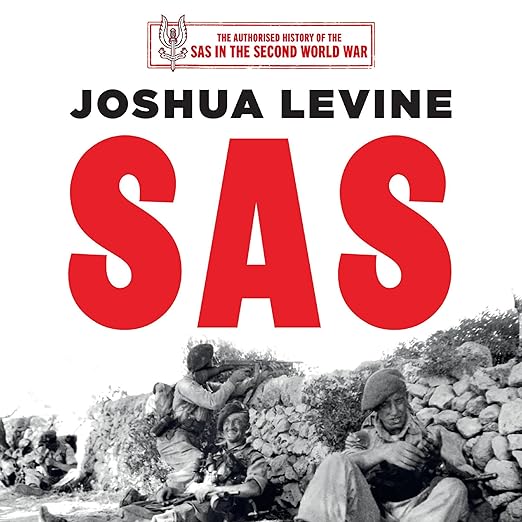
SAS began, according to Joshua Levine, as a lie: a fabricated British parachute unit invented to spook Axis commanders in the North African desert. This audiobook opens with that deception and never really lets go of the tension between myth and reality that defines the unit's own origin story. Levine, whose earlier book Dunkirk topped bestseller charts, had full cooperation from the SAS itself and exclusive access to its archives for this book, and that access shows in how confidently he moves past the familiar David Stirling and Paddy Mayne legend into figures like Bill Fraser, whose work helped make the unit's raids famous even though history mostly forgot his name.
Resourcefulness Mattered More Than Raw Endurance
One reviewer, using the handle muondude, specifically praised how Levine treats the unit's members as real personalities rather than manufactured heroes, and that distinction matters more than it might sound. Stirling and Mayne get their due as what the book calls unorthodox visionaries, but Levine spends just as much energy on the friction between commanders, the disagreements, and the eclectic personalities that made the early SAS as prone to failure as to brilliance.
That honesty about failure is part of what makes the book land. Levine gives real weight to operations that went badly alongside the raids that became legend, and muondude's review captured a genuine sense of amazement at what these young men risked fighting fascism in the desert. The result reads less like a recruitment poster and more like an attempt to recover the actual, flawed human beings underneath a myth the SAS has spent decades cultivating about itself.
The book's structure moves the unit from North Africa into the European theater as the war progresses, and that geographic arc mirrors the SAS's own evolution from an improvised desert raiding party into a more formalized special-forces model. Levine resists treating that evolution as a straight line of improvement, showing instead how much of the unit's early success depended on genuine trial and error, including operations that barely resembled the polished legend that came later.
The training sequences themselves get real attention too, since surviving SAS selection was never simply a matter of physical toughness. Levine details how the unit prized resourcefulness and independent judgment as much as raw endurance, a selection philosophy that shaped who actually made it into those early desert raids and why the unit's culture diverged so sharply from conventional army units around it.
Morgan Balances Intimate Testimony and Campaign Scope
Dan Morgan has to carry both intimate personal testimony, drawn from veteran interviews and family members, and a much larger campaign narrative spanning North Africa and Europe, and the book benefits from a narrator who does not oversell either register. The material moves between desert raids and quieter reflection without either one drowning out the other, which keeps a relatively compact seven hours from feeling rushed.
A reviewer named Robert, writing under the review title SAS in WWII, called it well written and authentic as far as his previous reading on the subject would suggest, which is a meaningful endorsement from someone already familiar with the territory. Combined with the exclusive archive access Levine secured, the audiobook offers texture that generic desert-campaign retellings tend to skip past entirely.
Levine's interest in recovering ordinary voices from beneath a familiar historical legend, the same instinct that shaped Dunkirk, carries through here in how much space he gives to lower-ranking soldiers and support figures rather than only commanders. That approach means listeners get texture from multiple rungs of the unit rather than a story told exclusively from the top down.
Levine also draws heavily on personal testimony from both veterans and their family members, which gives the training sequences in particular a visceral, sensory quality that pure archival research alone could not produce. A second reviewer, Sally Griffin, called it simply a thorough history of the unit, a modest but accurate description of how comprehensively Levine covers the ground between recruitment and combat.
Authorized by the SAS, Weigh It Accordingly
Given that the SAS itself cooperated fully with this project, it is worth asking how much polish comes with that access. Levine addresses the concern partly by including real failures alongside the victories, but listeners should still understand this as an authorized history rather than an independent outside investigation, and weigh the more flattering passages accordingly.
The sheer density of named figures across a compact six hours and fifty-nine minutes means several personalities arrive and depart quickly, especially the lesser-known leaders like Fraser who never got the fame Stirling and Mayne did. Without a visual index to lean on, keeping names straight in audio takes real attention, particularly for listeners new to WWII special-forces history rather than already steeped in it.
The unit's first real operation, a parachute drop into a sandstorm in November 1941, was close to a disaster, with many men killed, captured, or lost before the mission even properly began, and Levine does not soften that failure to protect the founding myth. Watching the SAS rebuild its tactics after that early catastrophe, rather than simply reading about its later triumphs, gives the book real narrative tension beyond a simple list of successful raids.
Stirling and Mayne are labeled unorthodox visionaries in the book's own framing, and Levine spends real time unpacking what that unorthodoxy actually looked like in practice, unconventional recruitment standards, a willingness to improvise tactics with no established precedent, and a command style that clashed constantly with traditional military hierarchy. Listeners expecting a straightforward chain-of-command war story should be ready for a much messier, more personality-driven account of leadership.
Casual Listeners May Lose Track of Names
WWII history readers, especially anyone who already enjoyed Levine's Dunkirk and wants to see where he goes next, will find plenty here. The same goes for listeners drawn to founding-myth-versus-reality narratives, and military history fans who want personal testimony from veterans and family members rather than just campaign maps and troop movements.
Listeners specifically drawn to founding stories where failure shapes the final method as much as success does will find that arc particularly satisfying here, since Levine treats the unit's early stumbles as essential to understanding why its later tactics worked at all.
Casual listeners without some baseline interest in WWII unit history may find the roster of commanders, raiders, and rivals accumulates faster than the audiobook pauses to explain them, so a little prior familiarity with the North African campaign genuinely helps going in. Without that grounding, some of the interpersonal friction Levine documents so carefully risks landing as background noise rather than the character study it is meant to be.
Good to Know
Does the SAS audiobook cover the unit's failures as well as its successes?
Yes, and that honesty is one of its strengths. Levine documents operations that went badly alongside the raids that became legendary, which keeps the book from reading like a recruitment poster.
Is the SAS audiobook only about David Stirling and Paddy Mayne?
No. While both commanders get significant attention as the unit's founding visionaries, Levine spends real time on lesser-known figures like Bill Fraser, whose work was essential to the SAS's early reputation.
How does SAS compare to Joshua Levine's earlier book Dunkirk?
Both draw on Levine's strength for personal wartime testimony over dry campaign summary, though SAS benefits from the added texture of exclusive archive access and full cooperation from the unit itself.
Was this audiobook written with input from the SAS itself?
Yes, Levine had full cooperation and exclusive access to SAS archives, veterans, and family members, though listeners should weigh that authorized access against the possibility of a more flattering angle in places.