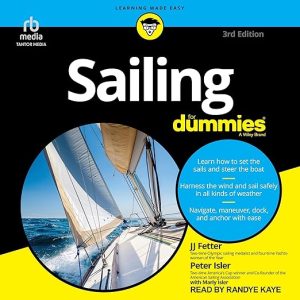
At a Glance
- Voice: Randye Kaye brings an engaged, warm-but-practical energy to J.J. Fetter's instructional content; she navigates technical sailing terminology without losing the encouraging tone that makes the Dummies format work.
- Big ideas: seamanship fundamentals, reading weather and water, confidence-building through progressive skill development
- Atmosphere: Encouraging and methodical, like a patient instructor walking you through the rigging before you ever leave the dock
- Worth it?: A genuinely thorough introduction to sailing that works in audio format, though listeners will want a physical copy alongside for the diagrams and knot illustrations.
Sailing instruction has a pedagogical problem that few manuals solve well: the subject is simultaneously physical, spatial, and deeply contextual. You cannot learn to tie a bowline from a paragraph, and you cannot understand how to read a telltale without having watched one flutter in real wind. So how much does Sailing for Dummies, this audiobook narrated by Randye Kaye across thirteen hours and fifty-two minutes, actually deliver? More than you might expect, and with honest limitations you should know about before you commit. J.J. Fetter, who has both sailed and taught sailing at high levels, brings a practitioner's authority to the material that comes through even when the subject demands physical demonstration.
The Dummies brand carries a specific contract with its readers: comprehensive, accessible, non-condescending. Fetter honors all three. One reviewer who has sailed and raced for over sixty years and teaches sailing professionally reports that he requires this book for sailing camp instructors in training. That is a striking endorsement that speaks to the text's legitimacy well beyond its beginner framing. Another called it essential and exactly as advertised. That consistency across experience levels tells you something about the range Fetter achieves across nearly fourteen hours of material.
What Stands Out
Kaye's narration brings steady energy to material that could easily become a recitation of lists. Fetter organizes the content in a logical sequence: from basic boat anatomy and how sails work with the wind, through docking, anchoring, and knot-tying, into reading weather and sea conditions, and out to handling emergencies and tricky situations. That arc from static knowledge to dynamic skill-application maps onto how people actually learn sailing, which is part of why the book works as preparation for time on the water rather than a substitute for it.
The wind-work sections are among the strongest. Understanding points of sail, from close-hauled through beam reach and broad reach to running, is foundational to everything else in sailing, and Fetter explains the relationships between sail trim, boat angle, and wind direction with the clarity of someone who has taught beginners many times over. Kaye's narration of these sections has the quality of a good diagram turned into words: precise, spatial, and patient about repeating the key terms until they stick in the listener's mental model of the boat.
The knot-tying content is the clearest example of the audiobook format's inherent limitation here. Fetter covers essential knots including the bowline, cleat hitch, clove hitch, and sheet bend, explaining their structure and function, but no amount of verbal description fully substitutes for watching hands move through rope. Listeners using this audiobook should treat the knot sections as taxonomy and preparation rather than as a how-to guide, and plan to use a physical rope and reference card alongside when learning the actual tying. This is not a criticism of Kaye or Fetter; it is the honest constraint of the format applied to tactile knowledge.
Before You Commit to Sailing for Dummies
The weather and conditions chapters are surprisingly strong in audio. Reading the sky, interpreting cloud formations, understanding how local geography affects wind patterns: all of this transmits well through description, and Fetter's years of observation show in the detail. Kaye's measured pace through the meteorological material allows you to construct a mental picture that will be genuinely useful when you are actually on the water watching weather build on the horizon.
The safety content deserves attention regardless of your experience level. Fetter covers capsize recovery, man-overboard procedures, navigation lights, and emergency signaling with an emphasis on preparation and calm decision-making that reflects the instructor's mindset. For new sailors, internalizing the safety protocols in audio form has real training value, since these are the procedures you need to recall under stress rather than look up in a book. The chapter structure is discrete enough that you can return to specific sections before a particular type of sail without rereading everything, which makes the audiobook work well as a long-term reference rather than a one-time listen.
The coverage of rules of the road, which govern right-of-way between different types of vessels on the water, is handled with admirable clarity for a topic that intimidates many new sailors. Understanding that a sailboat under sail generally has right-of-way over a powerboat, but that a sailboat under motor is treated as a powerboat, and that larger commercial vessels may have right-of-way over everything due to maneuverability constraints, is the kind of layered rule-set that benefits from repeated audio exposure rather than a single read-through. Kaye's delivery of this material is patient and precise, and listeners who return to these sections before their first multi-vessel encounters will find the repetition genuinely useful as a memory consolidation tool.
Best Suited For
Beginning and intermediate sailors preparing to get more serious about the sport will find the most value here. The audiobook works excellently as a primer before taking formal instruction or as reinforcement for skills learned on the water. Complete beginners who have not yet been on a boat should complement it with video instruction for the physical elements. Experienced sailors will find the early chapters elementary, but the safety and weather reading sections are strong enough that even veterans report finding useful material throughout. Randye Kaye's narration is clear and encouraging across the full thirteen-plus hours, never condescending, always oriented toward getting the listener onto the water with real confidence and the vocabulary to engage with other sailors from day one.
Good to Know
Does this audiobook cover enough to actually prepare me for sailing lessons or certification?
Yes, as a complement to on-water instruction. The audiobook covers the conceptual and procedural foundation thoroughly enough that you will arrive at your first lesson with vocabulary and frameworks that accelerate learning. It does not substitute for time on the water.
Is Sailing for Dummies available as an audiobook appropriate for complete beginners with zero sailing experience?
Yes. Fetter builds from the fundamentals and explains sailing terminology as it is introduced. Kaye's narration maintains an accessible tone throughout. Complete beginners should supplement with video for the knot-tying sections, which do not fully transmit through audio description alone.
How useful is the audiobook format for sailing instruction specifically?
More useful than you might expect for theoretical and conceptual material such as wind physics, weather reading, and navigation principles. Less useful for tactile skills like knot-tying. Many listeners find the audio format ideal for safety and emergency sections, which benefit from repeated listening.