Quick Take
- Big ideas: Human survival against oceanic forces, the psychology of extreme endurance at sea, literary writing about maritime danger
- Atmosphere: Intense and elemental, with the compressed quality of anthology short-form prose
- Worth it?: Clint Willis's anthology of sea writing draws on the best available literature on the subject, though listeners should know the excerpted format means some pieces end before their narrative arc completes.
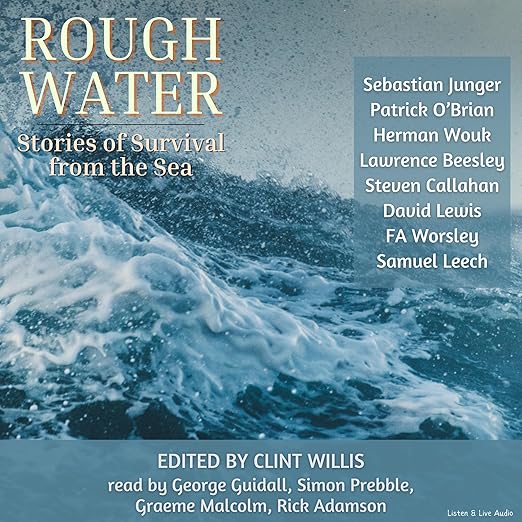
Clint Willis assembled Rough Water as part of a larger adventure anthology project that includes volumes on climbing, polar exploration, and war. This audiobook collects the finest available writing on the sea and those who challenge it, drawing on sources as varied as Sebastian Junger's The Whale Hunger and Herman Wouk's The Caine Mutiny. The narrator goes uncredited on this release, which is an anomaly worth noting upfront: for a collection of this literary weight, the absence of a named narrator removes one of the key signals prospective buyers use to evaluate an audio edition's quality and fit.
The anthology format is both the collection's greatest strength and its most significant structural limitation. Willis selects pieces that represent the high-water mark of maritime literature across genre categories: journalism, memoir, novel excerpt, adventure nonfiction. Sebastian Junger's contribution reflects the same sensibility that produced The Perfect Storm, which appeared the same year as this anthology's original publication. Herman Wouk's Caine Mutiny material brings canonical naval fiction into proximity with first-person survival accounts. The breadth of selection, across rogue waves, icebergs, sharks, starvation, and storms, means the collection does not have a single tonal register. Some pieces are elegiac; some are propulsive; some are technically demanding in ways that reward close listening and the willingness to sit with complexity.
One reviewer describes this as one of a series of books by Willis, each dedicated to a different extreme environment, and evaluates the series as consistently achieving its curatorial ambition. The books are quick reads but intricate and spellbinding, that reviewer notes, and that observation maps well to the audio format: the short-form pieces in the anthology give the five-hour listen a variety that a single-author narrative could not achieve. The juxtaposition of fiction and nonfiction across the collection creates an interesting dynamic that becomes one of the anthology's own subjects: how different genres approach the same elemental confrontation between human beings and oceanic force.
What Sebastian Junger Gets Right
Maritime adventure writing has a specific quality that benefits from audio performance more than many other literary genres. The physical reality of the sea, its sound and rhythm and scale, is something prose must work to evoke on the page, and a narrator who captures that physical quality through pacing and tone can enhance the effect considerably. The anonymous narrator here, while unnamed, delivers the collection at a level that at least one reviewer describes as well written and excellently performed. For listeners who want an overview of what serious sea writing can do, this anthology provides that survey in a format that prevents any single piece from exhausting patience before the next one begins.
At five hours and twenty-three minutes, the collection is appropriately compact for its anthology structure. Willis does not pad. The pieces he selects earn their inclusion, and the range across the collection is substantial: the anthology moves from open-ocean survival to naval fiction to the psychological territory of fear and suffering that Willis identifies as the subject beneath the subject of all good maritime writing. The reviewer T. S. Phillips notes the series achieves a powerful cohesive manner despite drawing on disparate sources, which speaks to Willis's editorial intelligence in selecting and sequencing the pieces.
Where Sebastian Junger Loses Some Ground
The most significant caveat about this audiobook comes directly from a listener who notes that the stories start with little background and end before the ending of the tale. This is a characteristic of anthology formatting: excerpted pieces from longer works may begin mid-narrative and conclude before the source text resolves. Listeners who want complete stories with full setup and resolution will find some of the anthology's pieces frustratingly truncated. That reviewer notes having to research afterward to find out what happened, which is a meaningful limitation for listeners who want self-contained audio experiences rather than curated introductions to longer works.
The uncredited narration also makes it impossible to assess the performance against a known body of work. Buyers cannot, as they can with named narrators, check sample recordings of previous projects to evaluate vocal fit. The absence of a narrator name is unusual for a professionally produced anthology audiobook and is worth factoring into the purchase decision, particularly for listeners whose enjoyment is heavily dependent on specific vocal qualities. The 4.5 rating across eight reviews suggests the overall experience is positive, but the range from 3.0 to 5.0 reflects the divided response to the anthology's structural limitations.
The value of Willis's editorial judgment is perhaps clearest when measured against the alternative: assembling a reading list of maritime literature from scratch requires familiarity with a genre that many listeners will not have. Willis has done that curatorial work and packaged it into a five-hour listen. For readers whose interest in extreme maritime experience was sparked by Junger's The Perfect Storm and who want more material from the same tradition, Rough Water functions as an expert's reading list compressed into accessible audio form. The anthology format imposes its limitations, but it also offers an efficiency that single-author works cannot match for listeners approaching the genre fresh.
Who Sebastian Junger Is Writing For
Readers who already love sea literature and want to encounter the best available writing on the subject in a curated format will find Willis's selection authoritative and satisfying. Listeners who came to the collection via Sebastian Junger's other work, particularly The Perfect Storm, will recognize the sensibility and want more from the same tradition. General adventure readers looking for an introduction to maritime writing will find this a useful and varied survey of the form. Anyone who needs complete narrative arcs from start to finish in every piece should know that the anthology structure does not guarantee that, and should approach the collection as a sampler of longer works rather than as a set of standalone stories.
Common Questions
Does this audiobook include complete pieces or excerpts from longer works?
The collection includes both complete short pieces and excerpts from longer works such as Herman Wouk's The Caine Mutiny and Sebastian Junger's journalism. Some excerpts begin mid-narrative and end before the source text resolves, which reviewers note can require outside research to complete the story.
Who narrates the Rough Water audiobook?
The narrator is uncredited on this release. The performance has received positive mention from reviewers for quality, but the absence of a named narrator makes it impossible to evaluate against a prior body of work before purchasing.
Is this audiobook connected to other volumes in Clint Willis's adventure anthology series?
Yes. Willis assembled a series of thematic anthologies covering extreme environments including climbing, ice, and war. Each volume stands alone, but listeners who respond to the curatorial approach of Rough Water will find the other volumes operate at the same level.
Does the audiobook work for listeners who are not familiar with maritime history or sailing?
Yes. The pieces selected represent extreme human experiences against oceanic conditions that require no specialist knowledge. The best maritime writing, like Junger's journalism, is intended for general readers and works as narrative even without technical background.