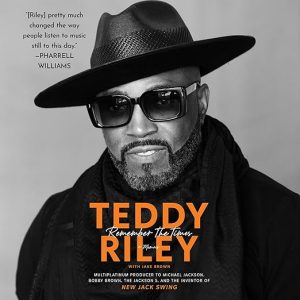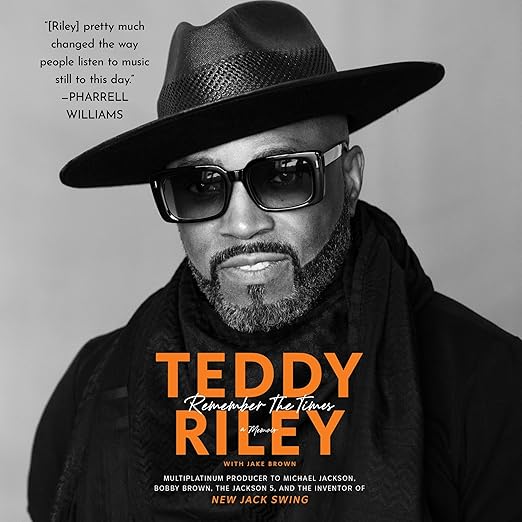
A memoir about inventing a sound, delivered in the one format capable of playing that sound and playing none of it: can that work? Teddy Riley is credited in the description with creating New Jack Swing, and this audiobook runs five hours and fifty-nine minutes without promising a single bar of the music it discusses. Every track named, and the description names a good number of them, arrives as a title you either carry in your head already or do not. That is the central fact about the listening experience here, and it decides more about who will enjoy this than any question of writing quality.
Correct the byline first. Teddy Riley is named alone as author, while the publisher's own description credits award-winning biographer Jake Brown as coauthor, so the credit line on this listing is incomplete rather than disputed. Simon & Schuster Audio put it out on February 10, 2026, JD Jackson is the credited reader, and eighteen ratings currently average 4.6, with five written responses that are enthusiastic, short, and almost entirely undetailed.
The Byline Leaves Out Co-Writer Jake Brown
For six hours, the ground covered is enormous. The description traces a route from the projects in Harlem to inventing a genre, selling out Madison Square Garden, and building the groups Guy and Blackstreet, with production credits reaching Bobby Brown's 'My Prerogative' and writing and producing work alongside Michael Jackson, Whitney Houston, Mary J. Blige and Lady Gaga. Institutional recognition follows the same scale: induction into the Hip-Hop Hall of Fame, the Soul Train Legend Award, and a star on the Hollywood Walk of Fame. Few careers in popular music are decorated at that level and still fit inside a single afternoon of listening.
Do the arithmetic on that and the shape of the book becomes clear. Roughly four decades of work across R&B, hip-hop, gospel, soul and pop, compressed into a runtime shorter than many single-subject histories, leaves something like a chapter's worth of attention per major collaboration. This is a personal narrative rather than an annotated discography, and expecting studio-level detail on any given record will lead to disappointment. Expect instead the version of each story a man tells when he has told it before and knows which part lands.
The word worth noticing in the description's own summary is betrayal, sitting between collaboration and creativity in a list of what the memoir contains. Music memoirs assembled with a professional biographer, and the copy names Jake Brown as an award-winning one, tend to arrive smoothed, so an explicit promise of falling-out material signals a book willing to name names rather than gesture at difficulty. How far it actually goes is not something the description settles. I would want that answered before buying, because the distance between a memoir that names the falling-out and one that gestures at it is most of the distance between a document and a press release.
A Fan Who Named Her Kitten Teddy
Historical reach is the strongest reason to listen. The description positions the book as illustrating the evolution of popular music from the eighties to the present and the expansion of Black influence across that landscape, told from inside the studio rather than from the critic's chair. It closes by reprinting a line from Mixdown Magazine in Australia, describing Riley as having grown 'to define the sound and reinvigorate contemporary R&B and hip-hop'. That is a blurb the publisher selected rather than an unprompted verdict, but the claim it makes is the reason a general listener should care. A production credit is an unusual vantage point for a music memoir as well, because the person at the desk hears every failed take the person at the microphone would rather forget.
The response pool is warm in a way that tells you something real about the audience. One reviewer writing a month after release says plainly that they really enjoyed the audio book and that they are from that era, and that is the only notice on the listing that mentions the format at all. Another reports that a husband who counts Riley among his inspirations as a music producer loved it. A third came to the book through an article and mentions having named a kitten Teddy after him. These are fans arriving with the catalog already in their heads.
A Producer's Memoir Read by Someone Else
Format tension deserves stating plainly rather than politely. A book about how records were built, delivered in audio with no music attached, asks the listener to supply the soundtrack from memory. For anyone who was there, that works beautifully and possibly better than print, since the titles trigger the tracks directly. For a younger listener arriving through a sample or a playlist, a great many names will land as names, and the specific innovations that made New Jack Swing distinctive will have to be taken on trust rather than heard. Consider queuing the catalog alongside the listening.
Eighteen ratings and five written responses, most running to a sentence or two, make a thin evidence base for a book only weeks old when those notices were filed, and the one four-star review sets the register more usefully than the praise does, promising that music fans who also want some gossip will be satisfied. The credit also goes to JD Jackson rather than to Riley, which is an entirely normal decision for a trade memoir but means the voice you hear is not the voice the book is about. Anyone hoping for the producer himself should sample first.
No Recording Comes With the Story of It
The natural audience is anybody who lived through the late eighties and nineties, and the pool of responses says so without being asked. Producers, engineers and working musicians will find the collaboration stories the most useful part of it, since the whole account comes from behind the desk rather than from out on the stage. It also suits anyone interested in how a genre gets built by a small number of people inside a short window, and readers of music memoir generally will recognize a career unusually well positioned across four decades of change in the industry around it.
Technical detail on how the records were actually made is the one thing six hours across this many collaborations cannot supply, so producers wanting a masterclass should adjust their expectations. Nor will it suit somebody for whom the names mean nothing yet, since the book assumes a working familiarity with the catalog and never stops to build it. No recording of the music comes with it, only the account of making it, which anyone hoping to hear the work discussed should factor into the purchase.
Before You Listen
Does the Remember the Times audiobook include any of the music?
Nothing on the listing promises any. The description names a long list of records and collaborators, but the recording is a spoken memoir, so every track referenced has to be supplied from your own memory. Listeners unfamiliar with the catalog may want to queue it alongside the book.
Who narrates the Remember the Times audiobook, and does Teddy Riley read it himself?
JD Jackson is the credited reader. That is a standard decision for a trade memoir, but it does mean the voice you hear belongs to a professional narrator rather than to the producer whose career the book describes. Anyone hoping to hear Riley directly should sample before buying.
Why does the byline not mention Jake Brown?
The author field names Teddy Riley alone, while the publisher's own description credits award-winning biographer Jake Brown as coauthor. Treat the listing credit as incomplete rather than contested. Memoirs built with a professional biographer usually show it in the shaping, and this one covers four decades in under six hours.