In Brief
- Narration: James Anderson Foster's measured, precise delivery suits the argument better than the art passages
- Themes: neuroscience and visual art, reductionism as method, perception and memory
- Mood: Intellectually dense but efficient
- Verdict: A sharp, compact crossover argument for listeners curious about brains and paintings alike
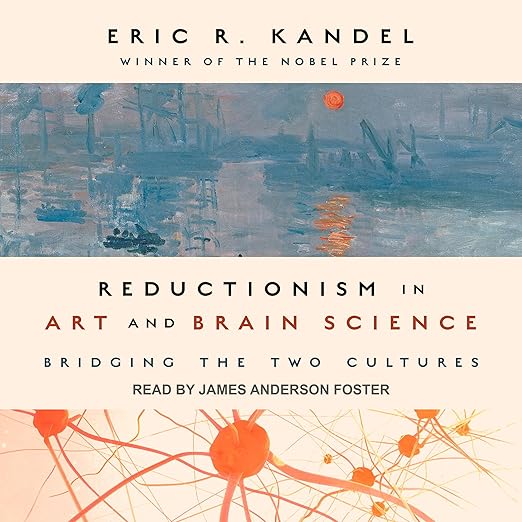
Eric Kandel won a Nobel Prize studying memory formation in sea slugs, and this audiobook asks what that same reductionist method, breaking a large question into its smallest working parts, can teach us about standing in front of a painting. Reductionism in Art and Brain Science argues that science and art aren't separated by the unbridgeable divide people assume, since both pursuits, at their best, distill something enormous, a scientific mechanism, an aesthetic effect, down into components small enough to actually study. Kandel draws a direct line from his own neurobiology work to the way modern artists distill subjective experience down into its rawest visual elements.
A Medical Scientist and an Artist Both Approve
At just over four hours, this is a genuinely compact argument rather than a survey course, and reviewer Dr. Debra Jan Bibel's description fits it well: a 'concise, clearly written, well-illustrated synopsis of the relationships of psycho-neurobiology and art appreciation.' She reviews as both 'a medical scientist and an artist,' a useful dual credential for judging whether Kandel's crossover argument actually holds up on both sides of the divide he's trying to bridge, and her five-star verdict suggests it does.
Reviewer Montana Skyline, a self-described admirer of Kandel's earlier books, specifically named In Search of Memory and The Age of Insight as points of comparison, praising this new one for the same 'clarity and precision of writing' that made those two stand out. That continuity matters for evaluating this specific title: Kandel has spent a public-facing career translating dense neuroscience for general readers, and Reductionism in Art and Brain Science reads as a distillation of that broader project rather than a one-off experiment in a new subject.
Artists Were Already Doing Reductionist Work
Kandel's own biography sits behind this argument in a way the synopsis doesn't spell out directly: a neuroscientist who fled Nazi-occupied Vienna as a child and built his later career studying memory in the brain, eventually winning the Nobel Prize in Physiology or Medicine in 2000 for that sea-slug research. A scientist with that kind of formation, displaced from one culture and remade in another, bringing rigorous method to bear on human meaning-making, has a personal stake in bridging science and art beyond simple intellectual curiosity, which gives the book's central question real weight beyond a clever academic exercise.
The synopsis's closing description of modern artists distilling 'their subjective world into color, form, and light' is worth sitting with for a moment: those three elements are also the basic vocabulary any studio art foundation course would teach as the building blocks of visual composition, which means Kandel isn't importing an outside scientific framework onto an unwilling subject. He's arguing that artists were already doing reductionist work by instinct, breaking felt experience into its rawest formal components, well before any neuroscientist arrived to explain why the technique works on a viewer's brain.
Foster's Steadiness Serves Science More Than Art
James Anderson Foster narrates with a measured, precise register suited to genuinely dense academic argument, appropriate for a book moving between neuroscience terminology and art criticism in the same paragraph without warning. That precision serves the book's argumentative backbone well, though it can read slightly flat in the passages where Kandel's own enthusiasm about visual art comes through most clearly in the prose; Foster's steadiness is an asset for the science, a smaller cost during the art-appreciation sections specifically.
Two Disciplinary Costumes, One Fundamental Method
The book's four-hour runtime is itself a why-listen argument: this is dense material delivered efficiently, without padding, which suits a lunch-break or single-flight listen far better than a sprawling twelve-hour popular-science book would. Reviewer Happy Peds confirmed learning 'a few things about the working of the human brain' even from a comparatively short listen, which speaks to how much Kandel manages to compress into a genuinely short runtime without the argument feeling rushed.
The book's central move echoes a much older debate about the divide between science and the humanities, sometimes called the 'two cultures' problem, and Kandel positions reductionism specifically as the bridge rather than picking a side. Breaking a scientific question into testable components and breaking an aesthetic experience into its own formal building blocks are treated as the same fundamental method wearing two different disciplinary costumes, a more specific and more defensible claim than the vaguer 'art and science are both creative' argument this kind of book often settles for instead.
No Diagram to Lean On
The most consistent critique across all three reviews is that the art side of the argument stays thinner than the science side. Happy Peds put it plainly: 'the art part would probably benefit by in-depth analysis of the works that were included, the artists and some art history related to the art work.' That's a fair complaint for anyone coming to this expecting an art history course with neuroscience seasoning, rather than what it actually is, a neuroscientist's argument about method that happens to use art as its case study.
This also isn't introductory neuroscience, and it isn't introductory art criticism either; Dr. Bibel's own uncertainty about how 'the general reader' will receive it is worth taking at face value from someone qualified to judge both halves of the argument. Listeners with zero background in either brain science or visual art theory may find the book moves faster than a true beginner's introduction would, assuming some baseline comfort with both vocabularies even as it explains its central reductionist method clearly.
The bottom-up and top-down framework Kandel uses, sensory processing building up from raw visual input, cognitive expectation pushing back down to shape what we actually perceive, does real conceptual work but assumes a listener can hold both directions in mind simultaneously without a diagram to lean on. Audio strips away the illustrations a print or ebook reader could pause on, which matters more here than in a typical popular-science book, since Kandel's argument depends partly on connecting his claims to specific visual artworks a listener has to picture from description alone.
A Gentler On-Ramp for Complete Newcomers
Listeners with real interest in both neuroscience and visual art, or in the philosophical question of whether the two fields are actually compatible, are the ideal audience, especially anyone who already appreciates Kandel's other popular-science crossover work. Working artists and art historians curious about a scientist's outside perspective on their own field will also find plenty to engage with, given the dual-credentialed praise from reviewers like Dr. Bibel.
Listeners hoping for extended close analysis of specific paintings or artists should adjust expectations, since Happy Peds' critique about thin art-history depth is a fair one to take seriously before starting. Anyone completely new to both neuroscience and art-criticism vocabulary may also want a gentler on-ramp first; this compact runtime assumes a reasonably informed listener rather than building every concept up from zero.
How long is the Reductionism in Art and Brain Science audiobook?
It runs just 4 hours and 1 minute, a compact argument rather than a long survey.
Do I need a science background to follow this audiobook?
Some baseline comfort with neuroscience and art-criticism vocabulary helps, since Kandel moves between both without much hand-holding, though the book is aimed at general readers rather than specialists.
Does the book cover specific paintings or artists in depth?
Not extensively. Reviewer Happy Peds specifically noted the art side would benefit from more in-depth analysis of the included works and artists.
Is this the same material as Kandel's other books like In Search of Memory?
No, this is a distinct, shorter work, though reviewer Montana Skyline found the same clarity and precision that made In Search of Memory and The Age of Insight stand out.