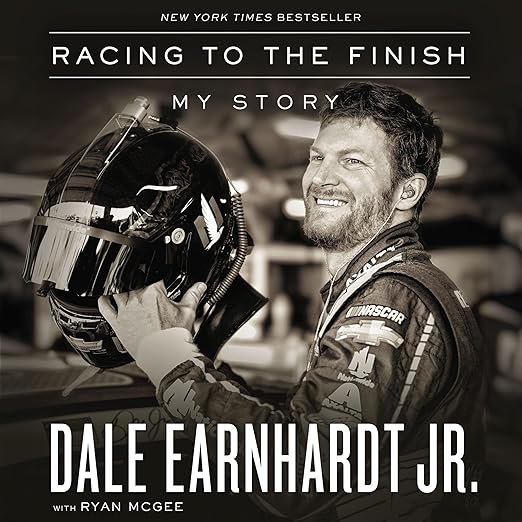
Dale Earnhardt Jr. kept private notes on his phone through years of racing-related concussions, and those notes anchor this audiobook's most candid passages. A minor-looking crash at Michigan International Speedway in June 2016 gave Earnhardt a concussion that, unlike previous ones, would not let go, ending his driving for the rest of that season and setting up the decision that closes out his 18-year NASCAR career the following year. The marketing calls this his only authorized account, and the phone notes charting his own worsening symptoms give the memoir a specific, verifiable spine that a purely reflective retrospective would lack.
Earnhardt frames his 2017 retirement as walking away a healthy man, on his own terms, but the real tension running through the book is everything leading up to that choice: years spent caught between NASCAR's race-at-all-costs culture and a private, growing fear that one more concussion could cost him more than his career.
Being his only authorized account matters given how much unauthorized racing journalism and biography exists about a driver as famous as Earnhardt; this is the version told entirely on his own terms, drawing on his own contemporaneous phone notes rather than a story reconstructed after the fact from outside reporting.
The synopsis also credits his wife directly, describing his admiration for the woman who stood by him through the ordeal, without naming her explicitly in the provided synopsis text, positioning the marriage as a stabilizing throughline running underneath the sport-and-injury narrative rather than a footnote to it.
Why Racing to the Finish Works as an Audiobook
D. Heath's review makes the case plainly, calling Earnhardt more than just, in D. Heath's own phrase, a guy who made a living making lefts, and praising the specific, detailed treatment of concussion causes, types, and long-term effects. Brock's review adds important context for listeners unfamiliar with NASCAR culture: Earnhardt built one of the sport's largest fan followings, nicknamed Junior Nation, a bond that only deepened after the death of his father, Dale Earnhardt Sr., in a 2001 crash, and Brock specifically credits Earnhardt with never losing his sense of humor despite everything the book covers.
ChuckinPensacola's review describes a shared listening experience, picked up first by a spouse and then recommended, driven by wanting to hear, in that reviewer's words, the full truth about what happened, and coming away impressed by Earnhardt's honesty in relating events most public figures would sand down for a memoir.
The synopsis also points toward what came after driving: Earnhardt's move into broadcasting, business, and family life, a pivot NASCAR fans have watched play out in real time through his post-retirement broadcasting career, and the audiobook gives listeners his own account of how the concussion decision shaped that transition rather than leaving it as an assumed happy ending.
NASCAR itself has spent the past decade visibly reckoning with driver safety and concussion protocol in ways it had not previously, and Earnhardt's own public struggle, playing out partly in real time as fans watched him miss races, is frequently cited as part of what pushed those institutional conversations forward within the sport.
Earnhardt's standing within NASCAR, inherited fame from his father combined with his own two-decade career, means his willingness to speak openly about a career-ending medical issue carried real cultural weight within a sport that has not always encouraged drivers to prioritize long-term health over short-term competitiveness, and several reviewers frame the book explicitly as an act of service to other drivers facing the same private calculation.
Weak Spots in Racing to the Finish
The synopsis is candid about the private cycle Earnhardt's phone notes reveal: suffering injuries during a race, struggling through the following week, then recovering just enough to race again, over and over, a pattern that took years to break. Listeners expecting a straightforward racing career retrospective should be ready for that cycle to dominate the emotional core of the book rather than serve as a brief chapter.
At just over 5 hours, this is a compact memoir rather than an exhaustive career history, so listeners wanting deep detail on specific races or seasons should expect a book focused more on the concussion arc, his father's legacy, and his life beyond driving than on a comprehensive NASCAR record.
Athlete memoirs built around concussion and traumatic brain injury have become more common across contact sports in recent years, and Racing to the Finish fits that broader wave while bringing something distinct to it: motorsport concussions come from sudden impact rather than repeated contact, and Earnhardt's account of an escalating, unpredictable symptom pattern reads differently than the more chronic patterns typically described in football or hockey memoirs.
The book's framing around his father's death in 2001 and Junior's own much less publicly dramatic but privately serious injury history invites a natural comparison between two very different kinds of racing tragedy, sudden and fatal versus slow and cumulative, without the book needing to state that contrast outright for listeners to feel its weight.
Should You Listen to Racing to the Finish?
This suits NASCAR fans and Junior Nation specifically, anyone interested in sports concussion memoirs regardless of racing knowledge, per D. Heath's point that the book works even for non-fans, and listeners drawn to candid accounts of athletes confronting the end of a career on their own terms.
Skip it if you want a detailed statistical or season-by-season NASCAR history rather than a personal account centered on health, family, and retirement.
This also suits listeners generally interested in sports memoir that centers health and family over highlight-reel career triumph, a growing subcategory of athlete memoir that treats retirement and its aftermath as seriously as the competitive years that preceded it.
Listeners who followed Earnhardt's own on-air explanation of his retirement in real time may still find new detail here, since a five-hour first-person memoir can go places a press conference or a television interview never could, into the private phone notes, the specific fears, and the conversations with his wife that shaped the final decision.