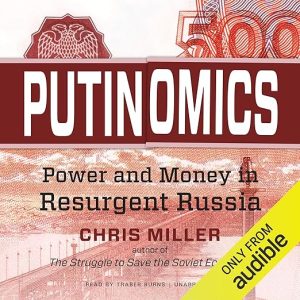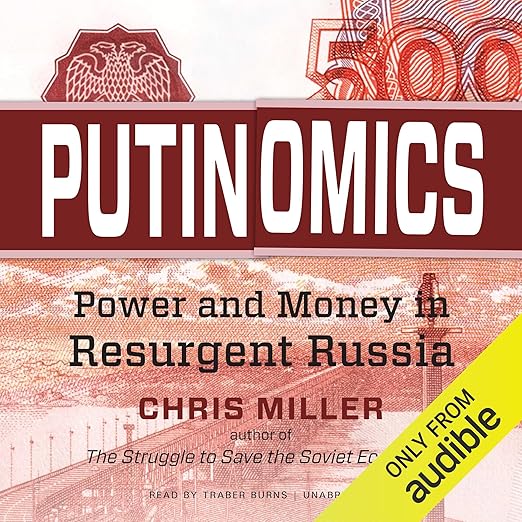
Quick Take
- Narration: Traber Burns delivers Miller’s dense economic analysis with professional clarity, he keeps the material moving without oversimplifying the data.
- Themes: Russian political economy, the relationship between resource dependency and political durability, macroeconomic management under authoritarian conditions
- Mood: Analytical and illuminating, with an urgency that only increases given what has unfolded since the 2018 publication
- Verdict: The clearest explanation of how Putin’s economic model actually works, and why it has been more resilient than Western observers expected.
I came to this one after watching the economic sanctions debates following 2022 unfold in real time, frustrated by how little of the public commentary seemed to engage with Russia’s actual economic structure rather than Western assumptions about it. Putinomics, published in 2018, is the corrective. Chris Miller wrote it as an argument against lazy analysis, and its core contention, that Putin’s economic governance has been far more effective than most Westerners realize, has only grown more relevant as sanctions have proven slower-acting than their proponents predicted.
Miller is a Tufts University professor of international history with a specialty in Soviet and Russian economic history. His other book, The Struggle to Save the Soviet Economy, was praised highly enough that at least one reviewer came to Putinomics specifically as a follow-up. Miller writes for nonspecialists without condescending to them, he assumes economic literacy but not expertise in Russian affairs, which is the right target for this kind of work.
Our Take on Putinomics
The book’s central analytical move is separating Russia’s macroeconomic performance from its microeconomic dysfunction. Miller’s argument is that Russia has, under Putin, maintained reasonably competent macroeconomic management, inflation control, fiscal conservatism, central bank independence, even as its microeconomic environment remained plagued by corruption, cronyism, and state capture of strategic industries. This dichotomy explains both Russia’s relative resilience and its structural fragility: the macro floor is higher than critics acknowledge; the micro ceiling is lower than boosters claim.
The quadrupling of per capita GDP in a decade and a half is the headline figure, and Miller’s analysis of how much of that is attributable to oil prices versus deliberate policy is one of the most careful treatments of the question available in a general readership book. His comparison to other petro-states, Venezuela and Saudi Arabia are the primary contrasts, is illuminating. Russia outperformed both through a combination of fortunate timing and genuine policy choices, and understanding which is which matters enormously for predicting the model’s future.
Why This Audiobook Rewards Full Attention
Traber Burns handles the economic terminology with the matter-of-fact precision it requires, terms like annualized real GDP growth, fiscal sterilization, and reserve fund accumulation are delivered without stumble or hesitation. For a book this analytically dense, that professionalism is not trivial. Burns does not inject drama where Miller has not written it, which suits an economic history that builds its case through evidence rather than narrative tension.
At eight hours, Putinomics is long enough to develop its argument fully without becoming exhausting. Miller structures the book around specific policy domains, oil, banking, labor, pensions, the armed forces, and each section can be processed individually before the synthesis chapters pull the threads together. Listeners interested in a specific aspect of Russian economic policy can navigate the structure without losing the larger argument.
What to Watch For in the 2018 Publication Date
Published before the 2022 invasion of Ukraine and the unprecedented Western sanctions response, Putinomics cannot address what became the most acute test of the model Miller analyzes. Readers should approach it as the baseline analysis, the best available picture of what Russian economic governance looked like and why, before the conditions changed radically. One reviewer noted its continued relevance today, and that is right with the caveat that readers will need to layer subsequent developments onto Miller’s framework independently.
One reviewer who had read The Struggle to Save the Soviet Economy found Putinomics slightly disappointing by comparison, noting it as a good book that did not quite match the earlier work’s ambition. That framing is useful: if you come expecting the scope of the Soviet economics book, adjust your expectations. Putinomics is more focused, more policy-driven, and more accessible, strengths that also set a ceiling on its depth.
Who Should Listen to Putinomics
Essential listening for anyone who wants to understand the economic foundations of Russian political durability beyond the standard corruption-and-oil narrative. Journalists, policy professionals, and informed general readers following Russia-West relations will get genuine analytical value. The 2018 publication date means supplemental reading is necessary for anyone wanting the full picture through 2025, but Miller’s framework remains the clearest starting point available in accessible form. Listeners who want narrative history rather than policy analysis will find this demanding but rewarding.
Frequently Asked Questions
Given that the book was published in 2018, how much of its analysis remains valid after the 2022 Ukraine invasion and sanctions?
Miller’s structural analysis of Russia’s macroeconomic management and its strengths and weaknesses remains valid as a baseline. The sanctions response tested and in some ways confirmed his framework’s predictions about Russia’s resilience. Readers should treat it as essential background requiring supplementation from more recent sources for post-2022 developments.
Does the book require economics training to follow, or is it accessible to general nonfiction readers?
Miller writes for nonspecialists. Basic economic literacy, understanding GDP, inflation, and fiscal policy at a general level, is sufficient. He explains Russian-specific terminology and institutions as they appear. No specialist training in economics or Russian affairs is required.
How does Miller’s argument about Putin’s economic model differ from the standard Western narrative of Russian corruption and resource dependency?
Miller accepts that corruption and resource dependency are real, but argues they tell an incomplete story. His contribution is showing that Russia maintained genuine macroeconomic competence, inflation management, fiscal conservatism, reserve accumulation, alongside those dysfunctions, and that this combination explains both its resilience and its limits.
Is Putinomics better as a starting point or as a follow-up to other Russia books?
It works as a starting point for economic analysis specifically. Readers with narrative historical background on Putin’s Russia, from books like Karen Dawisha’s Putin’s Kleptocracy or Masha Gessen’s The Man Without a Face, will find Miller’s economic frame a useful complement to those political accounts.