Quick Take
- Narration: Tia Rider handles the book’s dual registers – investigative journalism and personal memoir – competently, maintaining clarity through the extensive cast of historical figures and intelligence operatives.
- Themes: Oil and geopolitics as drivers of Middle Eastern violence, the deep history of American intelligence in the region, the personal cost of buried truth
- Mood: Part detective story, part family excavation – urgently investigative and quietly devastating
- Verdict: A companion PDF is included and load-bearing – the pipeline maps are essential for following the argument. The book itself is an unusual combination of family memoir and political history that works better than it has any right to.
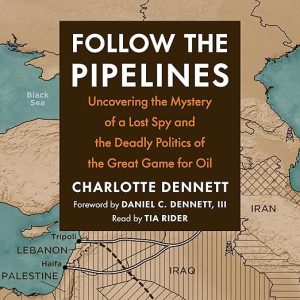
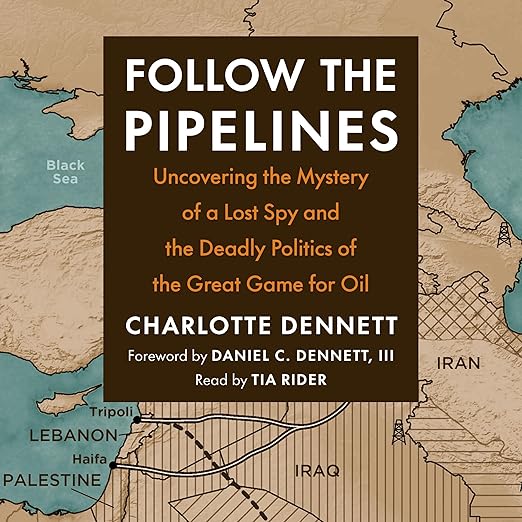
I finished Follow the Pipelines on a Sunday morning having started it Friday evening, which is not the typical pace at which I consume twelve-hour audiobooks about oil geopolitics. Charlotte Dennett writes with the urgency of someone who has been sitting on a question for forty-five years and is finally putting down everything she knows. Her father, Daniel Dennett – not the philosopher, but an earlier bearer of the name – was America’s first master spy in the Middle East, and he died in a plane crash in 1947 on the way to survey the route of the proposed Trans-Arabian Pipeline. Charlotte Dennett has spent most of her adult life trying to understand why that plane went down.
What makes the book extraordinary is that the personal pilgrimage and the political history are genuinely inseparable. The Trans-Arabian Pipeline that her father was studying when he died is not a footnote to Middle Eastern history; it is one of the central artifacts of the post-World War II competition for oil access that shaped everything that followed. The British, French, Russians, and Americans were all playing what Dennett calls the Great Game for the region’s energy resources, and the plane that killed her father was carrying a man who had become inconvenient to at least one set of interests in that competition.
The Intelligence Geography Her Father Mapped
Dennett grounds the book in maps – and here the companion PDF becomes genuinely useful rather than optional. Her father’s counterintelligence work involved literally mapping the Middle East for American strategic purposes, and the pipeline routes he was assessing were the physical geography of the competition for influence. Dennett’s argument is that following the pipelines – tracing where they were proposed, where they were built, where they were sabotaged, and what happened to the people who stood in their way – is a method for understanding the real history of the region beneath the official history of diplomatic communiques and state visits.
The cast of characters is large and the intelligence history dense, but Dennett has the good journalist’s instinct for the vivid detail that anchors an abstraction. When she describes the specific figures in the wartime Middle East – the OSS officers, the British intelligence agents, the oil company representatives who operated with quasi-governmental authority – they become individuals rather than types. The fog of competing interests clears just enough to see the outlines of what was actually happening in the region in the late 1940s, and what was actually happening was considerably less principled than the official narrative suggested.
Forty-Five Years of FOIA Requests
The book’s methodology is part of its argument. Dennett filed Freedom of Information Act requests for her father’s CIA records and other government documents over a period spanning decades, and the picture she assembled from what was released – and what was withheld – is itself a kind of evidence. Governments that have nothing to hide do not classify information about forty-year-old plane crashes. The pattern of what can be known and what remains sealed is part of the story she is telling.
Several reviewers have described the book as painstakingly documented, and that’s accurate – this is investigative journalism in the classic mold, where the methodology is as important as the conclusions. The line between what Dennett can prove and what she infers is generally visible, which is a mark of intellectual honesty in a book that could easily have indulged conspiracy without discipline. She has done the work, and the work is visible.
Tia Rider Navigating the Dual Narrative
Rider’s narration manages the book’s structural complexity – the movement between 1947 and the present, between family history and political analysis, between the specific crash and the broader geopolitical argument – without losing the listener. The twelve-hour runtime is appropriate for the scope of material Dennett is covering, and Rider’s pacing keeps the book from feeling either rushed or padded. The companion PDF is worth downloading before starting; following the pipeline routes on a map while listening to Dennett’s analysis of their geopolitical significance makes the argument considerably more vivid.
For Investigators and the Historically Curious
This book will appeal most strongly to readers interested in the deep structural history of American engagement in the Middle East – not the headline events but the subterranean interests that drove them. It works as a family memoir, as investigative journalism, and as political history, which is a rarer combination than it sounds. Readers who find conspiracy-adjacent books frustrating should be reassured that Dennett distinguishes carefully between documentation and inference. This is not a book that claims to know more than it can prove; it is a book that shows how much can be proved by following the right trail long enough.
Frequently Asked Questions
Is the companion PDF included with the audiobook essential?
Yes, for the pipeline mapping sections. The book’s argument involves tracing specific geographic routes and their political significance, and the maps Dennett references make those passages considerably clearer. The PDF is listed as available in the Audible library along with the audio.
Does Charlotte Dennett reach a definitive conclusion about what caused her father’s plane crash?
She reaches a well-documented conclusion about the most likely explanation, but she is honest about the limits of what can be established definitively given how much of the relevant documentation remains classified. The book’s intellectual integrity lies partly in that honesty.
How does Follow the Pipelines relate to the broader history of CIA operations in the Middle East?
Dennett’s father operated in the pre-CIA era – the OSS period – but the book traces the continuity between wartime intelligence operations and the CIA’s subsequent activities in the region. The 1953 Iranian coup and other famous CIA operations in the Middle East appear as downstream consequences of the dynamics she documents.
Is this book suitable for readers who are new to Middle Eastern history?
The personal and journalistic dimension makes it more accessible than a conventional academic history of the period, but listeners with some familiarity with the post-World War II Middle East and the early Cold War competition for influence will get considerably more from it. The cast of nations and interests is complex and assumes some baseline orientation.