- Performance: Christopher Gatterdam reads with measured intelligence, matching the book's blend of analysis and human detail without over-dramatizing the suffering.
- What it covers: Civilian resilience, wartime adaptation, the psychological weight of imposed darkness
- Feel: Quiet and absorbing, with an underlying tension that the material earns
- Our call: A focused, well-crafted overview of the British home-front blackout experience that rewards listeners new to the subject more than those already deep in WWII civilian history.
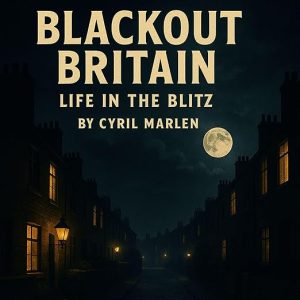
Blackout Britain: Life in the Blitz landed in my listening queue on an overcast autumn afternoon, the kind of grey light that makes the world feel slightly muffled. I put on my headphones and pulled the blinds, something I rarely do in daylight. Within minutes, Cyril Marlen's audiobook had pulled me out of my apartment and into the pitch-dark streets of wartime Britain, where a covered torch was a luxury and every lit window was a potential beacon for enemy aircraft. The effect was arresting in a way I hadn't anticipated from what is, on paper, a compact two-hour-and-twenty-minute listen.
What I didn't expect was how intimate this audiobook would feel. We're accustomed to WWII history that focuses on the military campaigns, the generals, the grand strategic decisions made in Whitehall bunkers. Marlen takes the opposite approach: this is a ground-level account, street by street and household by household, of how ordinary British people rebuilt their entire relationship with darkness. From the first minutes of the first chapter, the weight of it is tangible.
Ten Chapters, Ten Facets of Blackout
Cyril Marlen structures the material as ten focused chapters, each devoted to a distinct facet of the blackout experience. This is smart editorial architecture for short-form nonfiction: rather than attempting a sprawling chronological survey, Marlen zeroes in on specific human problems. One chapter examines the blackout's psychological toll, the disorientation, the spike in anxiety, the strange intimacy of sharing darkness with strangers on a train platform. Another looks at how shops, workplaces, and schools adapted their operations when natural light became a tactical liability. A third traces the remarkable ingenuity of the Anderson and Morrison shelters, where families essentially created small interior worlds designed to survive the collapse of the larger one.
The book's central argument is that the blackout was not merely a wartime inconvenience but a profound restructuring of social life. Marlen is good at articulating this without overstating it. He doesn't sentimentalize the period. He acknowledges the accidents, the accidents that killed pedestrians navigating unlit streets, the crime that accompanied darkness, and the genuine terror of the bombing raids. This is a history written with clear eyes.
Gatterdam's Measured Cadence Never Theatricalizes Suffering
Christopher Gatterdam's narration is well-matched to the material. He reads with a measured, intelligent cadence that suits the book's blend of historical analysis and humanizing detail. He doesn't theatricalize the suffering, which is the right call. Gatterdam understands that the material itself carries enough emotional gravity without vocal dramatics. His pacing through the more technically complex passages, the explanation of blackout regulations, the description of ARP warden duties, is clear without being stiff. For a two-hour listen, he holds attention effectively throughout.
The audiobook is part of the 'Everything World War 2' series, sitting at position thirty-one in a long-running educational series. It functions well as a standalone, though listeners who have worked through earlier volumes will find it fits neatly into the broader portrait of civilian wartime Britain that the series builds across multiple titles. Marlen's approach here is consistent with what a committed listener to the series would expect: rigorous, readable, and rooted in specific human experience rather than abstract strategy.
Focused Chapters Cut Some Threads Short
The book's brevity is both its strength and its limitation. At just over two hours, Marlen necessarily keeps each chapter focused and efficient. The tradeoff is that certain threads feel cut short just as they're becoming interesting. The discussion of blackout's effect on children, who went to school in dimmed rooms, navigated dark streets, and absorbed their parents' fear without always understanding its source, would have sustained considerably more examination. The same is true for the social dimensions of the shelter culture, the way neighbors who had previously maintained a reserved British distance found themselves sharing cramped spaces and genuine fear night after night. These moments surface and then pass quickly.
Listeners who come to this expecting primary-source voices, diary excerpts, letters home, testimony from survivors, will find the audiobook thinner than they'd like on that front. Marlen's approach is largely analytical and synthetic rather than oral-history driven. That's not a flaw exactly, but it does position this audiobook closer to an intelligent overview than a deeply textured immersive account. For that kind of depth, Juliet Gardiner's 'The Blitz: The British Under Attack' remains the standard reference. Marlen's contribution is more accessible and more tightly focused, which serves a different kind of reader.
What Marlen gets right, and what keeps this audiobook worth returning to, is the human scale of his telling. He is not interested in abstract wartime policy; he is interested in what it felt like to walk a dark street knowing that a bomber overhead might be using your neighbor's carelessly lit window as a navigation point. That sense of individual responsibility embedded in collective survival is the emotional core of the material, and Marlen sustains it across all ten chapters without letting it become sentimental or repetitive. For a series designed to be consumed alongside other volumes rather than as a standalone definitive account, that's exactly the right register.
Excellent for Newcomers, Reliable for Teachers
If you're coming to WWII home-front history for the first time, this audiobook is an excellent introduction: focused, well-narrated, and not overwhelming in length. It pairs well with other civilian-experience accounts in the 'Everything World War 2' series. If you're already well-read in this area, Marlen's synthesis is still worthwhile but the brevity may leave you wanting something with more archival depth. For teachers, podcast listeners, or anyone who absorbs history best through a well-organized spoken account rather than dense primary sources, this is a reliable and efficient listen.
A Few Questions About Blackout Britian: Life in the Blitz
Does this audiobook work as a standalone or do I need to have listened to the rest of the Everything World War 2 series?
It functions well as a standalone. The audiobook covers the blackout and Blitz experience as a self-contained topic. Prior familiarity with the series adds context but is not required.
How long is the audiobook and is it detailed enough for a serious history reader?
The runtime is two hours and twenty minutes. It's organized as a focused overview across ten chapters. Serious WWII historians may find the depth lighter than they'd prefer, but it's well-researched and efficient for general audiences.
Does the audiobook include survivor testimony or firsthand accounts?
Marlen's approach is primarily analytical and synthetic rather than oral-history driven. Listeners hoping for diary excerpts or survivor voices will find the audiobook leans toward historical summary over primary-source material.
Who narrates the audiobook and does the performance hold up over the full runtime?
Christopher Gatterdam narrates. His measured, even delivery suits the educational tone of the series. At just over two hours, he sustains the listen well without monotony.